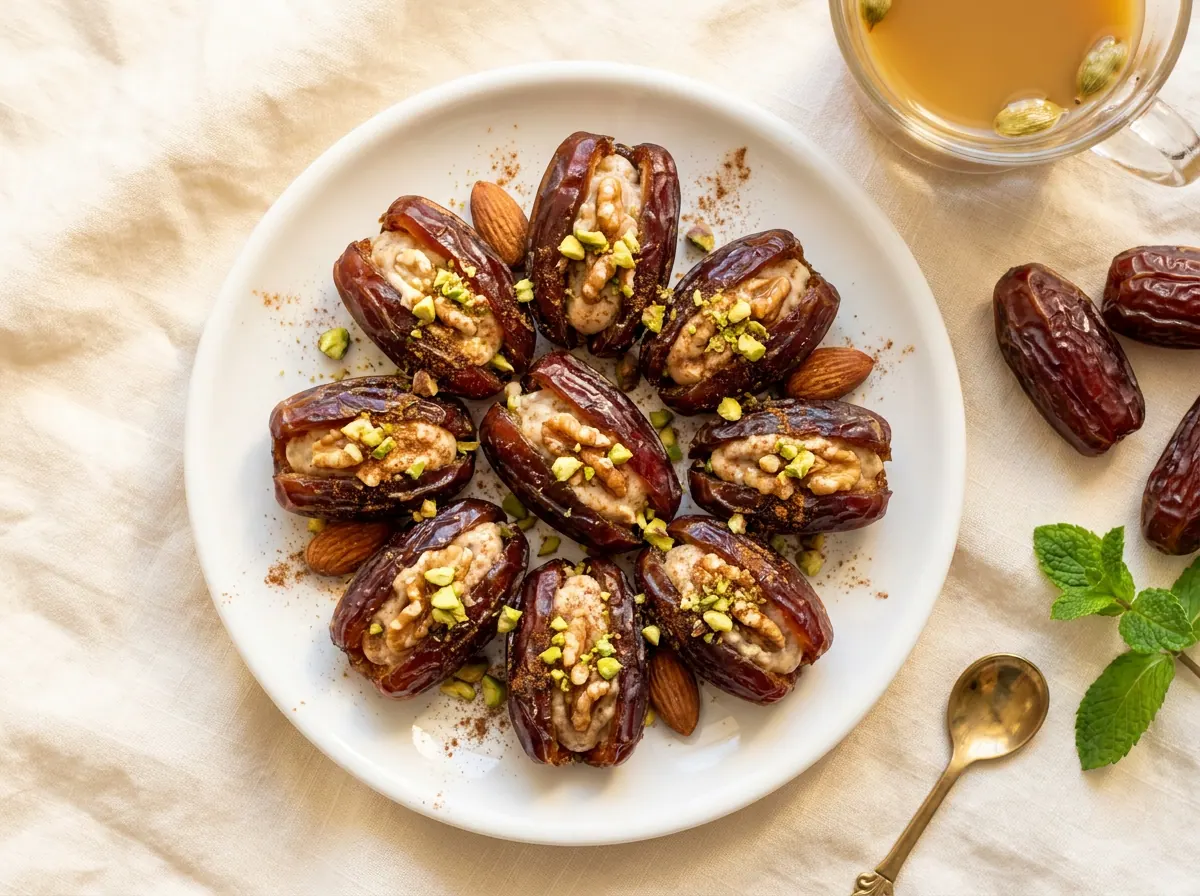
A Hejazi Eid confection — qamar al-din, apricot, fig, and raisins soaked and cooked with coconut and nuts into a rich jam-like preserve. A special-occasion sweet rich in fibre, with a moderate glycaemic load, containing tree nuts.
Dabyaza is a revered Hejazi Eid confection from Mecca, Medina, Jeddah, and Taif, prepared especially during Ramadan and Eid al-Fitr. It brings together soaked and cooked dried fruits — qamar al-din, apricot, fig, and raisins — with coconut and nuts into a rich jam-like preserve.
Its name may come from the word dabza (mixing). It is served on Hejazi Eid tables as a symbol of hospitality, generosity, and blessing, eaten with a spoon or by dipping Hejazi bread (qurss) into it. It is the heritage of the kitchens of the Two Holy Mosques.
Preparation Steps
Soak the dried fruit
Chop the qamar al-din, apricots, and figs into pieces, then soak them with the raisins in warm water for an hour or more until they soften and plump up. Soaking softens the dried fruit and makes it easier to cook to a jam-like consistency.
Cook the qamar al-din
In a pot, place the qamar al-din with its soaking water and a little extra water, and leave it over a gentle heat until it melts and forms a sticky paste, stirring to prevent sticking. Qamar al-din (concentrated apricot) is the base and texture of the dabyaza.
Add the remaining fruit
Add the soaked apricots, figs, and raisins, and cook everything over a gentle heat for about twenty minutes until the fruit thickens and blends into a thick jam consistency. Add the sugar according to the sweetness of the fruit — it may not need much.
Toast the nuts and coconut
Toast the nuts (almonds, pistachios, and pine nuts) in a dry pan until they colour, and lightly toast the shredded coconut until fragrant. Toasted nuts add crunch and richness to the dabyaza.
Combine
Add most of the nuts and coconut along with the rose water and cardamom to the fruit mixture, and stir until it comes together into a rich, firm jam. Reserve a few nuts for garnish. Taste and adjust.
Cool and serve
Pour the dabyaza onto a plate and spread it out, then scatter the remaining nuts and coconut on top. Leave it to cool. Serve cold with a spoon, or for dipping with bread or Saudi flatbread (qurss). Dabyaza is a Hejazi Eid confection (Mecca, Medina, and Jeddah), prepared especially during Ramadan and Eid, bringing together the richness of dried fruit and nuts.
Blood Sugar Impact
The glycemic index (GI) measures how quickly a food raises blood sugar, while the glycemic load (GL) measures how much a full serving raises it. Together they give the complete picture.
Glycemic Index
GI
41Low
Low0–55Medium56–69High70+
A low value (≤55) means a gradual rise in blood sugar — the most suitable range for diabetes and insulin resistance.
Glycemic Load
GL
18Medium
Low0–10Medium11–19High20+
Glycemic load reflects the impact of the full serving. To lower it: take half a serving, or pair the recipe with a source of protein and fiber.
Nutritional Information
Per ServingMakes 8 servings · one serving is about 80 g of raw ingredients
Calories262 kcal13%of Daily Value*
Protein3 g6%of Daily Value*
Carbohydrates48 g17%of Daily Value*
Fat8 g10%of Daily Value*
Fiber4 g14%of Daily Value*
Sodium10 mg0%of Daily Value*
* Percent Daily Values are based on a 2,000-calorie diet per FDA food-label reference values — your daily needs may be higher or lower. Values are derived from the recipe's ingredients via the USDA database.
Troubleshooting
The most common problems when preparing Hejazi Dabyaza (Dried Fruit Preserve), and how to fix them:
Dabyaza is hard or dry
Insufficient soaking or water. Soak the dried fruit well until it softens and add its soaking water plus a little extra while cooking. Dry fruit needs hydration to reach a jam consistency.
Dabyaza is too liquid and has not thickened
Too much water or not cooked long enough. Leave it to cook on a gentle heat until the water evaporates and the fruit thickens to a jam. Qamar al-din helps with thickening as it is the base of the texture.
Too sweet
Too much sugar. Dried fruit is naturally sweet, so start with little or no sugar and taste. If it turned out too sweet, add a pinch of lemon juice to balance it.
Nuts have gone soft
Added too early or not toasted. Toast the nuts separately and add most of them towards the end, reserving some for garnish at serving time to keep them crunchy.
Stuck to the bottom and burnt
Not stirred enough. Stir constantly, especially for the qamar al-din and thick jam which stick and burn easily, and cook over a gentle heat.
Storage and Make-Ahead
Refrigerator (4°C)
Dabyaza keeps in an airtight container in the refrigerator for a week to ten days (dried fruit and sugar are natural preservatives). Serve cold and add fresh nuts at serving time.
Freezer (-18°C)
Freezes for two months in an airtight container, and thaws in the refrigerator. The jam texture holds up well in the freezer. Practical for preparing Eid hospitality in advance.
Advance prep
Prepare days before Eid and refrigerate — the flavour improves as the fruits meld. Add the toasted nuts at serving time so they stay crunchy.
Note
Dabyaza is a rich fruit jam that keeps well, making it ideal for advance preparation for Eid tables. Store in an airtight container away from moisture.
Tested Ingredient Substitutions
Original Ingredient
Tested Substitute
Ratio
Flavor Difference
Qamar al-din
Extra dried apricots, mashed
Same quantity
Qamar al-din is a concentrated pressed apricot sheet — cooked and mashed dried apricot gives a similar base
Added sugar
Reduce or omit
To taste
Dried fruit is very sweet and generally needs little or no added sugar
Fruit selection
Whatever is available (apricots, figs, raisins, prunes)
Whatever is available
Variety is richer, but any dried fruit works — qamar al-din remains the distinctive base
How Much Does It Make? Scaling Guide
Servings
Qamar al-din
Dried fruit
Nuts
4 (half recipe)
100 g
half the amount
1/4 cup
8 (base)
200 g
full amount
1/2 cup
16 (Eid feast)
400 g
double
1 cup
EEINA Nutrition Tip
Dabyaza is smarter than many Eid sweets: it is built on dried fruit that naturally sweetens it and enriches it with fibre and minerals (potassium and iron), and the nuts provide healthy fats and protein — so it may not need much added sugar. However, it is concentrated in natural sugar and calories (dried fruit), so moderation is the key. A small portion is rich and satisfying. For people with diabetes: a small amount with awareness (dried fruit sugar is concentrated).
Add This Recipe to Your Plan
The EEINA app saves your favorite recipes, calculates them from their real ingredients, and shows your daily numbers toward your goal. Try it free now.
A Hejazi Eid confection from Mecca, Medina, and Jeddah, prepared during Ramadan and Eid. It brings together soaked and cooked dried fruits (qamar al-din, apricot, fig, and raisins) with coconut and nuts into a rich jam-like preserve, served as a symbol of hospitality.
What is qamar al-din?
A concentrated dried apricot pressed into sheets, used in dabyaza (and as a Ramadan drink). It is the base of dabyaza — it dissolves during cooking and gives the preserve its characteristic apricot flavour and consistency.
Is dabyaza healthy?
Smarter than many Eid sweets: it is built on dried fruit (fibre and minerals) and nuts (healthy fats and protein), and may not need added sugar. However, it is concentrated in natural sugar and calories, so a small portion is key.
How is dabyaza served?
Cold with a spoon, or for dipping with Hejazi bread (qurss) or tamees flatbread. It is served on Hejazi Eid tables as a rich hospitality sweet and garnished with nuts and coconut.