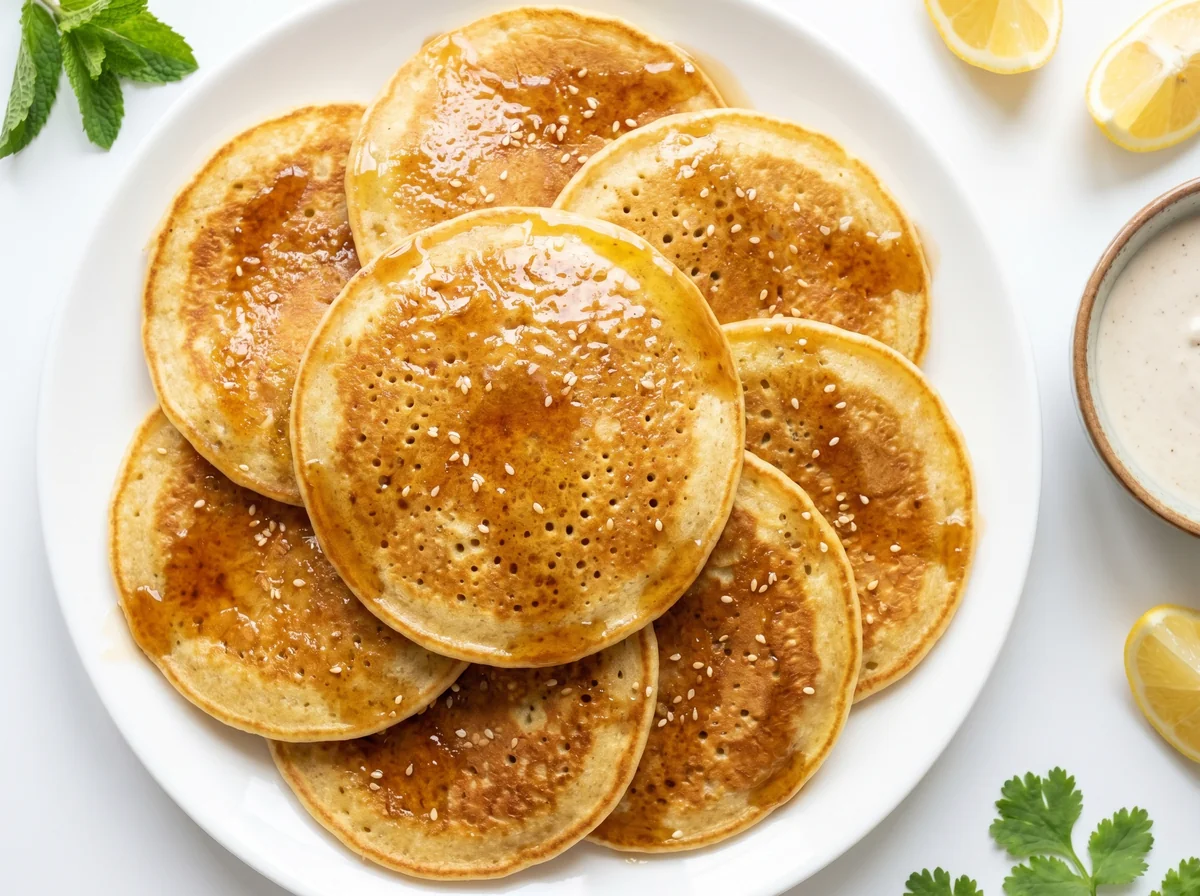
Fragrant Emirati pancakes — yeast-leavened flatbreads perfumed with saffron and cardamom, cooked on a griddle until golden and hole-studded, served with date molasses and honey. A classic Gulf breakfast with a medium glycaemic load; contains gluten, egg and dairy.
Chebab (also called khebz chebab) is a beloved traditional Emirati and Gulf breakfast — yeast-leavened flatbreads fragrant with saffron and cardamom, cooked on a griddle until golden and dotted with holes. The name means 'small bread'.
It is served at traditional breakfasts, gatherings, in hospitality and during Ramadan, alongside date molasses or honey and cheese — that beloved sweet-and-savoury Gulf combination. Saffron and cardamom, two treasured flavours in Gulf cooking, give it its identity. Chebab reflects the warmth of Emirati hospitality and the authenticity of the Gulf breakfast table; it is one of the heritage dishes that generations are determined to preserve as a symbol of identity.
Preparation Steps
Make the batter
Combine the flour, sugar, yeast, salt and cardamom, then add the egg, warm milk and soaked saffron, whisking until you have a smooth, pourable batter — thinner than cake batter, closer to a thick crepe mix. The saffron and cardamom are the signature flavours of chebab and give it its golden colour.
Ferment
Cover the batter and let it rest in a warm spot until it ferments and bubbles appear on the surface, about one hour. Yeast fermentation is what gives chebab its characteristic holes and soft spongy texture — quite different from baking-powder pancakes.
Heat the griddle
Heat a flat griddle or non-stick pan over medium heat and grease lightly with a little oil or ghee, wiping off the excess. A properly hot griddle is essential: too cold and the holes won't form; too hot and it burns.
Pour the chebab
Ladle one scoop of batter onto the griddle to form a circle. Holes will appear on the surface immediately from the yeast and steam — this is exactly what you want. Do not flip until the surface is dry and the holes are set.
Cook through
Once the surface is dry, the holes are set and the underside is golden, flip to briefly cook the second side (or leave single-sided like a baghrir, according to preference). Emirati chebab is typically cooked on both sides until golden and tender.
Serve
Serve the chebab hot, drizzled with date molasses or honey, and with cheese or clotted cream for those who enjoy the sweet-savoury combination so loved in Gulf cuisine. It is a cherished Emirati breakfast, served at gatherings, in hospitality settings and during Ramadan — its golden, saffron-and-cardamom-scented rounds with date molasses are a true Gulf breakfast experience.
Blood Sugar Impact
The glycemic index (GI) measures how quickly a food raises blood sugar, while the glycemic load (GL) measures how much a full serving raises it. Together they give the complete picture.
Glycemic Index
GI
72High
Low0–55Medium56–69High70+
A low value (≤55) means a gradual rise in blood sugar — the most suitable range for diabetes and insulin resistance.
Glycemic Load
GL
19Medium
Low0–10Medium11–19High20+
Glycemic load reflects the impact of the full serving. To lower it: take half a serving, or pair the recipe with a source of protein and fiber.
Nutritional Information
Per ServingMakes 8 servings · one serving is about 80 g of raw ingredients
Calories141 kcal7%of Daily Value*
Protein4 g8%of Daily Value*
Carbohydrates28 g10%of Daily Value*
Fat1 g1%of Daily Value*
Fiber1 g4%of Daily Value*
Sodium14 mg1%of Daily Value*
Potassium78 mg2%of Daily Value*
Phosphorus62 mg5%of Daily Value*
* Percent Daily Values are based on a 2,000-calorie diet per FDA food-label reference values — your daily needs may be higher or lower. Values are derived from the recipe's ingredients via the USDA database.
Troubleshooting
The most common problems when preparing Chebab (Emirati Saffron Pancakes), and how to fix them:
No holes forming
The yeast is weak, the batter has not fermented, or it is too thick. Check the yeast is active (milk should be warm, not hot), give the batter enough fermentation time (it should bubble), and keep the batter pourable, not thick. Holes come from yeast steam in a liquid batter on a hot surface.
Chebab is dense and heavy
The batter is too thick or has not fermented. Make it pourable (thinner than cake batter) and give it adequate fermentation time. Yeast and proper fermentation create the light spongy texture. Thick, under-fermented batter gives a heavy pancake.
Sticking to the griddle
The griddle is not greased or not hot enough. Grease the griddle with a little fat and wipe off the excess, and heat it properly before pouring. A cold or dry griddle sticks; a properly greased hot one gives a golden base that releases cleanly.
Burnt outside and raw inside
Heat too high. Cook over medium heat — high heat burns the base before the inside sets and the holes form. Medium heat gives even golden browning and even cooking.
Pale colour, not golden
Not enough saffron. Saffron soaked in water gives chebab its distinctive golden colour and flavour — use a sufficient amount soaked in warm water. A tiny pinch of turmeric can also help the colour (though saffron is the authentic choice).
Storage and Make-Ahead
Room temperature
Chebab keeps in a sealed bag at room temperature for one day, and it is best fresh and hot. Reheat on a griddle or in a toaster to restore warmth and softness. Ideally prepare and eat it fresh with date molasses.
Freezer
Freeze cooked chebab in layers with paper between them in a sealed bag for up to two months. Thaw and reheat on a griddle or toaster. Practical for batch-cooking and reheating portions for a quick breakfast.
Meal prep
Prepare the batter and let it ferment, then cook the chebab fresh at breakfast time. Or cook a batch and freeze. The fermented batter cooks quickly for a fast, warm breakfast.
Food safety
Chebab is a cooked flatbread containing egg and milk — cook it through completely, store it in a sealed container and reheat thoroughly. The fermented batter is best cooked on the day for best results.
Tested Ingredient Substitutions
Original Ingredient
Tested Substitute
Ratio
Flavor Difference
White flour
Mix of wholemeal flour or oats
up to one-third
Raises fibre and slightly lowers the glycaemic load, while keeping an acceptable spongy texture (adding more will make it heavy)
Date molasses for serving
Honey or reduce the amount
to taste
Date molasses is traditional and mineral-rich; honey is an alternative. Use moderately to reduce sugar, and serve it on the side so each person can control their own portion.
Sugar in the batter
Reduce it
1 tablespoon
A little is enough to activate the yeast and add a hint of sweetness. The main sweetness comes from the date molasses at serving time, so reduce the sugar in the batter.
How Much Does It Make? Scaling Guide
Number of pieces
Flour
Milk
Eggs
4 (half recipe)
1 cup
¾ cup
1 small egg
8 (base)
2 cups
1½ cups
1 egg
16 (feast)
4 cups
3 cups
2 eggs
EEINA Nutrition Tip
Chebab is a delicious breakfast that is lighter than deep-fried pastries (cooked on a griddle with very little fat), and the egg and milk add protein, while saffron provides antioxidants. The challenge is the white flour, sugar, date molasses and its medium glycaemic load. To lighten it: mix in some wholemeal flour, reduce the sugar in the batter, use date molasses sparingly, and serve with low-fat cheese (protein that balances the meal). A joyful Gulf breakfast in moderation, as part of a balanced meal.
Add This Recipe to Your Plan
The EEINA app saves your favorite recipes, calculates them from their real ingredients, and shows your daily numbers toward your goal. Try it free now.
A traditional Emirati and Gulf breakfast — yeast-leavened flatbreads fragrant with saffron and cardamom, cooked on a griddle until golden and hole-studded. Served with date molasses or honey and cheese at traditional breakfasts, gatherings and during Ramadan. A fragrant, heritage Gulf breakfast experience.
Why does it have holes?
The holes come from yeast steam rising through the liquid batter on the hot griddle (similar to Moroccan baghrir). Good yeast, proper fermentation and a pourable batter produce the holes and spongy texture — a sign of a successful chebab. Do not flip until they are set.
Is chebab healthy?
It is a delicious breakfast lighter than deep-fried options (cooked on a griddle), and the egg and milk add protein while saffron is an antioxidant. The challenge is the white flour, sugar, date molasses and medium glycaemic load. Mix in some wholemeal flour, reduce the sugar, serve with low-fat cheese, and go easy on the date molasses. A breakfast treat in moderation.
What is the difference between chebab and pancakes?
Chebab relies on yeast and fermentation (giving holes, a spongy texture and a fermented flavour), while pancakes rely on baking powder (giving a denser, cake-like texture). Chebab is also fragrant with saffron and cardamom (Gulf flavours) and served with date molasses — its Gulf identity is distinct.