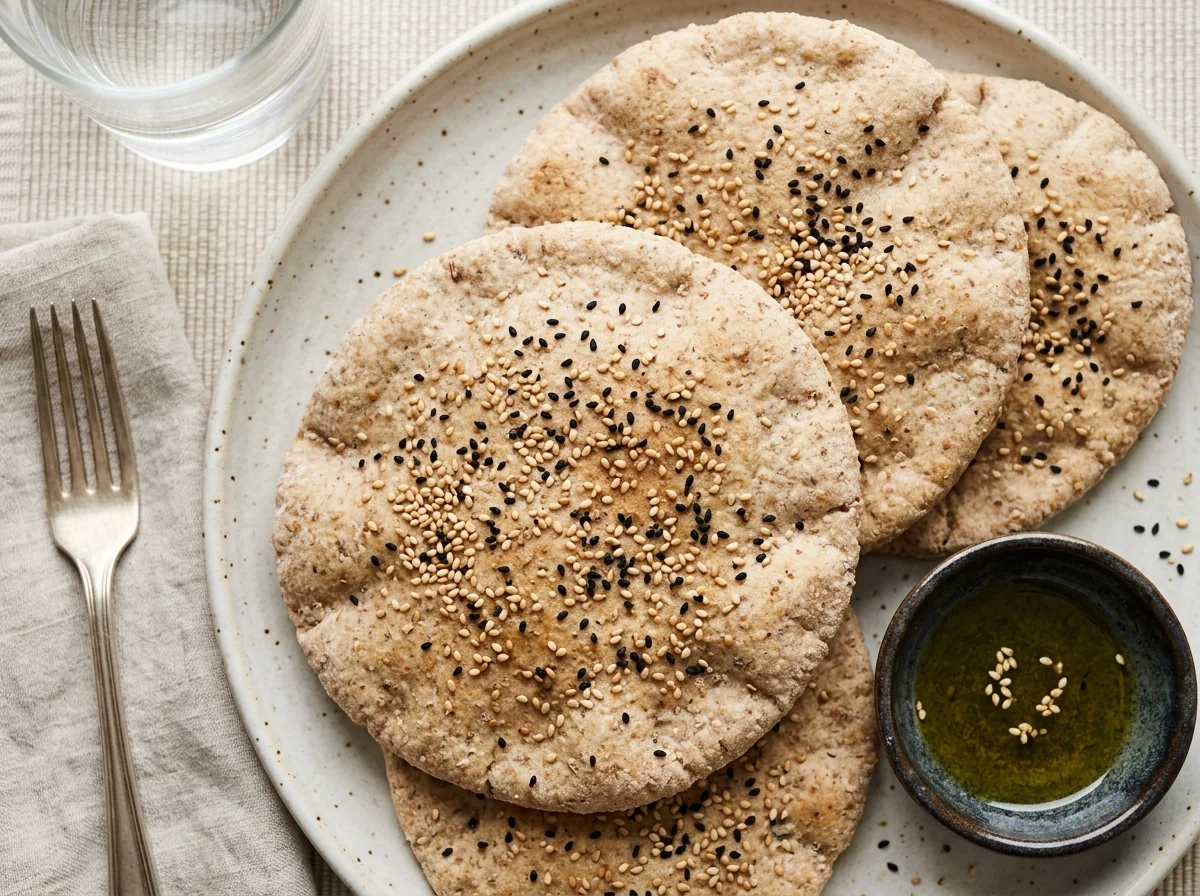
Traditional Arabian barley bread baked for suhoor — high in fiber, slow-release, and gentle on blood sugar. A filling choice that sustains energy through the fasting hours of Ramadan.
Barley bread is one of the oldest breads of the Arabian Peninsula, dating back thousands of years before wheat was introduced.
For suhoor it is filling and slow-release, sustaining energy for hours without spiking blood sugar — the health-conscious choice during Ramadan.
Preparation Steps
Dissolve the yeast
In a small bowl, combine the yeast and sugar with 100 ml of warm water and let stand 10 minutes until it activates and bubbles appear on the surface.
Mix the dry ingredients
In a large bowl, combine the barley flour, whole wheat flour, salt, sesame, and nigella seeds.
Knead
Add the yeast mixture, the remaining warm water, and the olive oil. Knead 10 minutes until the dough absorbs and becomes supple. Cover and let rise 1 hour until it doubles in size.
Shape the loaf
Knead the dough briefly again to release air and shape into a round, flat loaf about 2 cm thick. Cover and rest 20 minutes more.
Bake
Bake in a preheated oven at 220°C for 25–30 minutes until the loaf turns golden. Cover with a damp towel for 10 minutes to keep it soft.
Blood Sugar Impact
The glycemic index (GI) measures how quickly a food raises blood sugar, while the glycemic load (GL) measures how much a full serving raises it. Together they give the complete picture.
Glycemic Index
GI
44Low
Low0–55Medium56–69High70+
A low value (≤55) means a gradual rise in blood sugar — the most suitable range for diabetes and insulin resistance.
Glycemic Load
GL
24High
Low0–10Medium11–19High20+
Glycemic load reflects the impact of the full serving. To lower it: take half a serving, or pair the recipe with a source of protein and fiber.
Nutritional Information
Per ServingMakes 8 servings · one serving is about 150 g of raw ingredients
Calories373 kcal19%of Daily Value*
Protein10 g20%of Daily Value*
Carbohydrates66 g24%of Daily Value*
Fat7 g9%of Daily Value*
Fiber12 g43%of Daily Value*
Sodium499 mg22%of Daily Value*
* Percent Daily Values are based on a 2,000-calorie diet per FDA food-label reference values — your daily needs may be higher or lower. Values are derived from the recipe's ingredients via the USDA database.
Troubleshooting
The most common problems when preparing Barley Bread for Suhoor, and how to fix them:
Bread is dry
Cover with a damp towel for 10 minutes right after baking. Reduce bake time by 5 minutes next time.
Yeast did not activate
The water was too cold or the yeast is old. Warm the water to 37°C and use fresh yeast.
Bread is too flat
Let it rise longer before baking. Cold dough will not rise.
Taste is bitter
Reduce the barley flour and increase the wheat flour. Barley alone is slightly bitter.
Storage and Make-Ahead
Room temperature
Two days in a cloth bag. Cloth preserves the crust.
Freezer
One month after slicing. Reheat in a 180°C oven for 5 minutes.
Tested Ingredient Substitutions
Original Ingredient
Tested Substitute
Ratio
Flavor Difference
Barley flour
Oat flour
1:1
A lighter version.
Instant yeast
Fresh yeast
21 g
Dissolve it in the warm water.
Sesame
Cocoa
1:1
A different flavor.
How Much Does It Make? Scaling Guide
Ingredient
1 loaf
2 loaves
3 loaves
Barley flour
500 g
1000 g
1500 g
Wheat flour
200 g
400 g
600 g
Yeast
7 g
14 g
21 g
Water
400 ml
800 ml
1200 ml
EEINA Nutrition Tip
Barley flour absorbs more water than wheat flour because it soaks quickly. Add the water gradually until the dough absorbs it. A 20-minute rest before baking yields a softer loaf.
Add This Recipe to Your Plan
The EEINA app saves your favorite recipes, calculates them from their real ingredients, and shows your daily numbers toward your goal. Try it free now.