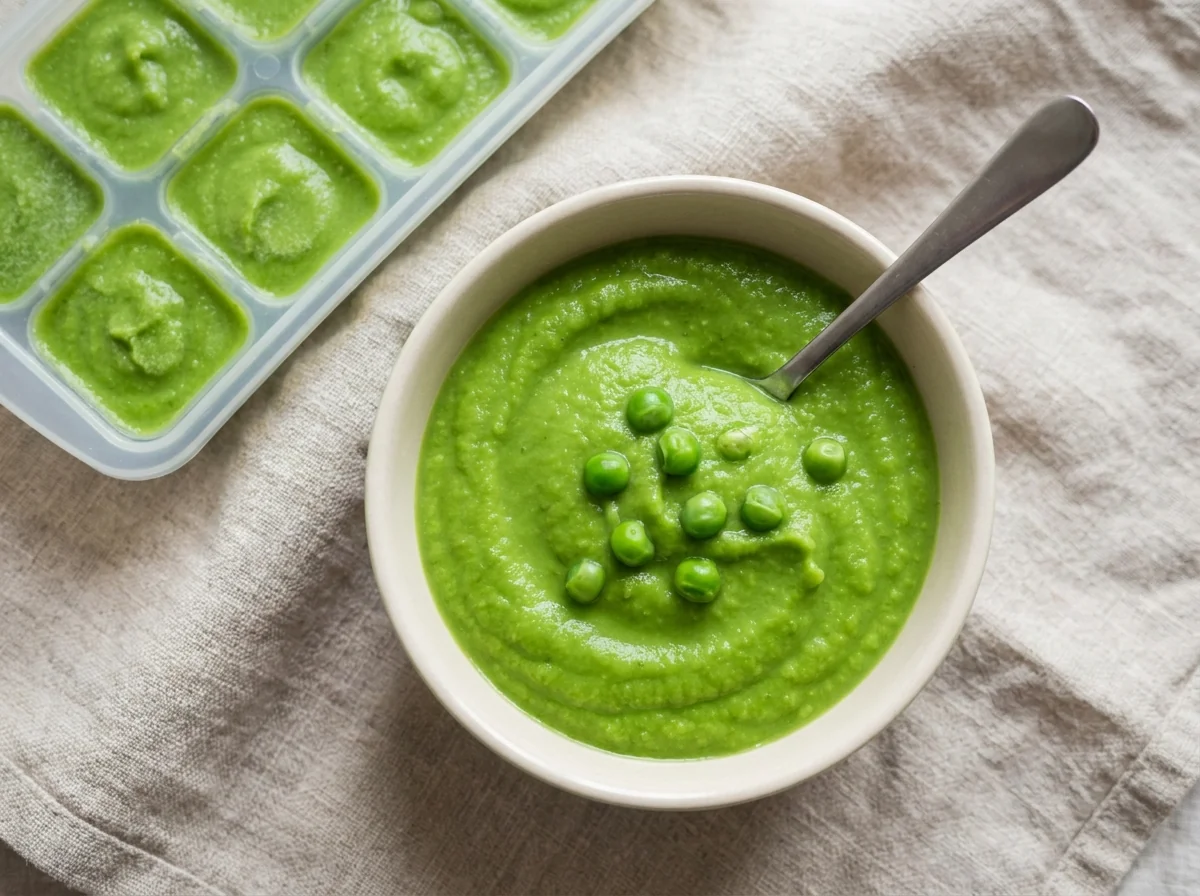
Pea puree (smooth mash) is one of the most important first vegetable meals for a baby: early plant protein and a light sweet taste.
The secret of its success is the sieve, since pea skins are not broken down by the blender and straining with the back of a spoon removes them, producing a smooth mash suited to the beginnings.
Preparation Steps
Use frozen peas with confidence
Frozen peas are usually frozen within an hour of picking, at their peak sweetness, while the sugars of fresh peas long displayed in the market turn to starch. For this baby meal, frozen is the better choice.
Steam them for eight minutes only
Place them in the steamer basket for eight minutes until they soften and stay bright green, since overdoing it turns their color yellow and gives a bitter taste.
Mash, then strain out the skins
Mash smoothly with spoonfuls of the cooking water, then pass the mash through a fine sieve with the back of a spoon. Pea skins are not broken down by even the strongest blender, and straining gives a smooth mash suited to early swallowing.
With no additions at all
No salt or anything else, since the peas' sweet taste is enough, and acceptance of vegetables forms from this stage.
Serve a meal and freeze the rest
Serve a few spoonfuls lukewarm, and freeze the rest in ice cube trays as ready meals.
Blood Sugar Impact
The glycemic index (GI) measures how quickly a food raises blood sugar, while the glycemic load (GL) measures how much a full serving raises it. Together they give the complete picture.
Glycemic Index
GI
51Low
Low0–55Medium56–69High70+
A low value (≤55) means a gradual rise in blood sugar — the most suitable range for diabetes and insulin resistance.
Glycemic Load
GL
2Low
Low0–10Medium11–19High20+
Glycemic load reflects the impact of the full serving. To lower it: take half a serving, or pair the recipe with a source of protein and fiber.
Nutritional Information
Per ServingMakes 6 servings · one serving is about 50 g of raw ingredients
Calories40 kcal2%of Daily Value*
Protein3 g6%of Daily Value*
Carbohydrates7 g3%of Daily Value*
Fat0 g0%of Daily Value*
Fiber3 g11%of Daily Value*
Sodium2 mg0%of Daily Value*
Potassium122 mg3%of Daily Value*
Phosphorus54 mg4%of Daily Value*
* Percent Daily Values are based on a 2,000-calorie diet per FDA food-label reference values — your daily needs may be higher or lower. Values are derived from the recipe's ingredients via the USDA database.
Troubleshooting
The most common problems when preparing Baby Green Pea Puree (6 Months+), and how to fix them:
Coarse skins despite the blender
This is the nature of peas, and the solution is the sieve, not a stronger blender. This step is not skipped in the beginnings.
The bright green turned yellow
The steaming time was too long. Stick to the eight minutes, since the bright color also indicates that the vitamins are preserved.
Refusal after accepting sweet potato
This is expected, since accepting vegetables is harder than sweet potato. Repeat the attempt with no pressure, and you may combine it with a sweet potato cube for a phase, then reduce it gradually.
Gas after its meal
Legumes may cause gas even when mashed. Offer small amounts and progress gradually, and watch without worry.
Storage and Make-Ahead
In the fridge
Two days.
In the freezer
Cubes for two months.
Serving
Served lukewarm, with its temperature tested on the inner wrist first.
Tested Ingredient Substitutions
Original Ingredient
Tested Substitute
Ratio
Flavor Difference
The peas
Steamed zucchini (no straining)
~
A second gentle green vegetable, and it needs no straining
The temporary bridge
A sweet potato cube combined in, then withdrawn
~
Sweetness that paves the way to acceptance, then withdrawn gradually
Thinning
Baby's usual milk
~
Thinning with the familiar milk eases acceptance
For the family
The rest of the bag as pea and mint soup for adults
~
One bag serves the baby's meal and the adults' soup
How Much Does It Make? Scaling Guide
Ingredient
~10 cubes
half batch
2 batches
Peas
300 g
150 g
600 g
Steaming time
8 min
8 min
10 min
Total working time
13 min
10 min
18 min
EEINA Nutrition Tip
Offer vegetables early and repeat the attempt, since the human palate naturally leans toward sweetness and learns to accept vegetables through repetition. A baby introduced to peas and zucchini in its early months accepts vegetables more in childhood than one who started with fruits alone, so the helpful order is: vegetables, then sweet vegetables, then fruits.
Add This Recipe to Your Plan
The EEINA app saves your favorite recipes, calculates them from their real ingredients, and shows your daily numbers toward your goal. Try it free now.
It is a common order, not a binding rule, and its logic is that a baby who starts with the sweetness of fruits may reject vegetables afterward. Starting with vegetables builds acceptance first, and the schools of thought vary; your child's doctor is the reference.
Protein in a vegetable puree?
Yes, peas are among the light legumes (~5 g protein per hundred grams), making them one of the earliest plant protein sources suited to the first spoonfuls.
Should I mix it with rice later?
After each item is accepted alone, its cube is combined with baby oatmeal or mashed rice as a composite lunch from around the seventh month.
Straining until when?
In the first months only. As swallowing develops (8-9 months), the mash is served with its coarse skins as chewing practice.