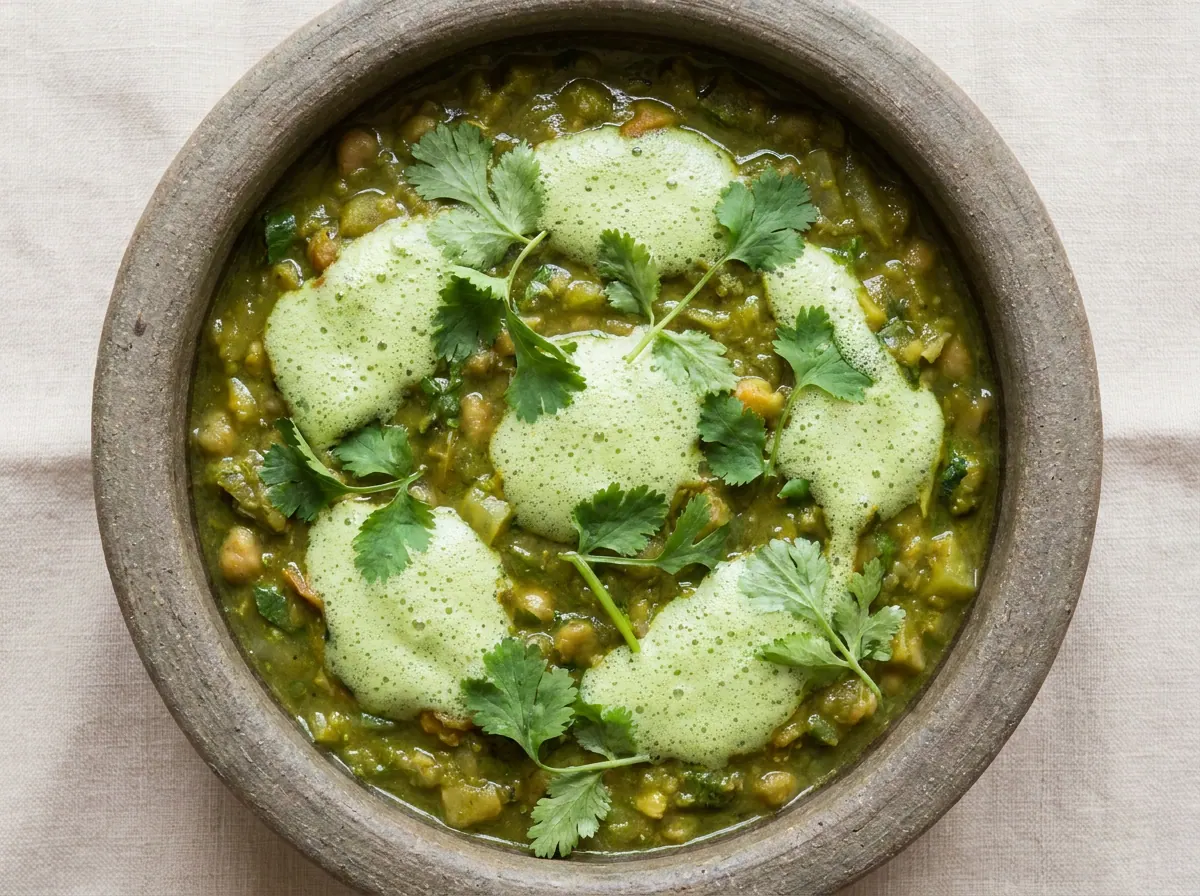
A light Yemeni green saltah — a vegetable and legume broth crowned with whisked fenugreek froth and green sahawiq without rice. GI 17 low, high fibre and plant protein.
Saltah is Yemen's national dish, served hot and bubbling in a stone vessel, and always crowned with whisked fenugreek (a white creamy froth) and green sahawiq (a coriander and chilli sauce). Its flavour comes from the broth, vegetables, and legumes, not from fat alone.
The light version here preserves the spirit of the dish: it keeps the whisked fenugreek and the sahawiq as they are, reduces the ghee to a single spoon, and relies on vegetable stock and lentils instead of a lot of rice. Fenugreek itself is rich in fibre and may help control blood sugar after eating [4].
Preparation Steps
Soak the fenugreek
Soak the fenugreek seeds in plenty of cold water for 6 to 8 hours (or a whole night) until they swell, then drain and wash them well to reduce the bitterness.
Whisk the fenugreek
Whisk the soaked fenugreek with a little water, a clove of garlic, and a pinch of salt until it turns into a thick, creamy white froth, then set it aside.
Prepare the sahawiq
Prepare the green sahawiq by grinding the coriander, green chilli, garlic, and cumin with a spoon of olive oil until a green sauce comes together.
Saute the base
In a pot, heat the spoon of ghee alone and saute the onion and garlic until they wilt, then add the turmeric and tomatoes and stir until they break down.
Cook the vegetables
Add the vegetable stock, the carrot, and the courgette, and leave them over low heat until the vegetables are cooked, about 20 minutes.
Add the legumes
Add the boiled lentils (or chickpeas) and salt, and leave the broth to come to a light boil until it firms up a little.
Crown it
Distribute the saltah into bowls, and add a spoon of whisked fenugreek over each bowl so its froth rises, then place a line of green sahawiq.
Serve
Serve it hot and bubbling with tandoor bread or local bread, and reduce the bread if the goal is to lower carbohydrates.
Blood Sugar Impact
The glycemic index (GI) measures how quickly a food raises blood sugar, while the glycemic load (GL) measures how much a full serving raises it. Together they give the complete picture.
Glycemic Index
GI
17Low
Low0–55Medium56–69High70+
A low value (≤55) means a gradual rise in blood sugar — the most suitable range for diabetes and insulin resistance.
Glycemic Load
GL
4Low
Low0–10Medium11–19High20+
Glycemic load reflects the impact of the full serving. To lower it: take half a serving, or pair the recipe with a source of protein and fiber.
Nutritional Information
Per ServingMakes 4 servings · one serving is about 540 g of raw ingredients
Calories242 kcal12%of Daily Value*
Protein11 g22%of Daily Value*
Carbohydrates33 g12%of Daily Value*
Fat9 g12%of Daily Value*
Fiber8 g29%of Daily Value*
Sodium1138 mg49%of Daily Value*
* Percent Daily Values are based on a 2,000-calorie diet per FDA food-label reference values — your daily needs may be higher or lower. Values are derived from the recipe's ingredients via the USDA database.
Troubleshooting
The most common problems when preparing Light Yemeni Green Saltah, and how to fix them:
The whisked fenugreek did not rise into a froth
Usually the soaking time was short or the water added during whisking was too little. Fenugreek needs long soaking (six to eight hours or a night) to swell completely, then is whisked with a sprinkle of cold water gradually until it doubles as a white froth. If it stays heavy: add a spoon of cold water and whisk an extra minute. Warm water reduces the froth.
The fenugreek tastes very bitter
It was not washed after soaking, or it was soaked in one water without changing it. The bitterness lessens by washing the swollen seeds well under running water before whisking, and some cooks change the soaking water once. A slight bitterness is part of the authentic fenugreek flavour and is not removed completely.
The broth is watery and did not firm up
There is too much broth or it was not left to boil enough. Leave the pot uncovered over low heat a few extra minutes so some liquid evaporates and the texture firms up. Boiled lentils mashed a little also help give a thicker texture.
The courgette fell apart and the carrot stayed hard
They were added at one time despite the difference in their cooking times. The carrot is firmer so it is added first with the broth, and the courgette is softer so it is added after a few minutes. If the courgette falls apart: no harm, it dissolves into the broth and gives it body, but for clear pieces add it later.
The green sahawiq is dull in colour and flavour
The coriander is too little or was over-ground so its colour oxidised. The sahawiq should be a deep, sharp green, so use plenty of fresh coriander and grind it coarsely and quickly with the chilli, garlic, and cumin. Prepare it a short time before serving and put it cold over the hot saltah so it keeps its colour.
The dish is richer than needed
The ghee was more than one spoon. The light version relies on just one spoon of ghee and the sahawiq oil, and the rest is flavour from the broth and vegetables. If we need deeper flavour without fat: increase the garlic, cumin, and ripe tomatoes instead of the ghee.
Storage and Make-Ahead
Refrigerator (4°)
The saltah broth: three days in an airtight container. It is reheated over low heat to a boil before serving. The whisked fenugreek and sahawiq: two days separately in the refrigerator, and are added fresh over the hot broth at serving.
Freezer (-18°)
The broth only: up to a month in an airtight container. As for the whisked fenugreek and sahawiq, they are not frozen, as they lose their texture and colour. We prepare them fresh at serving.
Advance preparation
Soaking the fenugreek: a whole night before preparation, kept swollen and washed in the refrigerator. The base broth: cooked hours ahead and kept chilled. The whisking and the sahawiq: shortly before serving for fresh froth and colour.
Serving
Saltah is a hot, bubbling dish served as soon as it is crowned with the fenugreek and sahawiq. The cooked broth is not left out of the refrigerator more than two hours per food safety recommendations.
Tested Ingredient Substitutions
Original Ingredient
Tested Substitute
Ratio
Flavor Difference
Boiled brown lentils
Boiled chickpeas
Same amount
Thicker texture and clearer grains, similar plant protein
Local ghee
Olive oil
Same amount (a spoon)
Lighter in saturated fat, a less traditional flavour
Ready-made vegetable stock
Homemade stock from vegetable scraps
Same amount
Less sodium and better control over salt
Courgette
Cubed aubergine
Same weight
Softer texture and deeper flavour, absorbs the broth more
Hot green chilli
Sweet green pepper
Same number
A milder sahawiq with no heat, suitable for children
How Much Does It Make? Scaling Guide
Number of servings
Vegetable broth
Boiled lentils
Courgette
Fenugreek seeds
2 (individual × 2)
2 cups
0.5 cup
Piece
1.5 tbsp
4 (base)
4 cups
1 cup
2
3 tbsp
8 (large family)
8 cups
2 cups
4
6 tbsp
12 (entertaining)
12 cups
3 cups
6
9 tbsp
EEINA Nutrition Tip
Fenugreek is a blood sugar ally: fenugreek is rich in soluble fibre, and scientific reviews indicate it may improve blood sugar control after eating [4]. Keeping it while reducing the ghee and rice turns the saltah into a filling dish with a low glycemic load without sacrificing its Yemeni identity.
Add This Recipe to Your Plan
The EEINA app saves your favorite recipes, calculates them from their real ingredients, and shows your daily numbers toward your goal. Try it free now.
The spirit of saltah is in the broth, the whisked fenugreek, and the sahawiq, not in the rice. Serving it with a little bread or without it is a light version that preserves the flavour and lowers the glycemic load.
Is it suitable for people with diabetes?
Suitable · estimated GI 17 is low and fibre is high from the lentils, fenugreek, and vegetables. Controlling the accompanying bread manages the carbohydrates.
How do I get rid of the fenugreek bitterness?
Long soaking (a night) then washing the swollen seeds well reduces the bitterness a lot. A slight bitterness stays and is part of the authentic fenugreek flavour.
What is sahawiq and is it necessary?
Sahawiq is a sauce of coriander, green chilli, garlic, and cumin, placed cold over the hot saltah. It is an essential part of the Yemeni dish, and it can be softened with sweet pepper for children.
Sources: USDA · University of Sydney · Gulf GSO · Our methodology · Updated on