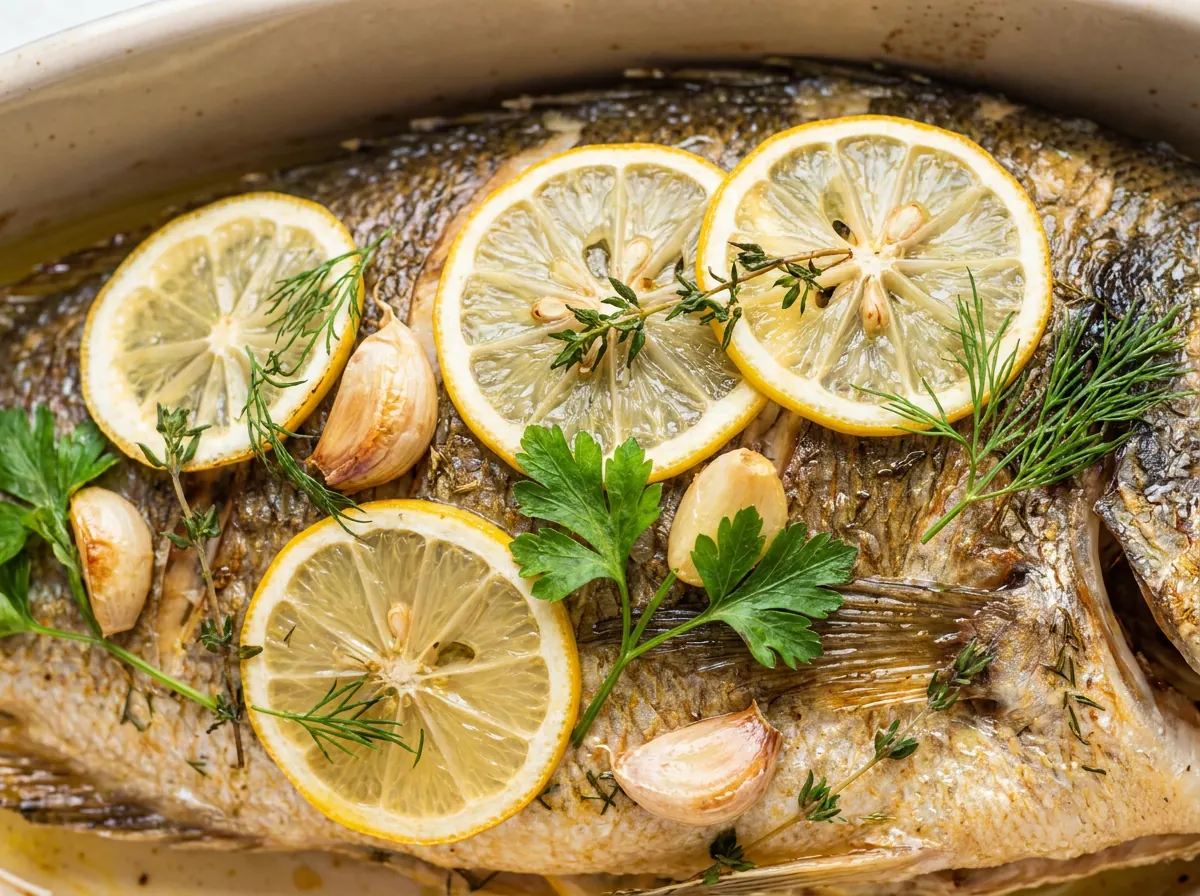
A whole hamour fish marinated in lemon, garlic, herbs, and spices then oven-baked. Pure protein with zero carbohydrates, GI 12, rich in selenium and omega-3, suitable for diabetes and keto.
Whole oven-baked fish is an authentic Gulf dish shared by the Saudi coasts with Kuwait, Bahrain, and the UAE. The whole fish, hamour or shari or sea bream, is marinated in lemon, garlic, and herbs and baked until its flesh separates easily, then served with rice, salad, and lemon slices.
The secret of the dish is in its simplicity: the tangy, aromatic marinade does not mask the fish but brings out its fresh flavour. And baking in the oven instead of frying preserves the healthy fats and reduces added fat, so the dish stays pure, low-calorie protein.
Preparation Steps
Clean the fish
Clean the fish well and remove the fins, rub it with salt and half a lemon to reduce the odour, then rinse and pat it dry.
Score both sides
Make diagonal cuts on both sides of the fish so the marinade penetrates and the fish cooks evenly.
Make the marinade
Mix the lemon juice, olive oil, garlic, turmeric, cumin, coriander, salt, and pepper, and rub the fish with the mixture inside and out.
Stuff and marinate
Stuff the cavity with lemon slices and the green herbs, and leave the fish to marinate for at least 30 minutes in the refrigerator.
Preheat the oven
Preheat the oven to 200 degrees C, and place the fish in a tray lined with aluminium foil.
Bake
Bake for 20 to 25 minutes until the flesh separates easily, uncovering the foil for the final 5 minutes to brown.
Check doneness
Make sure the core temperature of the fish reaches 63 degrees C with a thermometer before serving.
Serve
Serve the fish hot with fresh lemon slices and parsley, alongside rice and salad.
Blood Sugar Impact
The glycemic index (GI) measures how quickly a food raises blood sugar, while the glycemic load (GL) measures how much a full serving raises it. Together they give the complete picture.
Glycemic Index
GI
12Low
Low0–55Medium56–69High70+
A low value (≤55) means a gradual rise in blood sugar — the most suitable range for diabetes and insulin resistance.
Glycemic Load
GL
0Low
Low0–10Medium11–19High20+
Glycemic load reflects the impact of the full serving. To lower it: take half a serving, or pair the recipe with a source of protein and fiber.
Nutritional Information
Per ServingMakes 4 servings · one serving is about 415 g of raw ingredients
Calories297 kcal15%of Daily Value*
Protein40 g80%of Daily Value*
Carbohydrates4 g1%of Daily Value*
Fat13 g17%of Daily Value*
Fiber1 g4%of Daily Value*
Sodium499 mg22%of Daily Value*
* Percent Daily Values are based on a 2,000-calorie diet per FDA food-label reference values — your daily needs may be higher or lower. Values are derived from the recipe's ingredients via the USDA database.
Troubleshooting
The most common problems when preparing Whole Oven-Baked Fish, and how to fix them:
The fish flesh is dry and crumbly
The baking time was too long, or the temperature was higher than needed. Fish cooks quickly, and a hamour weighing a kilo and a half needs twenty to twenty-five minutes at two hundred degrees. Stop baking the moment the flesh separates easily from the fork with light pressure, or when the core temperature reaches sixty-three degrees. Overcooking by just two minutes turns the flesh from tender to dry.
The fish smell is strong and unpleasant
The fish was not rubbed with salt and lemon before cooking, or it was not fresh. To fix it: rub the fish inside and out with half a lemon and coarse salt, leave it ten minutes then rinse and dry it. The tangy lemon and garlic marinade also breaks down the odour. When buying, check for clear eyes, red gills, and a light sea smell.
The skin stuck to the tray and tore
The tray was not lined or greased, or the fish was moved before it had set. Line the tray with aluminium foil greased with a thin layer of olive oil. Leave the fish without moving it until the end of baking, as the skin sets and releases on its own when cooked. Lift it with two wide spatulas from underneath, not from one side.
The marinade did not penetrate the flesh
The cuts were not made on the sides, or the marinating time was too short. Deep diagonal cuts down to the bone open a path for the marinade, and half an hour in the refrigerator is the minimum for the flesh to absorb the flavour. For deeper flavour: marinate the fish two hours before cooking, and be sure to rub the marinade inside the cuts and the cavity.
The surface is pale with no browning
The fish stayed covered with foil throughout the baking, or the temperature was low. Uncover the foil for the final five minutes so the surface is exposed to direct heat and browns. For faster, prettier browning: switch on the top grill (broiler) for two to three minutes at the end with constant watching so it does not burn.
The fish did not cook through inside
The fish was large or went straight from the refrigerator to the oven. For fish larger than a kilo and a half, add five minutes and check the core temperature. Leave the fish ten minutes at room temperature before baking so it cooks evenly. The decisive rule: core temperature sixty-three degrees with a thermometer, not guessing by eye.
Storage and Make-Ahead
Refrigerator (4°)
Cooked fish: two days maximum in an airtight container, chilled within two hours of cooking. Raw marinated fish: one day in the refrigerator before baking, well covered.
Freezer (-18°)
Fresh raw fish freezes for up to three months. Cooked fish for one month, but its texture coarsens a little after thawing. Thaw it in the refrigerator, not at room temperature.
Advance preparation
The marinade: mixed and kept in the refrigerator for up to two days in an airtight container. Marinating the fish: two hours before baking at most, as the lemon begins to «cook» the flesh on the surface if left too long. Cutting and cleaning: on the same day only to preserve freshness.
Reheating
Reheat in the oven at 150 degrees for ten minutes covered with foil to retain moisture. Avoid the microwave as it dries the fish and intensifies its smell. Do not leave the fish out of the refrigerator more than two hours.
Tested Ingredient Substitutions
Original Ingredient
Tested Substitute
Ratio
Flavor Difference
Whole hamour
Whole shari or sea bream
Same weight
Shari is tastier with more bones and sea bream has softer flesh; all three are firm white flesh
Olive oil
Sunflower or corn oil
Same amount
Neutral flavour, loses the depth of olive oil but the result is lighter
Turmeric
Steeped saffron
A few steeped threads
A finer golden colour and a richer aroma, higher cost
Ground coriander
Ready-made fish spice blend
One teaspoon
A ready compound flavour, check that it is free of additives
The oven
The grill or charcoal
Cooking method
A clearer smoky flavour, needs care to prevent sticking and drying
How Much Does It Make? Scaling Guide
Number of servings
Fish weight
Lemon
Garlic
Olive oil
2 (individual × 2)
1 fish (750 g)
1.5 lemons
2 cloves
1.5 tbsp
4 (base)
1 fish (1.5 kg)
3 lemons
4 cloves
3 tbsp
8 (large family)
2 fish (1.5 kg)
6 lemons
8 cloves
6 tbsp
12 (entertaining)
3 fish (1.5 kg)
9 lemons
12 cloves
9 tbsp
EEINA Nutrition Tip
White fish is pure protein with zero carbohydrates: this makes it one of the best dishes for people with diabetes and those on keto, as it does not raise blood sugar at all and gives long-lasting satiety. And baking in the oven instead of frying preserves its healthy fats and reduces calories. For a balanced meal, pair it with leafy vegetables and a moderate amount of starches.
Add This Recipe to Your Plan
The EEINA app saves your favorite recipes, calculates them from their real ingredients, and shows your daily numbers toward your goal. Try it free now.
Ideal. Fish is pure protein with zero carbohydrates, GI 12, so it does not raise blood sugar at all, and gives long-lasting satiety that helps control appetite.
Which type of fish is best for this method?
Hamour, shari, and sea bream are all excellent, their white flesh is firm and withstands baking without crumbling. Choose a fresh fish with clear eyes and red gills.
How do I know the fish is fully cooked?
The flesh separates easily from the fork with light pressure, and the core temperature of the fish reaches 63 degrees C with a thermometer. We do not rely on guessing by eye alone.
Do I need a lot of oil?
No. Three tablespoons of olive oil are enough for the whole fish, and baking in the oven needs no frying oil. This is what makes the dish relatively low in calories.