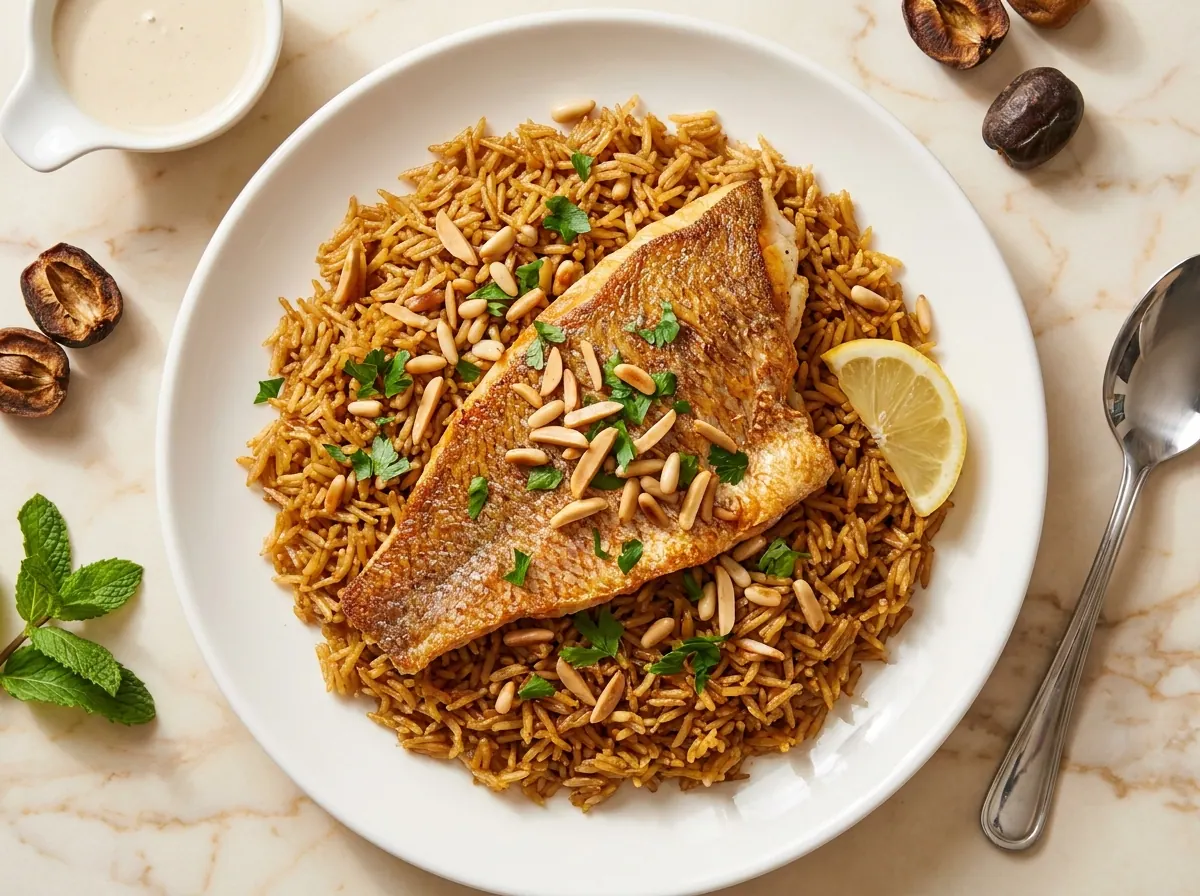
Sayadiyah is an authentic Hijazi dish from Jeddah · fresh hammour and rice cooked in fish broth with golden onion. 36 g of high-quality fish protein (Omega-3).
Sayadiyah is a Red Sea fisherman's dish — it goes back centuries. Its name comes from "sayyad" = fisherman.
It is the most famous dish on the Jeddah corniche and the Aseeri coast. Hammour (grouper) is one of the finest Red Sea fish — dense white flesh, almost free of bones, with a neutral taste that takes on every spice. A perfect choice for this dish.
Preparation Steps
Season the fish
Season the hammour fillets with salt, lemon juice, crushed garlic, and a quarter of the sayadiyah spice, then leave them for just twenty minutes and no longer, because the acidity of the lemon begins to cook the surface if we leave it too long.
Brown the onion
Finely chop the onion and heat the olive oil in a deep pot, then brown the onion over medium heat for about eight minutes until it turns deep golden, for this color is the secret of Hijazi sayadiyah. Be careful not to let it burn or its taste turns bitter.
Build and season
Add the chopped garlic and the rest of the spice to the onion and stir for a minute until fragrant, then add the pierced dried limes and three cups of water and let it come to a boil.
Cook the rice
Wash the rice three times until the water runs clear and add it to the broth, then lower the heat to its lowest, cover the pot, and cook for eighteen minutes without opening until it absorbs the broth.
Sear the fish and serve
While the rice cooks, sear the hammour fillets in a pan for two minutes per side until cooked and the edges are browned. Pour the rice onto the plate and arrange the fish on top, sprinkle with coriander and lemon juice, and serve with tahini on the side.
Blood Sugar Impact
The glycemic index (GI) measures how quickly a food raises blood sugar, while the glycemic load (GL) measures how much a full serving raises it. Together they give the complete picture.
Glycemic Index
GI
67Medium
Low0–55Medium56–69High70+
A low value (≤55) means a gradual rise in blood sugar — the most suitable range for diabetes and insulin resistance.
Glycemic Load
GL
40High
Low0–10Medium11–19High20+
Glycemic load reflects the impact of the full serving. To lower it: take half a serving, or pair the recipe with a source of protein and fiber.
Nutritional Information
Per ServingMakes 4 servings · one serving is about 275 g of raw ingredients
Calories457 kcal23%of Daily Value*
Protein30 g60%of Daily Value*
Carbohydrates62 g23%of Daily Value*
Fat9 g12%of Daily Value*
Fiber2 g7%of Daily Value*
Sodium364 mg16%of Daily Value*
Potassium796 mg17%of Daily Value*
Phosphorus305 mg24%of Daily Value*
* Percent Daily Values are based on a 2,000-calorie diet per FDA food-label reference values — your daily needs may be higher or lower. Values are derived from the recipe's ingredients via the USDA database.
Troubleshooting
The most common problems when preparing Hijazi Hammour Sayadiyah, and how to fix them:
The fish fell apart and did not hold its shape
The fish was overcooked, or stirred too early. Sayadiyah fish (hammour, naqis, or sbaiti) needs gentle cooking. According to the USDA, fish is safe to eat once it reaches 63°C at its deepest point [1]. Place the fish in the pot gently, do not move it except for the single flip, and after it is cooked lift it out carefully.
The rice came out dark brown and uneven in color
The onion burned before forming the color base. Sayadiyah has an even golden-brown color that comes from slowly sautéing the onion until it turns deep golden (20-25 minutes over low heat), not burnt. If it burns: start over, because burnt onion ruins the taste of the whole dish.
The rice cooked but lacks the fish flavor
The rice was cooked in water rather than fish broth. Classic sayadiyah cooks the rice in fish broth (made from boiling fish heads and bones with onion and spices before straining), so it absorbs all the deep seafood flavors.
The taste is flat with no Hijazi soul
The cumin and coriander were not toasted, or the turmeric was missing. Hijazi sayadiyah needs a seafood spice blend (cumin, coriander, turmeric, black pepper, fine cardamom) toasted in oil at the start of cooking. Turmeric gives the familiar golden-yellow color.
The fish smell is strong and unpleasant
The fish is not fresh, or it was not seasoned before cooking. For the fruity Hijazi flavor: soak the fish in fresh lemon juice with a pinch of salt and a spoon of turmeric for just 15-20 minutes before cooking. The acidity and turmeric neutralize strong odors.
The rice stuck to the bottom and burned
The heat was too high, or the water ratio was too low. Sayadiyah needs a thick-bottomed pot and low heat after it starts boiling. The golden crust at the bottom is intentional in Hijazi tradition, but a black burnt one is not. Lower the heat as soon as you see steam escaping from the sides of the lid.
Storage and Make-Ahead
Refrigerator (4°)
Complete sayadiyah: two days maximum in an airtight container, since fish spoils quickly. Rice on its own without the fish: four days in the refrigerator.
Freezer (-18°)
Rice only: one month in a freezer container. Cooked fish: not recommended, it loses its texture. If necessary: no more than one month.
Make ahead
Cleaning the fish: on the day of cooking, or buy it cleaned from a trusted seller. Seasoning the fish: only 20 minutes before cooking. Fish-head broth: an hour ahead in the refrigerator.
Reheating
In a medium oven (140°C) covered with aluminum foil for 12 minutes. Avoid the microwave, as it ruins the fish texture. Do not leave it out of the refrigerator more than two hours after reheating [2].
Tested Ingredient Substitutions
Original Ingredient
Tested Substitute
Ratio
Flavor Difference
Hammour or naqis
Qaris or sbaiti fish
Same weight
Cheaper, similar flavor, needs less time
White basmati rice
Saudi red Hassawi rice
Same amount
Higher fiber, deeper flavor, local Saudi identity
Fresh grated turmeric
Ground turmeric
Each spoon grated → half a spoon ground
Similar flavor, fresh is stronger in color
Extra virgin olive oil
Local sunflower oil
Same amount
Neutral taste, higher smoke point, cheaper
Dried lime (loomi)
Fresh lemon juice
Each dried lime → a spoon of juice
Clearer fresh flavor, loses the traditional brown color
How Much Does It Make? Scaling Guide
Number of servings
Fish
Rice
Onion
Cooking time
2 (individual × 2)
400 g
1 cup
2 medium onions
45 min
4 (base)
800 g
2 cups
4 onions
1 hour
8 (large family)
1.5 kg
4 cups
8 onions
1.5 hours
12 (entertaining)
2.25 kg
6 cups
12 onions
2 hours
EEINA Nutrition Tip
The secret of the Hijazi flavor: the onion must be deep golden (neither pale nor burnt). This color gives sayadiyah its taste and natural sweetness. Do not rush this step.
Add This Recipe to Your Plan
The EEINA app saves your favorite recipes, calculates them from their real ingredients, and shows your daily numbers toward your goal. Try it free now.