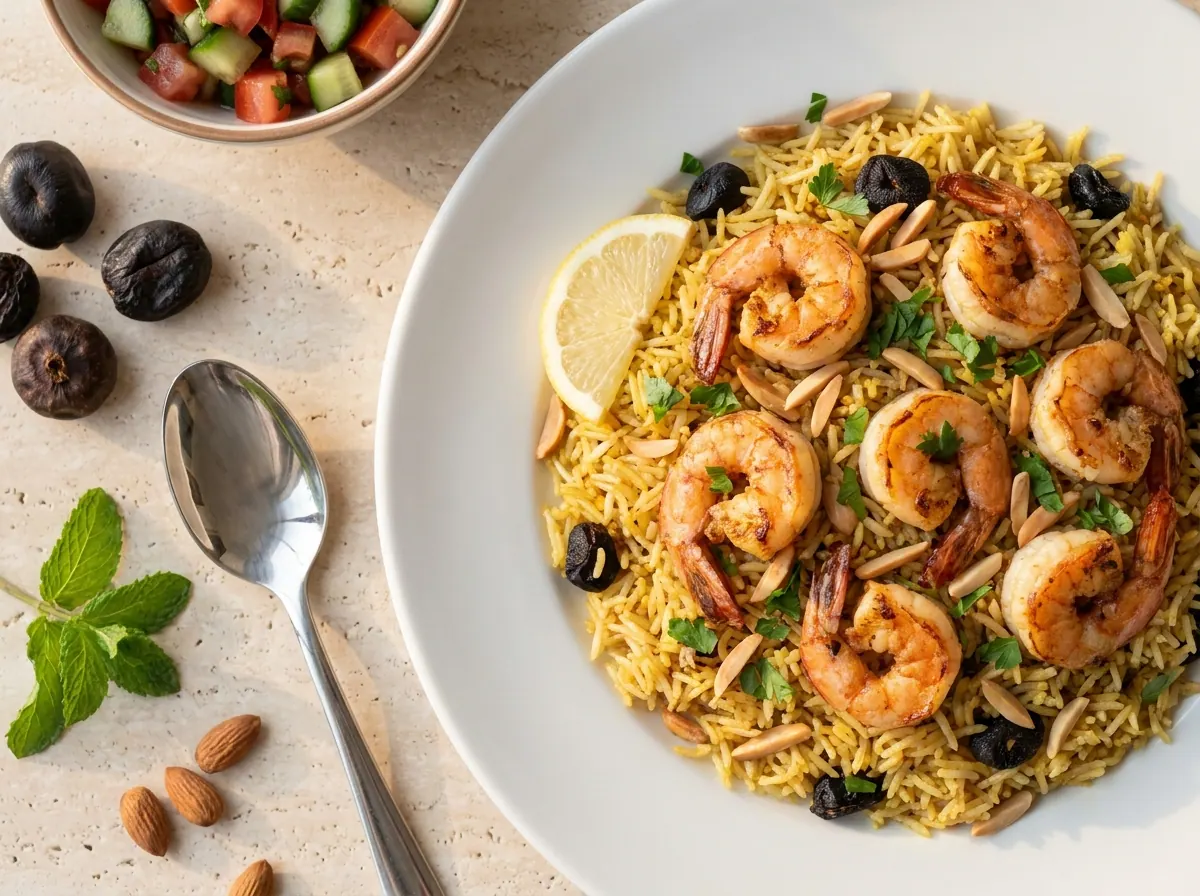
A traditional Bahraini Machbous — basmati rice with Bahraini machbous spice blend and saffron, topped with expertly grilled shrimp. Rich in Omega-3 and iodine, with 34 g of high-quality seafood protein.
Machbous is the most celebrated dish of the Gulf — its name means "compressed" because of the sealed cooking method. Every Gulf country has its own version: Saudi Arabia has Kabsa (Saudi spiced rice dish), Kuwait has Machboos, and Bahrain and the UAE call it Machbous.
The Bahraini version is famous for shrimp, as Bahrain's coastline produces some of the finest prawns in the region. We combine their traditional technique with precise GI and macro calculations.
Preparation Steps
Clean the shrimp
Peel the shrimp, remove the black vein, and rinse well, then marinate with turmeric, salt, and lemon juice for ten minutes.
Build the broth
Finely chop the onion and garlic and sauté in the olive oil, then add the machbous spice blend, the pierced loomi (dried black lime), cinnamon, and clove and stir for one minute until the aroma blooms.
Sear the shrimp
Add the shrimp to the pot and stir for only two minutes — they cook fast — then remove and keep warm so they do not dry out.
Cook the rice
Wash the rice three times, add it to the pot with the stock and the soaked saffron pinch, cover and cook over gentle heat for eighteen minutes.
Serve
Open the lid and return the shrimp on top of the rice for two minutes so they absorb the flavour, then garnish with coriander and lemon slices and serve with Bahraini daqoos (tomato sauce).
Blood Sugar Impact
The glycemic index (GI) measures how quickly a food raises blood sugar, while the glycemic load (GL) measures how much a full serving raises it. Together they give the complete picture.
Glycemic Index
GI
69Medium
Low0–55Medium56–69High70+
A low value (≤55) means a gradual rise in blood sugar — the most suitable range for diabetes and insulin resistance.
Glycemic Load
GL
54High
Low0–10Medium11–19High20+
Glycemic load reflects the impact of the full serving. To lower it: take half a serving, or pair the recipe with a source of protein and fiber.
Nutritional Information
Per ServingMakes 4 servings · one serving is about 465 g of raw ingredients
Calories559 kcal28%of Daily Value*
Protein36 g72%of Daily Value*
Carbohydrates80 g29%of Daily Value*
Fat10 g13%of Daily Value*
Fiber2 g7%of Daily Value*
Sodium437 mg19%of Daily Value*
Potassium804 mg17%of Daily Value*
Phosphorus497 mg40%of Daily Value*
* Percent Daily Values are based on a 2,000-calorie diet per FDA food-label reference values — your daily needs may be higher or lower. Values are derived from the recipe's ingredients via the USDA database.
Troubleshooting
The most common problems when preparing Bahraini Shrimp Machbous, and how to fix them:
The shrimp are tough and rubbery
They were overcooked. Shrimp cook very quickly — they turn pink and curl into a ring within 2 to 3 minutes only. According to USDA, shrimp are safe to eat when the thickest part reaches 63°C. Remove them from the heat the moment their colour changes and they curl — residual heat finishes the cooking.
The shrimp have a strong, unpleasant fishy smell
The shrimp are not fresh, or the vein was not removed. For clean flavour: remove the head, shell, and black back vein. Soak the shrimp in lemon juice with a pinch of salt for only 10 minutes before cooking — the acidity neutralises odours. If the smell persists after washing: the shrimp are not fresh; replace them.
The rice is pale and lacks machbous flavour
The Bahraini/Kuwaiti bezzar (spice blend) was not used, or the turmeric was left out. Gulf bezzar is a blend of coriander, cumin, cinnamon, cloves, and pepper — toast it in the oil before adding the rice. Turmeric gives the golden colour. The pierced loomi (dried black lime) gives the characteristic brown tint.
The shrimp lost their golden crust
They were cooked in the sauce from the start. For a beautiful golden crust: sear the shrimp separately in a dry pan for two minutes over high heat before adding them to the rice at the end. This creates a light caramelised layer that seals the flavours inside.
The rice is sticky and clumped
It was not rinsed, or too much water was used. Rinse the basmati rice in a fine sieve until the water runs clear, soak for half an hour, then drain. The basic ratio: 1 cup of rice to 11/2 cups of stock (not 2 full cups).
The machbous is cold and flavourless at serving time
Serving was delayed, or the bowl was cold. Machbous is a dish served hot immediately after cooking. If you must wait: cover the pot tightly and keep over the very lowest heat. Do not leave it for more than two hours after reheating outside the refrigerator, per USDA guidelines.
Storage and Make-Ahead
Refrigerator (4°C)
Complete machbous: two days in an airtight container — shrimp deteriorate quickly. Rice alone: four days in the refrigerator.
Freezer (-18°C)
Raw fresh shrimp: three months in an airtight freezer container. Cooked shrimp: not recommended — they lose their texture. If necessary: no more than one month.
Advance preparation
Cleaning the shrimp: on the day of cooking, store covered in the refrigerator for a few hours. Preparing the spice blend and spices: one hour ahead. Washing and soaking the rice: half an hour before cooking.
Reheating
Rice in a moderate oven (160°C) covered with aluminium foil for 15 minutes. Do not reheat the shrimp — eat them cold after chilling, or add fresh shrimp to the reheated rice.
Tested Ingredient Substitutions
Original Ingredient
Tested Substitute
Ratio
Flavor Difference
Shrimp
Squid rings
same weight
Chewier texture, similar seafood flavour, less expensive
Shrimp
Chicken, cut into small pieces
same weight
Less seafood character, completely different flavour — an option for those who dislike seafood
White basmati rice
Saudi red Hasawi rice
same amount
Higher fibre, deeper flavour, Saudi local identity
Kuwaiti bezzar
Najdi Saudi bezzar
same amount
Similar flavour with minor differences, more readily available in Saudi Arabia
Dried loomi (dried black lime)
Fresh lemon slices
each loomi → half a lemon
Brighter, fresher flavour — you lose the classic deep colour
How Much Does It Make? Scaling Guide
Number of servings
Shrimp
Rice
Broth
Cooking time
2 (individual × 2)
300 g
1 cup
1.5 cups
30 min
4 (base)
500 g
2 cups
3 cups
45 min
8 (large family)
1 kg
4 cups
6 cups
1 hour
12 (entertaining)
1.5 kg
6 cups
9 cups
1.25 hours
EEINA Nutrition Tip
The secret to the flavour: do not cook the shrimp for more than 4 minutes total — they become rubbery. The final 2 minutes on top of the rice is enough to reheat them.
Add This Recipe to Your Plan
The EEINA app saves your favorite recipes, calculates them from their real ingredients, and shows your daily numbers toward your goal. Try it free now.
Grouper or grilled fish (500 g fillets). Same spices and roughly the same timing.
Where can I find Bahraini machbous spice blend?
International spice shops online, or in Mecca through pilgrims. Alternative: a blend of turmeric, cumin, cinnamon, cardamom, and ground loomi (dried black lime).
Is it safe for people with diabetes?
GI 69 is medium — a small portion (200 g) with a large salad is OK. Avoid it if your blood sugar is not well controlled.
What can I use instead of loomi (dried black lime)?