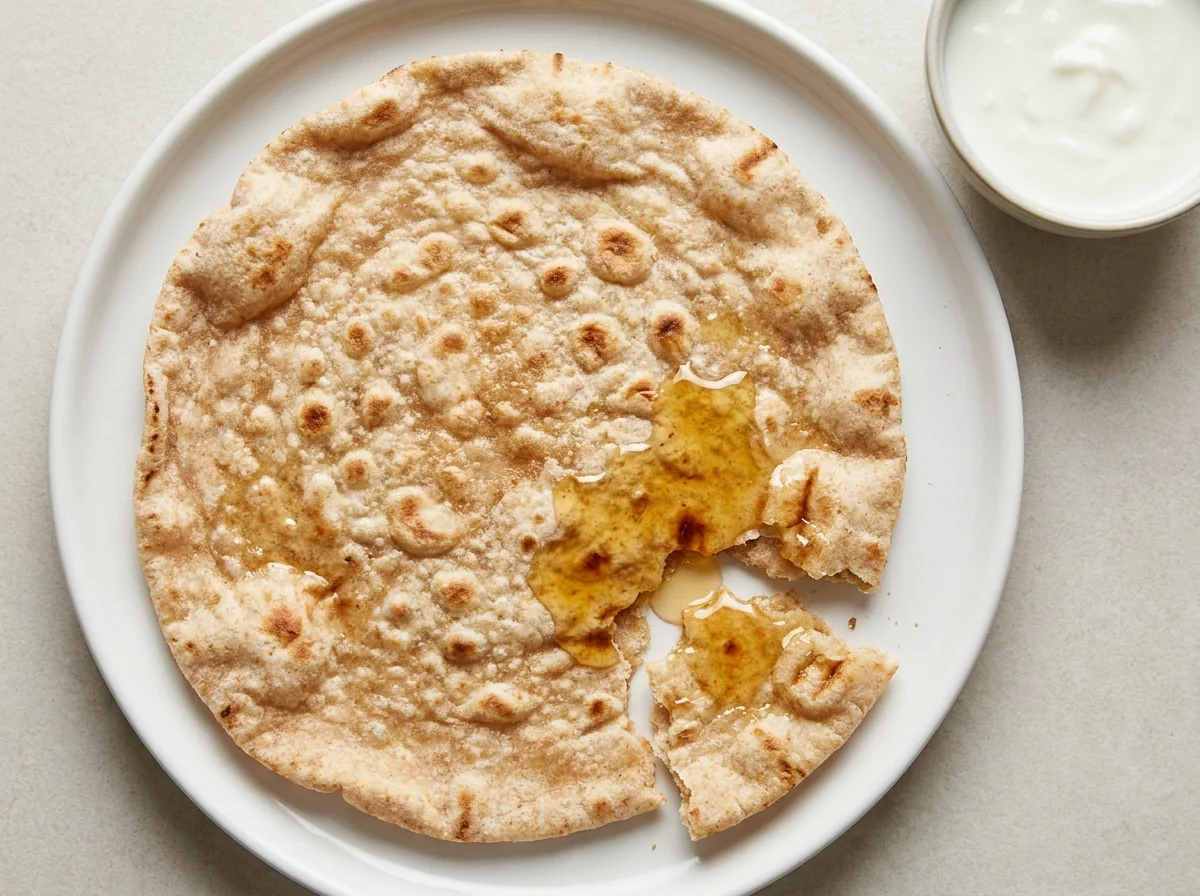
The tawa is a deep-rooted Qassimi griddle bread named after the tool that bakes it (the tawa, meaning the griddle), documented by Saudipedia among the essential suhoor foods of Qassim, where it is served with honey or milk before the start of the fast.
Preparation Steps
Activate the dough
Mix the flour with the salt, and dissolve the yeast and sugar in the warm water and leave it for five minutes until a live foam rises on it. Bring everything together and knead for eight minutes until a soft, moist dough that pulls away from the wall of the bowl.
Proof a suhoor's worth
Cover the dough and leave it for half an hour until it puffs up and nearly doubles. The short suhoor proof gives a tender tawa without the sourness of a long-fermented dough.
Divide and roll into discs
Divide it into four balls and, on a flour-dusted surface, roll each ball into a disc half a centimeter thick. No thinner, for the tawa is a moist bread, not a wafer.
Bake on the hot tawa
Heat the griddle (tawa) greased with a swipe of ghee over medium heat until a drop of water dances on it. Place the disc: two minutes until bubbles puff on its face and its bottom blushes with golden spots, then flip it for another two minutes.
Serve it the Qassimi way
Hot and tender with honey or date molasses to dip, or broken into milk. This is how the homes of Qassim have had it for suhoor since the forefathers.
Blood Sugar Impact
The glycemic index (GI) measures how quickly a food raises blood sugar, while the glycemic load (GL) measures how much a full serving raises it. Together they give the complete picture.
Glycemic Index
GI
75High
Low0–55Medium56–69High70+
A low value (≤55) means a gradual rise in blood sugar — the most suitable range for diabetes and insulin resistance.
Glycemic Load
GL
56High
Low0–10Medium11–19High20+
Glycemic load reflects the impact of the full serving. To lower it: take half a serving, or pair the recipe with a source of protein and fiber.
Nutritional Information
Per ServingMakes 4 servings · one serving is about 175 g of raw ingredients
Calories416 kcal21%of Daily Value*
Protein10 g20%of Daily Value*
Carbohydrates78 g28%of Daily Value*
Fat6 g8%of Daily Value*
Fiber3 g11%of Daily Value*
Sodium391 mg17%of Daily Value*
Potassium117 mg2%of Daily Value*
Phosphorus114 mg9%of Daily Value*
* Percent Daily Values are based on a 2,000-calorie diet per FDA food-label reference values — your daily needs may be higher or lower. Values are derived from the recipe's ingredients via the USDA database.
Troubleshooting
The most common problems when preparing Qassimi Tawa Bread, and how to fix them:
The tawa is dry and tough
We kneaded a dry dough or rolled it thinner than necessary. A moist dough and a half-centimeter thickness preserve the softness.
The face burned and the center is raw dough
The griddle is blazing. Medium heat and two minutes per side.
No bubbles puffed up
The yeast is inactive or the proof was too short. Make sure of the activation foam and give it its full half hour.
It stuck to the griddle
The griddle is cold or not swiped with fat. Good heating and a swipe of ghee before each disc.
Storage and Make-Ahead
Hot, right away
Like any griddle bread. Its peak is in its first minutes.
In a cloth bag, then airtight
Two days at room temperature, revived on the griddle for a few seconds.
In the freezer
A month, baked, between sheets of parchment. Goes straight onto a hot griddle.
Tested Ingredient Substitutions
Original Ingredient
Tested Substitute
Ratio
Flavor Difference
White flour
Half of it whole-wheat flour
1:1 for the half
A rustic tawa higher in fiber
The yeast
A spoon of milk with a little yeast and a longer proof
to taste
A more deep-rooted country flavor
Ghee on the griddle
A completely dry griddle
to taste
A tawa with no fat at all for whoever wants it
Honey to serve
Date molasses
1:1
Another Qassimi tradition
How Much Does It Make? Scaling Guide
Ingredient
4 loaves
2 loaves
8 loaves
Flour
400 g
200 g
800 g
Water
260 ml
130 ml
520 ml
Yeast
4 g
2 g
8 g
EEINA Nutrition Tip
The heat of the griddle is the key to the tawa: lukewarm dries it out, and blazing burns its face before its center cooks. The dancing water-drop test never fails.
Add This Recipe to Your Plan
The EEINA app saves your favorite recipes, calculates them from their real ingredients, and shows your daily numbers toward your goal. Try it free now.
What is the difference between it and Levantine Saj bread?
The tawa is thicker, more tender, and proofed, while Levantine saj is thin and paper-like. Two similar tools and two different breads.
Why is it a Qassimi suhoor?
A quick warm bread with honey or milk: energy, protein, and fluids with the least effort at the time of suhoor. The nutritional wisdom of the forefathers.
Is it stuffed?
The original is unstuffed, and whoever makes it with cheese or dates has made another delicious dish.
Without yeast for those in a hurry?
It becomes an acceptable 'flatbread,' but the soul of the tawa is in its light puff.