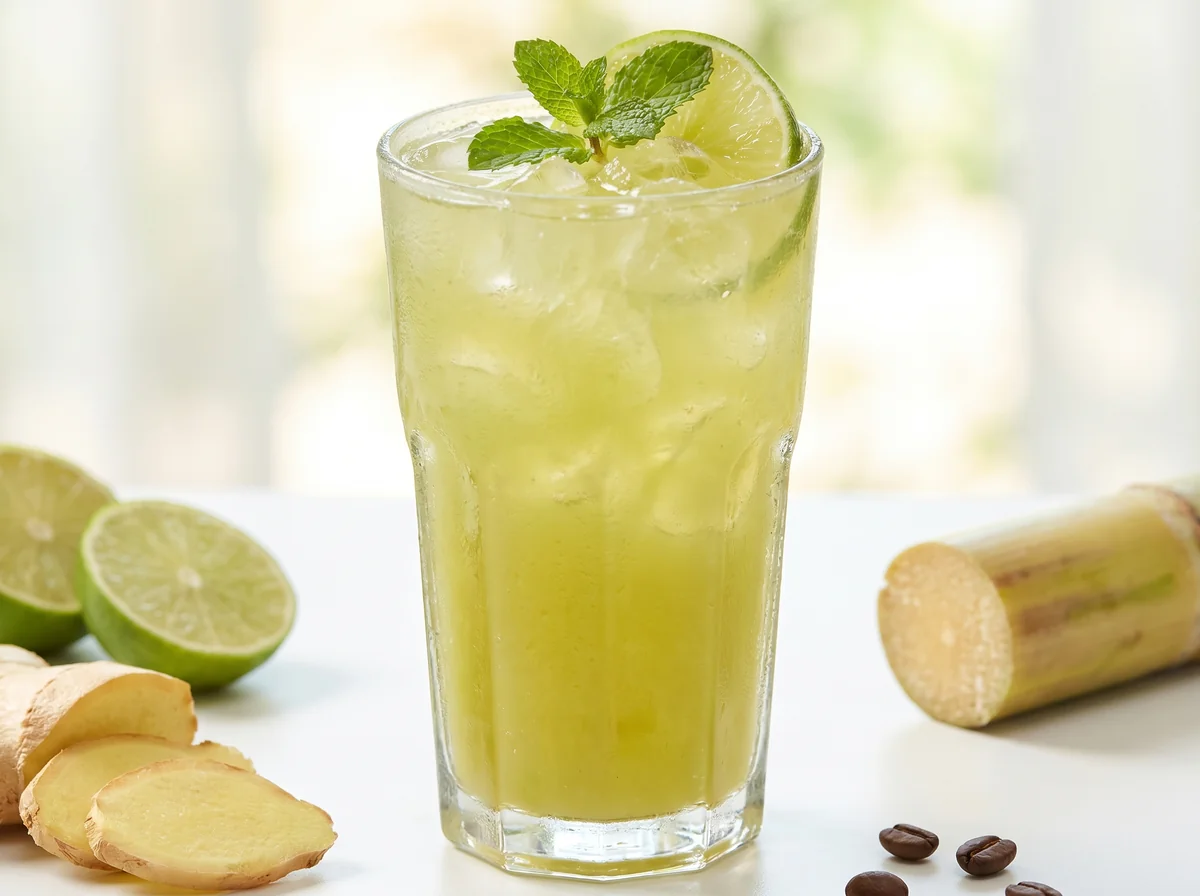
A popular Egyptian street drink — fresh sugarcane juice pressed cold and served over ice. The famous Egyptian street drink, naturally sweet, low glycemic load, free from common allergens.
Sugarcane juice is the quintessential famous Egyptian street drink, sold at juice shops (aseer asab) spread across every Egyptian city and village, where the stalks are pressed in front of the customer in distinctive special presses. It is a refreshing, naturally sweet summer drink, part of the Egyptian popular scene and daily life — inexpensive and accessible to everyone.
Egypt is one of the world's largest sugarcane producers, so the juice is abundant and authentic. Its unique natural sweetness, cold refreshment, and the spectacle of the live pressing have made it an icon of beloved Egyptian street drinks across generations.
Preparation Steps
Prepare the sugarcane
Choose fresh sugarcane stalks (green and tender, not dry), wash them well, peel the hard outer layer with a knife, and cut the inner pulp into small pieces. Fresh tender sugarcane gives a sweeter, higher-yield juice — dry old stalks yield less.
Press (using a sugarcane press)
The traditional method uses a dedicated sugarcane press (a mechanical squeezer) that presses the stalks directly. If available, pass the peeled stalks through it several times to extract all the juice. This method gives the authentic clear juice.
Press (using a blender — home alternative)
At home without a sugarcane press, place the sugarcane pulp pieces with a little water in a powerful blender and blend well until the sugarcane breaks apart and releases its juice. Sugarcane is fibrous and tough — it needs a powerful blender and a little water to help.
Strain
Strain the mixture well through a fine sieve or cheesecloth to separate the juice from the coarse fibres, and squeeze the fibres to extract all the juice. Good straining gives a clear juice without coarse fibres.
Add lemon
Add a small squeeze of lemon (optional) to the juice — it balances the sweetness, adds a refreshing note, and slows oxidation and colour change. Sugarcane is naturally very sweet, and lemon softens its sweetness and makes it more refreshing.
Serve
Serve the sugarcane juice very cold with generous ice immediately (its taste and colour change quickly — drink it fresh). It is the quintessential famous Egyptian street drink, sold at juice shops (aseer asab) everywhere, naturally sweet and refreshing, a symbol of the Egyptian summer and beloved street drinks. Its unique natural sweetness and cold refreshment have made it an icon of Egyptian street drinks, cherished across generations.
Blood Sugar Impact
The glycemic index (GI) measures how quickly a food raises blood sugar, while the glycemic load (GL) measures how much a full serving raises it. Together they give the complete picture.
Glycemic Index
GI
20Low
Low0–55Medium56–69High70+
A low value (≤55) means a gradual rise in blood sugar — the most suitable range for diabetes and insulin resistance.
Glycemic Load
GL
0Low
Low0–10Medium11–19High20+
Glycemic load reflects the impact of the full serving. To lower it: take half a serving, or pair the recipe with a source of protein and fiber.
Nutritional Information
Per ServingMakes 2 servings · one serving is about 20 g of raw ingredients
Calories5 kcal0%of Daily Value*
Protein0 g0%of Daily Value*
Carbohydrates2 g1%of Daily Value*
Fat0 g0%of Daily Value*
Fiber0 g0%of Daily Value*
Sodium0 mg0%of Daily Value*
Potassium23 mg0%of Daily Value*
Phosphorus2 mg0%of Daily Value*
* Percent Daily Values are based on a 2,000-calorie diet per FDA food-label reference values — your daily needs may be higher or lower. Values are derived from the recipe's ingredients via the USDA database.
Troubleshooting
The most common problems when preparing Egyptian Fresh Sugarcane Juice, and how to fix them:
Little juice from the sugarcane
The sugarcane is dry and old, or was not pressed well. Use fresh tender sugarcane (higher yield), pass it through the press several times, or blend well with a little water and strain and squeeze the fibres to extract all the juice.
Coarse fibres in the juice
Not strained well. Strain the juice through a fine sieve or cheesecloth to separate the fibres, and squeeze them. Sugarcane is fibrous — good straining gives a clear smooth juice.
The juice changed colour and taste quickly
Natural — sugarcane juice oxidises quickly. Drink it immediately after pressing (fresh and cold) — it does not keep well. A squeeze of lemon slows the change slightly, but it remains a drink best consumed fresh.
Too sweet (concentrated)
Sugarcane is naturally very sweet. Add water and ice to dilute it, and a squeeze of lemon to moderate and balance the sweetness. Generous ice dilutes the concentration and adds refreshment.
The blender could not break up the sugarcane
Sugarcane is tough and fibrous and needs a powerful blender. Cut the sugarcane into small pieces, add a little water to help, and blend in batches. A dedicated press is better, but a powerful blender is an acceptable home alternative.
Storage and Make-Ahead
Drink fresh
Sugarcane juice should be drunk immediately after pressing (fresh and cold) — it oxidises and changes colour and taste within hours. It does not keep well, so prepare only what will be drunk right away. This is the secret of drinking it fresh at juice shops.
Refrigerator (limited)
If necessary, keep chilled in a sealed cup for a few hours only with a squeeze of lemon, but the taste and colour deteriorate quickly. Freshly pressed is the original — storage makes it lose its freshness.
Freezer
Sugarcane juice can be frozen in ice cube trays for later use in drinks or blends, but fresh is far better. Freezing preserves it longer than refrigerating if necessary.
Food safety
Hygiene of sugarcane juice is essential (the sugarcane is sometimes pressed with its skin), so wash and peel the sugarcane well and use clean equipment. At juice shops, be mindful of hygiene, drink it fresh — juice left out spoils quickly.
Tested Ingredient Substitutions
Original Ingredient
Tested Substitute
Ratio
Flavor Difference
plain sugarcane juice
add lemon, mint, or ginger
to taste
Lemon and mint moderate the sweetness and add refreshment; ginger adds flavour (common additions at juice shops)
sugarcane press
powerful blender with straining
—
A home alternative when a dedicated sugarcane press is not available — blend the pulp with a little water and strain well
fresh sugarcane
packaged sugarcane juice (when unavailable)
—
Freshly pressed is far better in flavour and nutrition; packaged is a substitute when fresh sugarcane is unavailable (watch out for added sugar)
How Much Does It Make? Scaling Guide
Number of cups
Sugarcane stalks
1 (cup)
2 stalks
2 (base)
4 stalks
4 (family)
8 stalks
EEINA Nutrition Tip
Sugarcane juice is naturally sweet and contains some minerals (calcium, potassium, iron) and antioxidants, with a relatively moderate glycemic index (it contains fructose). However, it is concentrated in natural sugar and calories (liquid sugar without fibre), so it raises blood sugar relatively quickly despite its moderate index. My advice: drink it in moderation (a small cup) as a seasonal treat, not daily. Add lemon to moderate the sweetness, and be mindful of the hygiene of the juice shop. Those with diabetes should avoid it or consume very little.
Add This Recipe to Your Plan
The EEINA app saves your favorite recipes, calculates them from their real ingredients, and shows your daily numbers toward your goal. Try it free now.
It contains some minerals (calcium, potassium, iron) and antioxidants, with a relatively moderate glycemic index (it contains fructose). However, it is concentrated in natural sugar and calories (liquid sugar without fibre). Drink it in moderation as a seasonal treat, not daily. Those with diabetes should avoid it or consume very little.
How do I press it at home?
With a dedicated sugarcane press (best) the stalks are pressed directly. At home, with a powerful blender: cut the peeled sugarcane pulp into small pieces, blend with a little water, then strain well through cheesecloth and squeeze the fibres to extract the juice.
Why drink it immediately?
Sugarcane juice oxidises and changes colour and taste within hours, so drink it fresh and cold immediately after pressing for the best flavour and colour (that is why juice shops press it in front of the customer). A squeeze of lemon slows the change slightly, but it remains a drink best consumed fresh.
Why add lemon?
Sugarcane is naturally very sweet, and a squeeze of lemon balances its sweetness, adds a refreshing gentle acidity, and slows its oxidation and colour change. It is an optional but common addition that makes the juice more refreshing and less overpoweringly sweet.
Sources: University of Sydney · Gulf GSO · Our methodology · Updated on