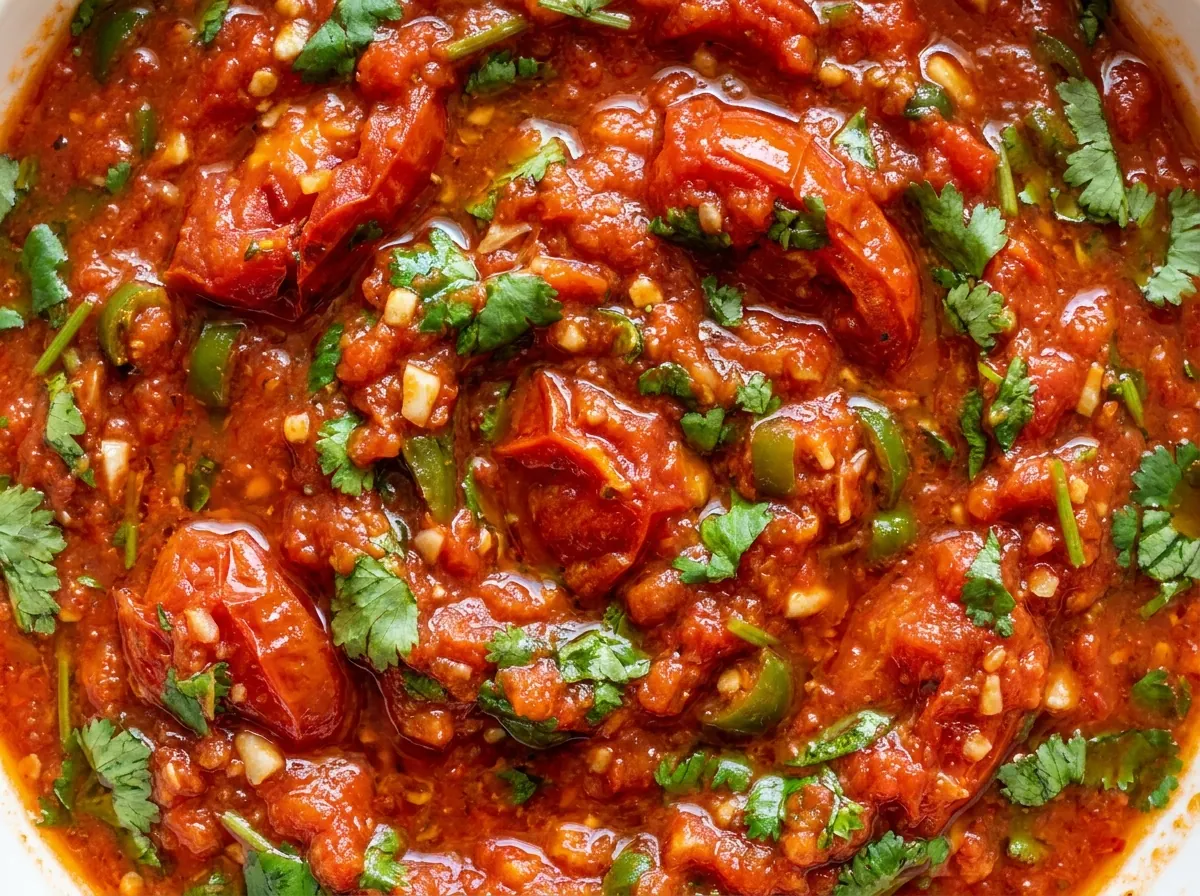
A bold Saudi tomato and chilli sauce blended raw or lightly cooked — the essential table condiment served alongside Kabsa (Saudi spiced rice dish), Mandi (Yemeni-Saudi smoked meat and rice), rice dishes, grills, and almost anything else.
Daqoos is the Saudi national condiment — as essential to a Saudi table as harissa to a Tunisian one. Every household, every grandmother, and every restaurant has their version: some raw and vibrant, some slow-cooked and deep, some blazing with heat, some mild and fragrant.
What never changes is its purpose: to bring life to Kabsa (Saudi spiced rice dish), Mandi (Yemeni-Saudi smoked meat and rice), and rice. EEINA's version is a balanced, medium-heat Daqoos that lets you adjust the chilli to your table.
Preparation Steps
Prepare the ingredients
Roughly chop the tomatoes, chillies, and garlic. Remove the chilli seeds for a milder sauce, or leave them in for the traditional heat. Daqoos ranges from mild to fiery — the choice is yours.
Blend
Combine the tomatoes, chillies, garlic, coriander, lemon juice, salt, cumin, and black pepper in a blender. Blend to a rough, slightly textured purée — Daqoos is not a smooth sauce. Add a splash of water if needed to help the blending.
Cook (optional but recommended)
Heat the oil in a small saucepan, pour in the blended sauce, and cook over medium heat for 10 to 15 minutes until the colour deepens and the raw tomato smell cooks off. Cooked Daqoos has a richer flavour; raw Daqoos is brighter and fresher. Both are authentic.
Taste and adjust
Taste and adjust the salt, lemon, and chilli. Daqoos should be tangy, garlicky, and lightly spiced — bold enough to stand up to a plate of Kabsa (Saudi spiced rice dish) or Mandi (Yemeni-Saudi smoked meat and rice).
Cool and store
Allow to cool completely before transferring to a clean jar. Store refrigerated. Daqoos keeps for up to a week and the flavour improves after a few hours of resting.
Serve
Serve alongside Kabsa (Saudi spiced rice dish), Mandi (Yemeni-Saudi smoked meat and rice), Saleeg, grilled meats, or any rice dish. Place in a small bowl at the table — every Saudi household has its own Daqoos recipe.
Scale and customise
Double the batch for a party or a large family gathering. The sauce also works as a marinade base for chicken or a dipping sauce for bread.
Blood Sugar Impact
The glycemic index (GI) measures how quickly a food raises blood sugar, while the glycemic load (GL) measures how much a full serving raises it. Together they give the complete picture.
Glycemic Index
GI
15Low
Low0–55Medium56–69High70+
A low value (≤55) means a gradual rise in blood sugar — the most suitable range for diabetes and insulin resistance.
Glycemic Load
GL
0Low
Low0–10Medium11–19High20+
Glycemic load reflects the impact of the full serving. To lower it: take half a serving, or pair the recipe with a source of protein and fiber.
Nutritional Information
Per ServingMakes 8 servings · one serving is about 85 g of raw ingredients
Calories31 kcal2%of Daily Value*
Protein1 g2%of Daily Value*
Carbohydrates4 g1%of Daily Value*
Fat2 g3%of Daily Value*
Fiber1 g4%of Daily Value*
Sodium150 mg7%of Daily Value*
Potassium158 mg3%of Daily Value*
Phosphorus22 mg2%of Daily Value*
* Percent Daily Values are based on a 2,000-calorie diet per FDA food-label reference values — your daily needs may be higher or lower. Values are derived from the recipe's ingredients via the USDA database.
Troubleshooting
The most common problems when preparing Saudi Daqoos Sauce, and how to fix them:
Too watery
Cook the sauce for longer over medium heat, uncovered, until it reduces and thickens. Alternatively, use Roma tomatoes which have less water.
Too hot
Remove the seeds from the chillies before blending. Use fewer chillies, or balance with a pinch of sugar or more tomato.
Raw tomato smell
Cook the blended sauce in oil for at least 10 minutes until the raw aroma cooks off and the colour deepens to a rich red.
Too bitter
Garlic was burned in the oil. Heat the oil first, then add the blended sauce directly. Do not fry raw garlic separately before adding it.
Lacks depth
Add a pinch more cumin and a tiny pinch of cinnamon — traditional Saudi spice additions that give depth without making it taste sweet.
Storage and Make-Ahead
Refrigerator (4°C)
Up to one week in a clean, sealed jar. Flavour deepens over the first day.
Freezer (-18°C)
Up to two months in small portions (ice cube tray, then transfer to a bag). Thaw overnight in the refrigerator.
Room temperature (serving)
Serve at room temperature or slightly warm. Do not leave out for more than two hours [2].
Batch cooking
Daqoos scales well — make a large batch and freeze in portions for convenience.
Tested Ingredient Substitutions
Original Ingredient
Tested Substitute
Ratio
Flavor Difference
Fresh green chillies
Jalapeño or serrano for a milder or sharper heat respectively
Same quantity
Adjust to your heat preference; remove seeds for milder sauce
Fresh coriander
Flat-leaf parsley
Same quantity
For those who dislike coriander; the flavour is lighter
Fresh tomatoes
Tinned whole tomatoes, drained
400 g tin = 4 fresh tomatoes
Works well for the cooked version; avoid for raw Daqoos
Lemon juice
White vinegar
Half the quantity
Sharper acidity; use sparingly
How Much Does It Make? Scaling Guide
Number of servings
Tomatoes
Garlic
Hot pepper
Water
4 (small table)
2
2 cloves
1
0.25 cup
8 (base)
4
3–4 cloves
1–2
0.5 cup
12 (gathering)
6
5 cloves
2–3
0.75 cup
20 (large gathering)
10
8 cloves
3–4
1.25 cups
EEINA Nutrition Tip
Daqoos is almost calorie-free and has a negligible glycemic load — it is one of the most EEINA-friendly condiments in Saudi cuisine. Tomatoes provide lycopene and vitamin C. Use it freely alongside rice dishes to add flavour without adding calories.
Add This Recipe to Your Plan
The EEINA app saves your favorite recipes, calculates them from their real ingredients, and shows your daily numbers toward your goal. Try it free now.
What is the difference between raw and cooked Daqoos?
Raw Daqoos is bright, fresh, and punchy — blended and served immediately. Cooked Daqoos is richer, deeper, and milder — the oil cooking removes the raw edge. Both are authentic. Saudi households often have strong opinions about which is correct.
Which dishes is Daqoos served with?
The classic companions are Kabsa (Saudi spiced rice dish) and Mandi (Yemeni-Saudi smoked meat and rice), but Daqoos also goes with Saleeg, any grilled meat or fish, rice dishes, and as a dipping sauce for bread.
Is Daqoos suitable for people with diabetes?
Yes — the glycemic load is negligible and it is almost calorie-free. Use it freely to add flavour without affecting blood sugar. It is one of the most EEINA-friendly condiments in the Saudi kitchen.
Sources: USDA · University of Sydney · Gulf GSO · Our methodology · Updated on