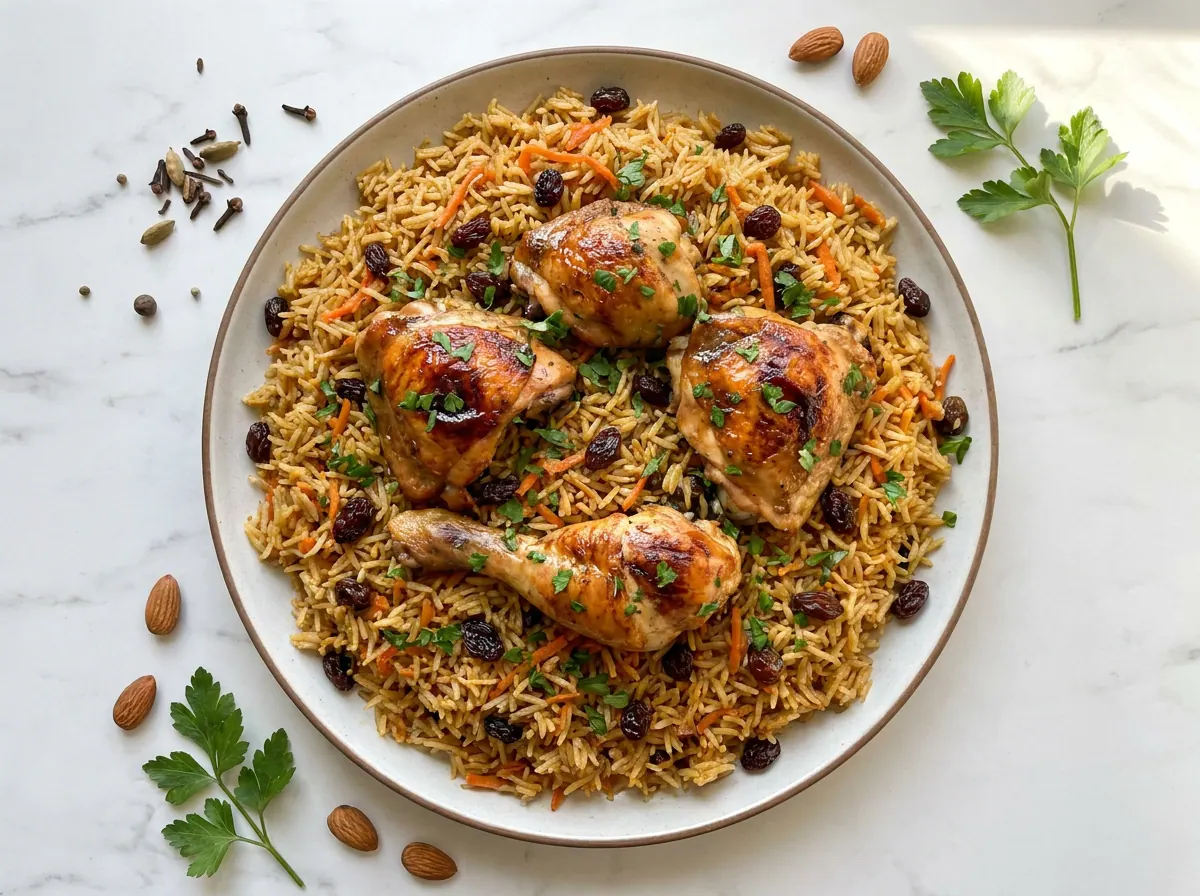
Bukhari Rice with browned chicken — a Saudi Hejazi dish with documented origins in the city of Bukhara on the Silk Road. Basmati rice spiced with baharat (Gulf spice blend), grated carrot, raisins and chicken. GI 69, glycaemic load 39.
Bukhari Rice is a dish that travelled with traders from the city of Bukhara on the Silk Road and settled in the Hejaz, where the Saudi kitchen adopted it until it became a national dish served with honour at the table. Its essential composition is consistent across multiple culinary sources: spiced basmati rice with grated carrot, raisins and browned chicken.
The secret of its flavour lies not in an abundance of ghee but in the chicken stock in which the rice is cooked. The lighter version here removes the chicken skin, reduces the ghee to one tablespoon for the whole recipe, and replaces deep-frying with oven browning — preserving the flavour while reducing the fat. Even so, it remains a white-rice dish dense in carbohydrates, so a moderate portion and accompanying vegetables are the key.
Preparation Steps
Poach the chicken and prepare the stock
Simmer the skinless chicken with the onion, bay leaf, cardamom and cinnamon until cooked through. Strain and reserve the stock — it is the secret of the rice's flavour.
Brown the chicken
Brown the poached chicken in the oven or in a non-stick pan with a little ghee instead of deep-frying until it develops a golden colour.
Sauté the onion and spices
Chop the onion and sauté it in the tablespoon of ghee. Add the tomato paste and the Bukhari baharat (baharat) and stir until fragrant.
Add the carrot and raisins
Add the grated carrot and raisins and stir for two minutes until the carrot softens and releases its natural sweetness.
Fold in the rice
Add the soaked, drained basmati rice and fold it in gently until every grain is coated with the spices.
Add the stock and saffron
Pour in the hot chicken stock at a ratio of about 11/2 cups liquid per cup of rice. Add the pre-soaked saffron threads and adjust the salt modestly.
Cook on a low heat
Cover the pot and cook on the lowest heat for about twenty minutes until the rice has absorbed the stock and is cooked through, then leave to rest for five minutes.
Serve
Fluff the rice with a fork, arrange it on the serving plate and top with the browned chicken and raisins.
Blood Sugar Impact
The glycemic index (GI) measures how quickly a food raises blood sugar, while the glycemic load (GL) measures how much a full serving raises it. Together they give the complete picture.
Glycemic Index
GI
69Medium
Low0–55Medium56–69High70+
A low value (≤55) means a gradual rise in blood sugar — the most suitable range for diabetes and insulin resistance.
Glycemic Load
GL
50High
Low0–10Medium11–19High20+
Glycemic load reflects the impact of the full serving. To lower it: take half a serving, or pair the recipe with a source of protein and fiber.
Nutritional Information
Per ServingMakes 4 servings · one serving is about 285 g of raw ingredients
Calories612 kcal31%of Daily Value*
Protein39 g78%of Daily Value*
Carbohydrates75 g27%of Daily Value*
Fat16 g21%of Daily Value*
Fiber3 g11%of Daily Value*
Sodium127 mg6%of Daily Value*
Potassium621 mg13%of Daily Value*
Phosphorus313 mg25%of Daily Value*
* Percent Daily Values are based on a 2,000-calorie diet per FDA food-label reference values — your daily needs may be higher or lower. Values are derived from the recipe's ingredients via the USDA database.
Troubleshooting
The most common problems when preparing Bukhari Rice with Chicken, and how to fix them:
The rice is sticky and clumped, not fluffy
The rice was not washed properly before cooking, or too much stock was added. Wash the basmati until the rinsing water runs clear of starch, and soak it for twenty minutes then drain it. Keep to a liquid-to-rice ratio of ~1.5:1 — basmati needs less liquid than Egyptian rice. After cooking, leave it covered for five minutes before fluffing with a fork.
The bottom of the rice burned before the top cooked through
The heat was too high or the pot had a thin base. After adding the stock, reduce the heat to the lowest possible setting and cover tightly — it is the trapped steam that cooks the rice, not direct heat. A heavy-based pot distributes heat evenly and prevents sticking.
The flavour is flat and lacks Bukhari depth
The rice was cooked in water instead of chicken stock, or the spices are old. The stock from simmering the chicken on the bone is the secret of the flavour — do not replace it with water. Grind the Bukhari baharat freshly before use: cumin, coriander and cinnamon lose their aromatic oils over time. Toast the spices in the fat briefly before adding the rice so they bloom.
The chicken is dry after browning
The chicken was poached too long then browned over high heat. Poach it just until cooked through (juices run clear), then brown it quickly in a hot oven or pan until golden — do not overdo it. Chicken thighs stay juicier than breast when browned because the internal fat retains moisture.
The dish is greasy and heavy on the stomach
Too much ghee or the chicken skin was left on. The lighter version removes the skin and reduces the ghee to one tablespoon for the whole recipe, replacing deep-frying with oven browning. Serve the dish with a green salad or light Rob (plain full-fat yogurt) to balance the feeling of fullness.
The raisins are hard or burned on top
The raisins were added too late over direct heat. It is better to add them with the carrot during the sautéing stage so they plump up with moisture and soften, or soak them in warm water for five minutes before use. Do not leave them on top of the rice under direct heat or they will scorch.
Storage and Make-Ahead
Refrigerator (4 °C)
Rice with chicken: three days in a sealed container. Cool the dish within two hours of cooking and do not leave it outside the fridge longer than that, following the USDA danger zone rule. Strained stock: three days refrigerated in a sealed container, suitable for a future dish.
Freezer (−18 °C)
Cooked rice with chicken freezes for up to one month in individual-portion containers. Thaw overnight in the fridge and reheat with a splash of water or stock until soft again.
Prep ahead
Stock: poach the chicken and strain the stock the day before and refrigerate. Carrot and onion: grate and chop the evening before in a sealed container. Bukhari baharat: grind in advance and store in a sealed jar away from light.
Reheating
Reheat the rice with a splash of water or stock over a low covered heat, or in the microwave with a cup of water beside it. Make sure the chicken is heated until piping hot all the way through (74 °C) before serving.
Stays juicier when browned because the internal fat retains moisture; slightly higher in fat than breast
Ghee
Olive oil or canola oil
Same quantity
Lighter fats, less richness than traditional ghee
Raisins
Chopped prunes or dried apricots
Same weight
Deeper sweetness with a gentle acidity — the same idea of a sweet accent
Chicken stock
Home-made vegetable stock
Same quantity
Vegetarian version; lighter flavour compensated for by increasing the Bukhari baharat
How Much Does It Make? Scaling Guide
Number of servings
Basmati rice
Chicken
Grated carrots
Broth
2 (small meal)
150 g
260 g
0.5 cup
2 cups
4 (base)
300 g
520 g
1 cup
4 cups
8 (large family)
600 g
1 kg
2 cups
8 cups
12 (entertaining)
900 g
1.5 kg
3 cups
12 cups
EEINA Nutrition Tip
The glycaemic load is high, so portion size is the answer: Bukhari Rice is a dense white-rice dish, and its glycaemic load of 39 is high. For people with diabetes and insulin resistance: start with half a portion, fill half the plate with green salad or vegetables, and serve the protein first before the rice. This order slows the blood-sugar rise without depriving you of the dish.
Add This Recipe to Your Plan
The EEINA app saves your favorite recipes, calculates them from their real ingredients, and shows your daily numbers toward your goal. Try it free now.
Is Bukhari Rice suitable for people with diabetes?
With caution. The glycaemic index is 58 (medium), but the glycaemic load is 39 (high) because it is a dense white-rice dish. If you want to include it: half a portion with a green salad and protein first, and monitor your blood sugar. The brown-rice version reduces the load slightly.
What is the origin of Bukhari Rice?
It originated in the city of Bukhara on the Silk Road, and travelled with traders until it settled in the Hejaz, where the Saudi kitchen adopted it and it became a national dish served at occasions.
How do I make the rice fluffy, not clumped?
Wash the basmati until the water runs clear of starch, soak it for twenty minutes, keep to a liquid ratio of 1.5:1, cook it covered on a low heat, then leave it to rest for five minutes before fluffing with a fork.
Can I make a vegetarian version?
Yes. Replace the chicken and its stock with home-made vegetable stock and increase the Bukhari baharat slightly to compensate for the flavour. Add cooked chickpeas or toasted nuts as a protein source.
Sources: USDA · University of Sydney · Gulf GSO · Our methodology · Updated on