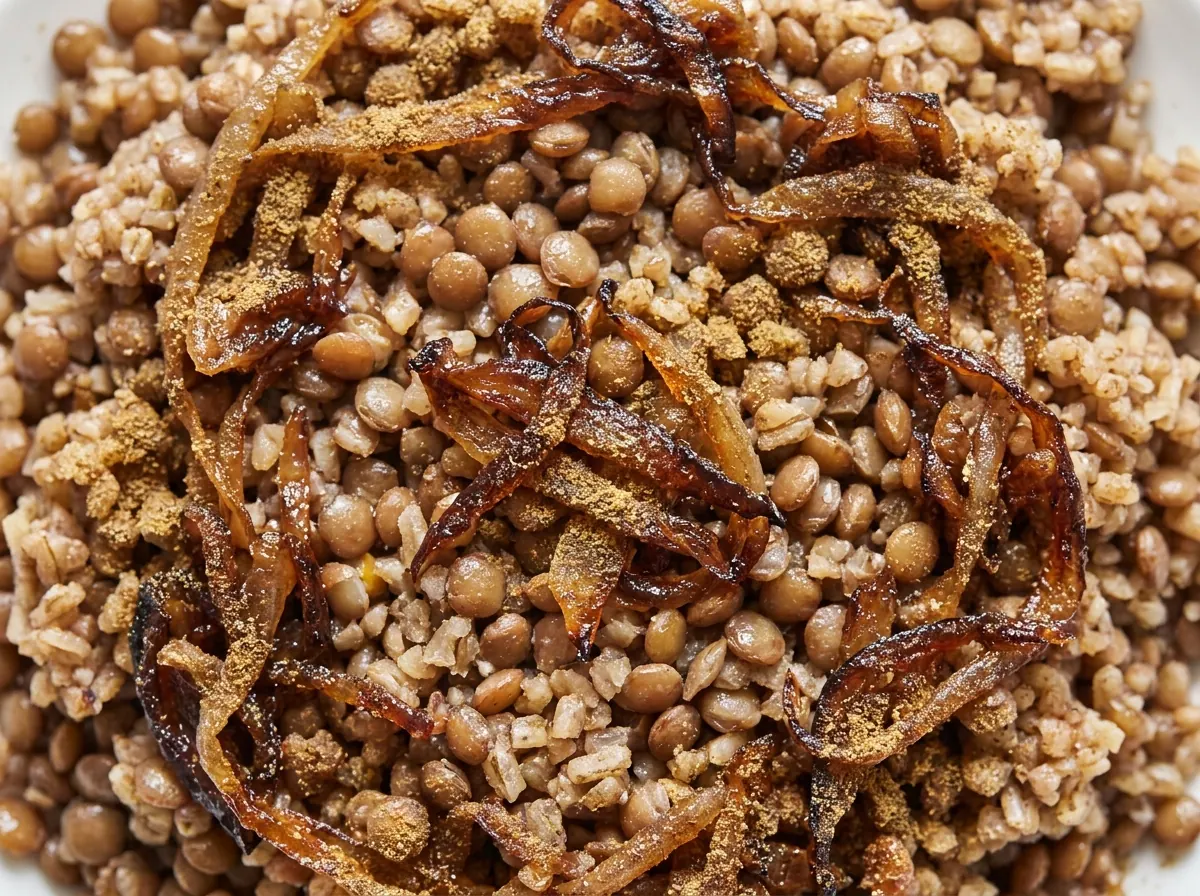
Brown lentils and coarse bulgur wheat with deeply caramelized onions — a Levantine classic rooted in centuries of tradition. GI 35, rich in plant protein, fiber, and iron.
Mujaddara is one of the most ancient dishes of the Levantine kitchen, documented in medieval Arabic cookbooks and deeply rooted in the tables of Lebanon, Syria, Palestine, and Jordan for centuries. Its name is derived from the Arabic word for smallpox, likening the caramelized onion pieces scattered over the lentils.
This red version pairs brown lentils with coarse bulgur, while other versions substitute rice. What makes it nutritionally distinctive is that the pairing of lentils (legume) with bulgur (wheat) complements the amino acids, bringing the protein close to complete — the reason this dish was relied upon as a staple food in times of fasting and frugality through generations.
Preparation Steps
Cook the lentils
Rinse and drain the brown lentils, then place them in a pot with about four cups of water. Bring to a boil, then simmer over low heat for twenty minutes until tender but not falling apart.
Caramelize the onions
Finely chop the onions and caramelize them in olive oil over medium to low heat for fifteen to twenty minutes until deeply dark brown and almost jam-like. Reserve a portion for garnish.
Add the onions and spices
Add most of the caramelized onions with their oil to the lentil pot along with the cumin, black pepper, and salt.
Add the bulgur
Add the coarse bulgur without pre-soaking, adjusting the water so it covers the mixture by about two centimeters, and stir gently.
Simmer until done
Cover the pot and cook over low heat for ten minutes until the bulgur absorbs the water and is fully cooked.
Rest off the heat
Remove from heat and leave the pot covered for five to ten minutes to allow the steam to be absorbed and the bulgur grains to separate.
Serve
Fluff with a fork, then arrange in a serving dish and top with the reserved caramelized onions. Serve warm or at room temperature, traditionally with labneh (strained yogurt) or a green salad.
Blood Sugar Impact
The glycemic index (GI) measures how quickly a food raises blood sugar, while the glycemic load (GL) measures how much a full serving raises it. Together they give the complete picture.
Glycemic Index
GI
34Low
Low0–55Medium56–69High70+
A low value (≤55) means a gradual rise in blood sugar — the most suitable range for diabetes and insulin resistance.
Glycemic Load
GL
19Medium
Low0–10Medium11–19High20+
Glycemic load reflects the impact of the full serving. To lower it: take half a serving, or pair the recipe with a source of protein and fiber.
Nutritional Information
Per ServingMakes 5 servings · one serving is about 390 g of raw ingredients
Calories488 kcal24%of Daily Value*
Protein20 g40%of Daily Value*
Carbohydrates70 g25%of Daily Value*
Fat15 g19%of Daily Value*
Fiber15 g54%of Daily Value*
Sodium712 mg31%of Daily Value*
Potassium688 mg15%of Daily Value*
Phosphorus299 mg24%of Daily Value*
* Percent Daily Values are based on a 2,000-calorie diet per FDA food-label reference values — your daily needs may be higher or lower. Values are derived from the recipe's ingredients via the USDA database.
Troubleshooting
The most common problems when preparing Mujaddara with Lentils and Bulgur, and how to fix them:
The lentils fell apart and became mashed
The lentils were overcooked or cooked over high heat. Brown lentils hold their shape when simmered gently for twenty minutes only, until they yield between the fingers — not more. If they start breaking down early, lower the heat and stop cooking as soon as they are tender. Brown or green whole lentils work better than red lentils, which naturally turn mushy.
The bulgur remained hard
Not enough water to cover the mixture, or the pot was removed too early. Coarse bulgur needs water that covers it by two centimeters and ten minutes over low heat, then resting covered. If it stays firm, add a quarter cup of hot water and cover for five more minutes. Do not uncover the pot too often during cooking so the steam does not escape.
The mujaddara is dry and sticking to the bottom
The water ran out or the heat was too high and the bottom scorched. The rule: water covering the mixture by two centimeters after adding the bulgur, low heat with a tight lid. If it dries quickly, add a little hot water and gently scrape the bottom. Resting the pot covered off the heat redistributes moisture through the grain.
The onions are bitter rather than sweet and caramelized
The heat was too high and the edges burned before caramelizing. Proper caramelization is over medium to low heat with frequent stirring, fifteen to twenty minutes until they turn a deep dark brown without blackening. Black turns bitter. If part of the onions burned, remove them before mixing the rest into the lentils.
Flat flavor with no depth
The onions were not caramelized enough, or there is too little cumin. The deeply caramelized onions are the primary flavor source in red mujaddara — the darker the caramelization, the deeper the dish. Add a full teaspoon of cumin and a pinch of black pepper, and keep a portion of the onions for the garnish on top of the dish to give fresh flavor in every bite.
The mujaddara is too salty
All the salt was added before the bulgur absorbed the water, and it concentrated as the water evaporated. Add only half the salt first and adjust after tasting at the end. For an immediate fix, serve with labneh or plain yogurt — it balances the saltiness — or add a little unsalted cooked lentils if available.
Storage and Make-Ahead
Refrigerator (4°C)
Cooked mujaddara: three to four days in a sealed container. It firms up more after chilling, so add a little water when reheating. Caramelized onions stored separately: three days with their oil in a small container for garnishing when serving.
Freezer (-18°C)
Suitable for freezing for up to one month in a sealed container. Thaw overnight in the refrigerator, then reheat with a splash of water over low heat to restore the texture. The bulgur may soften slightly after thawing.
Advance prep
Cook the lentils: one day ahead, store drained in the refrigerator. Caramelize the onions: two days ahead, store with their oil in a container. Final cooking: add the bulgur and cook just before serving for the best texture.
Serving
Serve warm or at room temperature, with labneh, yogurt, or a green salad. Do not leave it out of the refrigerator for more than two hours per food safety guidelines.
Tested Ingredient Substitutions
Original Ingredient
Tested Substitute
Ratio
Flavor Difference
Coarse bulgur
Brown or white long-grain rice
same amount
The well-known rice version of mujaddara — softer texture and milder flavor.
Coarse bulgur
Cooked quinoa
same amount
Gluten-free [2], higher protein, neutral flavor.
Brown lentils
Whole green lentils
same amount
Also holds its shape well; slightly earthier flavor.
Cumin alone
Cumin with a pinch of cinnamon or baharat (Gulf spice blend)
add a quarter teaspoon
Deeper warmth in the Levantine style, without changing the dish's identity.
Olive oil for caramelizing
Neutral vegetable oil
same amount
Slightly faster caramelizing, less depth of flavor than olive oil.
How Much Does It Make? Scaling Guide
Number of servings
Brown lentils
Coarse bulgur
Onion
Water (approximate)
2 (small meal)
0.5 cup
1/3 cups
1 large
2 cups
5 (base)
1.5 cups
1 cup
3
4–5 cups
8 (large family)
2.5 cups
1.67 cups
5
7–8 cups
12 (entertaining)
4 cups
2.5 cups
7
10–12 cups
EEINA Nutrition Tip
A complementary combination: pairing lentils with bulgur is not merely tradition — it completes the amino acids so the protein approaches complete. To raise absorption of plant iron, serve the mujaddara with a salad containing lemon or tomatoes, as a source of vitamin C doubles the benefit from the lentils' iron.
Add This Recipe to Your Plan
The EEINA app saves your favorite recipes, calculates them from their real ingredients, and shows your daily numbers toward your goal. Try it free now.
What is the difference between mujaddara with bulgur and mujaddara with rice?
Both are authentic. The red Levantine version uses coarse bulgur with deeply caramelized dark onions, while other versions use rice. Bulgur gives a deeper wheaty flavor and more fiber.
Is it suitable for people with diabetes?
Yes — GI 35 is low and the high fiber slows sugar absorption. Monitor portion size and pair it with a green salad and protein to lower the glycemic load further.
Does the bulgur need to be soaked before cooking?
No. Coarse bulgur is cooked directly in the lentil water, absorbing the flavor. Pre-soaking would make it too soft in this recipe.
Is mujaddara a complete vegan meal?
Yes, fully vegan. And the pairing of lentils with bulgur brings the protein close to complete, making it a satisfying main meal without meat.
Sources: USDA · University of Sydney · Gulf GSO · Our methodology · Updated on