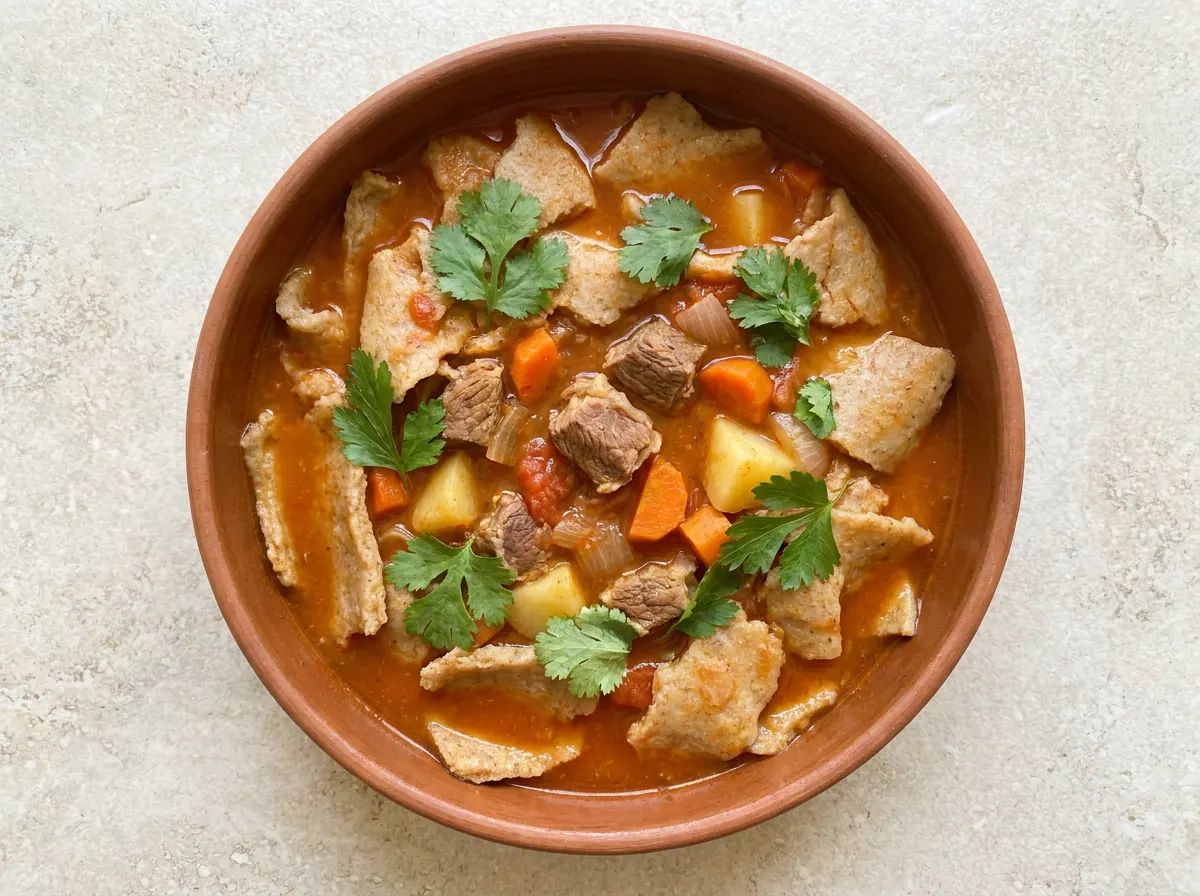
Najdi Matazeez (thick wheat dough in lamb broth) with Squash
Matazeez is a traditional Najdi dish of whole-wheat dough pieces cooked in lamb and vegetable broth — distinguished from Margoog by the thickness of its dough rounds and the presence of squash. GI 51.
Matazeez (thick wheat dough in lamb broth) is a venerable Najdi dish, celebrated in Najd, Riyadh, and especially the Qassim region, and served at family gatherings. At its heart are small rounds of whole-wheat dough (burr) shaped by hand and dropped into a rich lamb and vegetable broth.
What distinguishes Matazeez from Margoog (vegetable stew with flatbread) is the thickness and smaller size of its rounds, compared with the wide, paper-thin discs of Margoog. Matazeez typically includes squash and vegetables with lean lamb or veal, combining whole-grain carbohydrates, lean protein, and vegetable vitamins in a single dish.
Preparation Steps
Knead the dough
Knead the whole-wheat flour with a pinch of salt, a little oil, and water until a smooth, cohesive dough forms, then cover with a damp cloth and leave to rest for 20–30 minutes.
Brown the lamb
In a wide pot, heat the olive oil and brown the onion, then add the lamb and stir until coloured and its juices have evaporated.
Build the broth
Add the grated tomatoes, tomato paste, and the Najdi spices — cardamom, turmeric, black pepper, and loomi (dried black lime) — and the salt, then cover the lamb with water and simmer over a low flame until the meat is tender and the broth is rich.
Add the vegetables
Add the carrot, squash, and courgette to the broth and cook until they are tender without falling apart.
Shape the dough rounds
Divide the dough into egg-sized balls and flatten each one by hand into a relatively thick round disc — thicker than for Margoog (vegetable stew with flatbread).
Drop the Matazeez
Drop the rounds one by one into the simmering broth, stirring gently so they do not stick together.
Finish the simmer
Simmer the Matazeez (thick wheat dough in lamb broth) over a medium flame for 15–20 minutes until the rounds are cooked through, saturated with the broth's flavour, and the consistency has come together.
Serve
Serve hot in a wide bowl with the lamb and vegetables arranged over the dough rounds.
Blood Sugar Impact
The glycemic index (GI) measures how quickly a food raises blood sugar, while the glycemic load (GL) measures how much a full serving raises it. Together they give the complete picture.
Glycemic Index
GI
51Low
Low0–55Medium56–69High70+
A low value (≤55) means a gradual rise in blood sugar — the most suitable range for diabetes and insulin resistance.
Glycemic Load
GL
22High
Low0–10Medium11–19High20+
Glycemic load reflects the impact of the full serving. To lower it: take half a serving, or pair the recipe with a source of protein and fiber.
Nutritional Information
Per ServingMakes 6 servings · one serving is about 400 g of raw ingredients
Calories750 kcal38%of Daily Value*
Protein39 g78%of Daily Value*
Carbohydrates52 g19%of Daily Value*
Fat42 g54%of Daily Value*
Fiber9 g32%of Daily Value*
Sodium502 mg22%of Daily Value*
Potassium1039 mg22%of Daily Value*
Phosphorus536 mg43%of Daily Value*
* Percent Daily Values are based on a 2,000-calorie diet per FDA food-label reference values — your daily needs may be higher or lower. Values are derived from the recipe's ingredients via the USDA database.
Troubleshooting
The most common problems when preparing Najdi Matazeez (thick wheat dough in lamb broth) with Squash, and how to fix them:
The dough rounds stuck together in the pot
All rounds were dropped at once into gently simmering broth and stuck before their surfaces set. From experience: keep the broth at a steady, medium simmer and drop the rounds one by one with a gentle stir after every few. If they have already stuck: carefully separate them with the back of a spoon without breaking them.
The rounds stayed raw inside
Shaped too thick, or removed from the heat before fully cooked. Matazeez rounds are thicker than Margoog but they are not thick lumps — palm-sized and moderately thick. Simmer for 15–20 minutes over a medium flame and test one by cutting it in half to check it is cooked through.
The broth became very heavy and gluey
The starch from the dough rounds was released during prolonged simmering or too many rounds were used. Quick fix: add a little hot water and stir until the consistency returns to normal. For next time: keep the dough quantity proportional to the broth, and do not continue simmering once the rounds are cooked.
The squash dissolved and melted into the broth
The squash was added too early with the lamb and overcooked. Squash softens quickly, so add it in the vegetable stage after the lamb is tender — not before. If you want visible pieces: cut them larger and add them in the last ten minutes.
Bland flavour with no Najdi depth
Too little loomi and spices, or added too late. The Najdi spices — cardamom, turmeric, black pepper, and loomi (dried black lime) — should be added with the broth early so their flavour penetrates the lamb. Pierce or crack the loomi before adding so it releases its flavour into the broth.
The lamb stayed tough and did not tenderise
The pot was taken off the heat before the lamb was fully cooked. Lamb or veal needs long, gentle cooking until completely tender before the vegetables and dough are added. If time is short: use a pressure cooker to shorten the lamb cooking time, then continue in a regular pot for the vegetables and rounds.
Storage and Make-Ahead
Refrigerator (4°C)
Cooked Matazeez keeps for up to three days in a sealed container. The rounds absorb the broth and thicken further — reheat with a little hot water. Let the dish cool before storing, and do not leave it outside the fridge for more than two hours (USDA danger-zone rule) [1].
Freezer (-18°C)
The lamb broth alone freezes well for up to a month. The dough rounds tend to fall apart after thawing, so the best approach is to freeze the broth and lamb and cook fresh rounds at serving time.
Prep ahead
The dough can be kneaded an hour ahead and kept covered with a damp cloth in the fridge; bring to room temperature before shaping. The broth and lamb can be cooked in advance and brought back to a boil before dropping in the fresh rounds.
Reheating
Reheat over a low flame with a little hot water, as the rounds absorb the broth. Stir gently so they do not break apart. Make sure the dish reaches a full boil before serving.
Tested Ingredient Substitutions
Original Ingredient
Tested Substitute
Ratio
Flavor Difference
Lamb
Lean veal
Same quantity
Lighter flavour, less fat, a gentler broth
Yellow squash
Butternut squash or pumpkin
Same weight
Slightly more pronounced sweetness and a deeper colour
Whole-wheat flour alone
Blend of whole-wheat and a little white flour
Same total quantity
Softer, easier-to-shape dough; slightly less fibre
Courgette
Chopped green beans
Same quantity
Firmer texture, a more pronounced green flavour
Loomi (dried black lime)
Fresh lemon juice added at the end
Approximately 1 tablespoon
Brighter, cleaner acidity; loses the smoky depth distinctive to loomi
How Much Does It Make? Scaling Guide
Number of servings
Wheat flour
Lamb
Squash
Onion
3 (half recipe)
1.5 cups
500 g
1 cup
0.5
6 (base)
3 cups
1 kg
2 cups
1
9 (large family)
4.5 cups
1.5 kg
3 cups
1.5
12 (entertaining)
6 cups
2 kg
4 cups
2
EEINA Nutrition Tip
Vegetables and protein moderate the glycaemic load: the dough rounds are the main carbohydrate source in Matazeez and their glycaemic load is high, but the generous lamb, squash, and vegetables in the dish slow sugar absorption. For a better balance: reduce the portion of rounds slightly and increase the squash and vegetables in your bowl.
Add This Recipe to Your Plan
The EEINA app saves your favorite recipes, calculates them from their real ingredients, and shows your daily numbers toward your goal. Try it free now.
What is the difference between Matazeez and Margoog?
Matazeez rounds are smaller and thicker, shaped by hand; Margoog has very thin, wide discs. Matazeez also typically includes squash and vegetables with the lamb.
Is it suitable for diabetics?
The glycaemic index is medium (60) and the glycaemic load is high for a full serving. A person with diabetes can enjoy it with a smaller portion of rounds, more vegetables and protein, to slow the blood-sugar rise.
How long does it keep in the fridge?
Up to three days in a sealed container. The rounds thicken by absorbing the broth — reheat with a little hot water.
Can it be made without lamb?
Traditional Matazeez is cooked in lamb broth. It can be made with a rich vegetable stock, but this takes it outside the authentic character of the dish and reduces the protein.
Sources: USDA · University of Sydney · Gulf GSO · Our methodology · Updated on