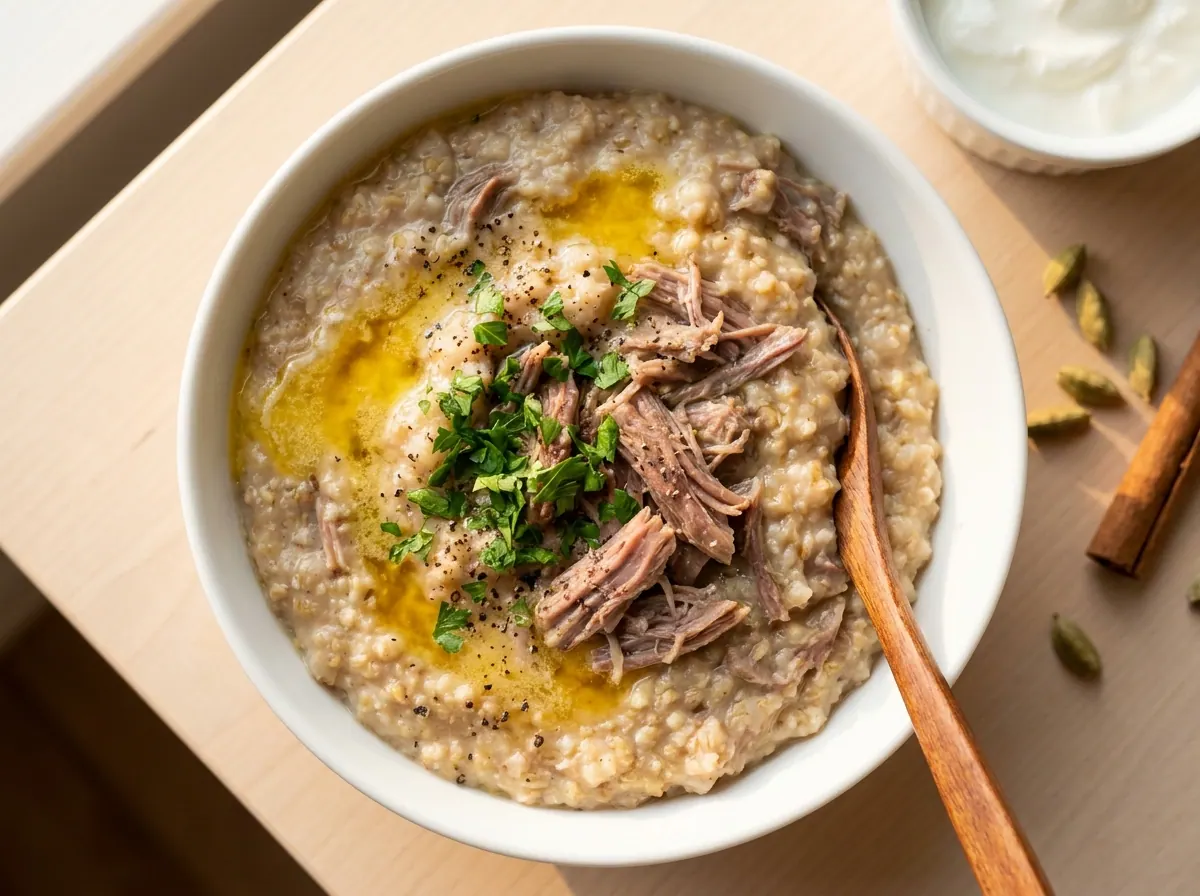
Jareesh (cracked-wheat porridge) is an authentic Najdi dish of cracked wheat and lean lamb. Rich in soluble fiber (β-glucan) — it lowers cholesterol and slows sugar absorption.
Jareesh is one of the oldest dishes in Najd — Saudis knew it long before rice arrived.
Made from cracked wheat (broken into 2–3 pieces), it retains all layers of the grain including the bran, which is rich in fiber. Its nutritional value is significant: 7 g of fiber per serving, a GI of 53 (low), and β-glucan that WHO studies show lowers LDL by 7%.
Preparation Steps
Soak the Jareesh
Soak the Jareesh in warm water for one hour until it softens and the cooking time is reduced.
Sauté the lamb
Melt the ghee in a pot. Finely chop the onion and garlic and sauté until golden, then add the ground lamb and stir until completely browned.
Add the Jareesh
Drain the Jareesh and add it to the lamb. Stir for two minutes with the Kabsa spice blend until everything is well coated with flavor.
Cook slowly
Add the broth and the loomi and bring to a boil, then lower the heat. Cover the pot and leave for twenty-five minutes, stirring occasionally to prevent sticking.
Serve
The texture becomes creamy and thick, like a savory rice pudding. Pour into a deep dish, garnish with parsley and serve warm.
Blood Sugar Impact
The glycemic index (GI) measures how quickly a food raises blood sugar, while the glycemic load (GL) measures how much a full serving raises it. Together they give the complete picture.
Glycemic Index
GI
37Low
Low0–55Medium56–69High70+
A low value (≤55) means a gradual rise in blood sugar — the most suitable range for diabetes and insulin resistance.
Glycemic Load
GL
13Medium
Low0–10Medium11–19High20+
Glycemic load reflects the impact of the full serving. To lower it: take half a serving, or pair the recipe with a source of protein and fiber.
Nutritional Information
Per ServingMakes 4 servings · one serving is about 335 g of raw ingredients
Calories503 kcal25%of Daily Value*
Protein22 g44%of Daily Value*
Carbohydrates40 g15%of Daily Value*
Fat28 g36%of Daily Value*
Fiber6 g21%of Daily Value*
Sodium305 mg13%of Daily Value*
Potassium588 mg13%of Daily Value*
Phosphorus394 mg32%of Daily Value*
* Percent Daily Values are based on a 2,000-calorie diet per FDA food-label reference values — your daily needs may be higher or lower. Values are derived from the recipe's ingredients via the USDA database.
Troubleshooting
The most common problems when preparing Jareesh (cracked-wheat porridge) with Light Lamb, and how to fix them:
Jareesh stayed grainy and didn't turn creamy
Insufficient cooking time, or the Jareesh was not soaked. Coarse cracked wheat needs a full hour of soaking in cold water before cooking, then long slow cooking (11/2 to 2 hours) with continuous stirring to become smooth and uniform.
The lamb is tough and not cooked enough
It hasn't reached the safe temperature, or the cooking time was insufficient. According to USDA, fully cooked meat needs an internal temperature of at least 71°C [1]. Local lamb needs at least two hours over very low heat to become tender.
The Jareesh is dry and pulling away from the bottom
Too little water, or it was overcooked after the liquid evaporated. Good Jareesh is creamy in texture but not doughy. Add hot water a spoonful at a time until you reach the desired consistency. Well-made Jareesh holds the impression of a spoon for a few seconds before leveling.
The flavor is flat with no Najdi character
Local ghee is missing, or Najdi bzar spice blend was not added. Authentic Jareesh needs a drizzle of local ghee at the end, a pinch of Najdi bzar (a traditional Saudi spice mix containing cumin, pepper and cinnamon) and ground cardamom. This combination is the signature of the Najdi kitchen.
The Jareesh is heavy and makes you drowsy
The portion is too large for the body's needs. Jareesh is rich in starch and protein, and one cup is enough for the average adult. Serve it with a full salad and a glass of ayran for digestion. The traditional wisdom: Jareesh is a lunch dish, not a dinner — your digestive system needs time to process it.
The top crust burned before it formed
The final oven browning used too high a heat. The golden crust on Jareesh comes from a light browning in a moderate oven (180°C) for only 10–15 minutes after drizzling extra ghee. If it burns: remove the tray immediately and place a clean plate on top — the burnt layer will come off.
Storage and Make-Ahead
Refrigerator (4°C)
Complete Jareesh: three days in an airtight container after cooling to room temperature. Jareesh without the lamb: four days — add fresh lamb when reheating.
Freezer (-18°C)
Jareesh: two months in a freezer container, leaving 1 cm of space for expansion. Thaw overnight in the refrigerator. Individual portions: in small containers for daily single servings.
Meal prep
Soaking the Jareesh: one hour before cooking. Lamb marinade: the night before in the refrigerator. Final cooking: Jareesh is a hot dish — serve on the day with a drizzle of local ghee.
Reheating
Over gentle heat with a quarter cup of hot water, stirring continuously. Do not leave out for more than two hours after reheating [2].
Tested Ingredient Substitutions
Original Ingredient
Tested Substitute
Ratio
Flavor Difference
Coarse cracked wheat (Jareesh)
Finely crushed wheat (Hareesh)
Same amount
Smoother texture, almost like Hareesh (wheat and meat porridge), similar flavor
Local lamb
Whole chicken
Same weight
Lower in fat, cooks faster, less of a Bedouin flavor
Local ghee
Extra-virgin olive oil
Same amount
Monounsaturated fats instead of saturated, lighter flavor
Najdi bzar spice blend
Cumin, black pepper and cinnamon (your own blend)
Same total amount
Similar taste, made at home, avoids ready-made blends high in sodium
Dried loomi (dried black lime)
Fresh lemon juice
1 loomi → 1 tbsp juice
Brighter, fresher flavor — you lose the classic dark notes
How Much Does It Make? Scaling Guide
Number of servings
Jareesh
Lamb
Water
Cooking time
2 (individual × 2)
1 cup
300 g
4 cups
1.5 hours
4 (base)
2 cups
500 g
8 cups
2 hours
8 (large family)
4 cups
1 kg
16 cups
2.5 hours
12 (entertaining)
6 cups
1.5 kg
24 cups
3 hours in a large pot
EEINA Nutrition Tip
For people with diabetes: Jareesh is an excellent choice — GI 37, high fiber and complete protein. It is preferred over white rice. One cup serving = 42 g of carbs, factor it into your daily total.
Add This Recipe to Your Plan
The EEINA app saves your favorite recipes, calculates them from their real ingredients, and shows your daily numbers toward your goal. Try it free now.