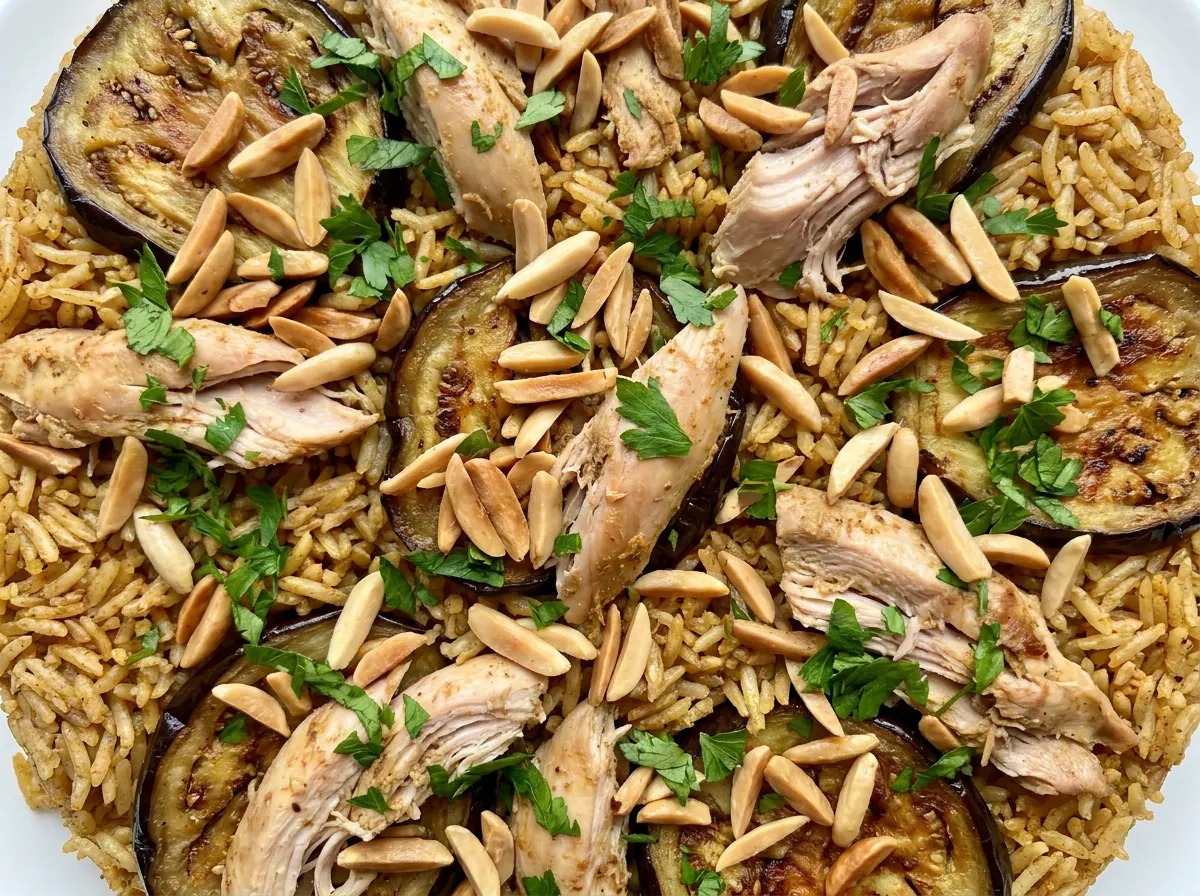
Authentic eggplant and chicken maqluba, the Levantine-Palestinian upside-down rice dish layered with roasted eggplant and bone-in chicken. GI 64 and glycemic load 53.
Maqluba is a venerable Levantine-Palestinian dish, and its name describes the way it is served: the vessel is flipped upside down onto a wide plate so the layers of golden eggplant appear over the seasoned rice, with the chicken beneath. It is the dish of Friday feasts and occasions across the Levant, and is mentioned in Palestinian heritage sources as one of the most famous Levantine rice dishes.
Maqluba is a dish dominated by rice, so it is naturally rich in starches. But its layered structure allows it to be balanced: the bone-in chicken adds protein that slows the glycemic response a little, roasting the eggplant instead of frying it cuts the fat, and serving it with yogurt or an Arabic salad completes the balance without compromising its authenticity.
Preparation Steps
Season the chicken and cook it
Season the bone-in chicken pieces (thighs or drumsticks) with the mixed spices, cinnamon, turmeric, salt, and black pepper, and rub them well so the flavor penetrates. Then boil them in water that covers them, or brown them in the pot with a little of the allotted vegetable oil (four to five tablespoons) until partly cooked and colored, and keep the resulting broth, for it is what moistens the rice later.
Soak the rice and drain it
Soak the long-grain basmati rice in cold water for twenty to thirty minutes, then drain it well from the soaking water. Soaking softens the grain and helps it come out fluffy and separate rather than clumped.
Roast the eggplant
Slice the two eggplants and arrange them on a tray, then roast them in the oven or air fryer, or fry them in oil, until they wilt and take on a golden color. Roasting with a little oil cuts the fat considerably compared with deep frying and gives the same texture in the layers.
Arrange the layers in the pot
Line the bottom of a wide pot: a layer of onion slices first, then the chicken pieces over them, then line the bottom and sides of the pot with the roasted eggplant slices. This arrangement makes the golden face that appears after flipping.
Distribute the rice and press it
Distribute the drained rice evenly over the eggplant and chicken layers, and press it gently with the back of the spoon so the surface levels and the layers hold together.
Season the broth and pour it
Add the rest of the mixed spices, cinnamon, cardamom, and salt to the hot broth, then pour it gently down the edge of the pot until it covers the rice by about a finger's width. Pouring down the edge rather than directly over the rice preserves the arrangement of the layers.
Cook over low heat
Cover the pot and cook over low heat for forty to sixty minutes until the rice is cooked and absorbs all the broth. Do not stir the rice while cooking so the grains do not break and release their starch.
Rest the pot and flip it
Turn off the heat and leave the maqluba to rest, covered, for twenty to thirty minutes before flipping, for the rest sets its shape and prevents the layers from breaking. Then place a wide plate over the pot and flip the two together in one firm motion, and garnish the face with toasted almonds or pine nuts. Serve it with plain yogurt or an Arabic salad to balance the starches.
Blood Sugar Impact
The glycemic index (GI) measures how quickly a food raises blood sugar, while the glycemic load (GL) measures how much a full serving raises it. Together they give the complete picture.
Glycemic Index
GI
64Medium
Low0–55Medium56–69High70+
A low value (≤55) means a gradual rise in blood sugar — the most suitable range for diabetes and insulin resistance.
Glycemic Load
GL
53High
Low0–10Medium11–19High20+
Glycemic load reflects the impact of the full serving. To lower it: take half a serving, or pair the recipe with a source of protein and fiber.
Nutritional Information
Per ServingMakes 6 servings · one serving is about 580 g of raw ingredients
Calories788 kcal39%of Daily Value*
Protein45 g90%of Daily Value*
Carbohydrates88 g32%of Daily Value*
Fat27 g35%of Daily Value*
Fiber5 g18%of Daily Value*
Sodium838 mg36%of Daily Value*
Potassium819 mg17%of Daily Value*
Phosphorus399 mg32%of Daily Value*
* Percent Daily Values are based on a 2,000-calorie diet per FDA food-label reference values — your daily needs may be higher or lower. Values are derived from the recipe's ingredients via the USDA database.
Troubleshooting
The most common problems when preparing Eggplant and Chicken Maqluba, and how to fix them:
The maqluba broke apart when flipped and its layers did not hold
You flipped the pot too early, before it rested. Hot rice is loose and needs twenty to thirty minutes of rest after turning off the heat so it sets and holds its shape. Leave the pot covered on a cool surface, then place the serving plate over it and flip the two together in one firm motion. Do not remove the pot immediately; leave it a minute so its contents drop out gently.
The rice cooked on top but stayed hard at the bottom
The heat was too high so the broth evaporated before reaching the bottom, or the amount of broth was too little. The rule from experience: the broth covers the rice by about a finger's width, and cook over very low heat after the first boil. If you notice the surface drying and the bottom raw: add half a cup of hot broth down the edge, cover, and extend the cooking by ten minutes.
The eggplant turned greasy and heavy
It was fried in abundant oil so the spongy flesh absorbed it. Eggplant drinks oil greedily when deep fried. The lighter and cleaner solution: the eggplant slices are brushed with a little oil and roasted in the oven or air fryer until they wilt and take on a golden color. This cuts the fat considerably and gives the same texture in the layers.
The dish is too salty
The ready-made broth was salty to begin with and then you added salt on top of it. Packaged broth cubes are high in sodium. If you use them, do not add salt until after tasting, or make a homemade broth from boiling the chicken to control the salt. To fix a salty batch: serve it with plain yogurt and an unsalted salad, for they balance the saltiness in the mouth.
The rice is clumped and sticky, not fluffy
The rice was not soaked or not drained well, or it was stirred while cooking. Basmati is soaked twenty to thirty minutes then drained completely before arranging, and it is never stirred after the broth is poured so the grains do not break and release their starch. Leave it to cook still under the lid.
The chicken is dry and tough
The chicken was cooked too long, twice: once in boiling and once with the rice. Boil the chicken only until partly cooked (not until it falls apart), for it finishes cooking with the rice in the pot. Choosing bone-in pieces (thighs or drumsticks) retains moisture better than boneless chicken breast.
Storage and Make-Ahead
Refrigerator (4°)
Cooked maqluba: three to four days in an airtight container, per the general USDA recommendation for leftovers of cooked dishes containing meat and poultry [1]. Quick cooling: do not leave it out of the fridge more than two hours after cooking (danger zone rule).
Freezer (-18°)
It tolerates freezing for up to a month in an airtight container, but the texture of the rice and eggplant softens after thawing. It is best to freeze the chicken and rice separately if possible.
Make ahead
Boiled seasoned chicken: prepared a day ahead and kept chilled with its broth. Roasted eggplant: roasted a day ahead and kept in a container in the fridge. The arranging and final cooking: the day of serving for the best texture.
Reheating
Heat the portion over low heat with a splash of water or broth to return moisture to the rice, or in the microwave covered. Heat until fully hot at the core (74°C for poultry) [2].
Tested Ingredient Substitutions
Original Ingredient
Tested Substitute
Ratio
Flavor Difference
Eggplant
Roasted cauliflower (florets)
Same weight
A documented Palestinian version of maqluba [3], lighter in flavor and lower in carbohydrates
Bone-in chicken
Skinless chicken thighs
Same weight
Less fat while retaining moisture, lowers the calories slightly
White basmati rice
Brown basmati rice
Same amount with a little more broth
Higher fiber and lower glycemic load, needs a longer cooking time
Deep frying the eggplant
Roasting in the oven or air fryer
A light brushing of oil
Clearly less fat with a similar golden color
Pine nuts for garnish
Toasted slivered almonds
Same amount
More economical, similar crunch, both tree nuts
How Much Does It Make? Scaling Guide
Number of servings
Bone-in chicken
Basmati rice
Eggplant
Broth
3 (half recipe)
500 g
1.5 cups
1 large
2.5 cups
6 (base)
1 kg
3 cups
2
5 cups
9 (medium gathering)
1.5 kg
4.5 cups
3
7.5 cups
12 (banquet)
2 kg
6 cups
4
10 cups
EEINA Nutrition Tip
Maqluba is a starchy dish, so balancing it is on the plate, not in eliminating it: make your portion half rice and half eggplant and chicken instead of letting the rice dominate, and always serve it with plain yogurt and a green salad. This pairing with protein and fiber slows the glycemic response without giving up the authenticity of the dish.
Add This Recipe to Your Plan
The EEINA app saves your favorite recipes, calculates them from their real ingredients, and shows your daily numbers toward your goal. Try it free now.
Because the pot is flipped upside down onto the serving plate, so the layers of eggplant and chicken appear above the rice after having been at the bottom during cooking.
Is maqluba suitable for diabetics?
It is a starchy dish with a high glycemic load (31), so it should not be a daily food for a diabetic. If you want it: reduce the rice portion, increase the eggplant and chicken, and pair it with yogurt and salad. Cooling the rice before reheating lowers the index slightly through resistant starch.
How do I keep the maqluba from sticking to the bottom?
Line a layer of onion then eggplant slices at the bottom of the pot before the rice, for they form a cushion that prevents sticking and gives a beautiful golden face when flipped.
Can it be made with cauliflower instead of eggplant?
Yes, cauliflower maqluba is a documented and common Palestinian version, and gives a lighter dish with fewer carbohydrates. The cauliflower florets are roasted or browned exactly like the eggplant.