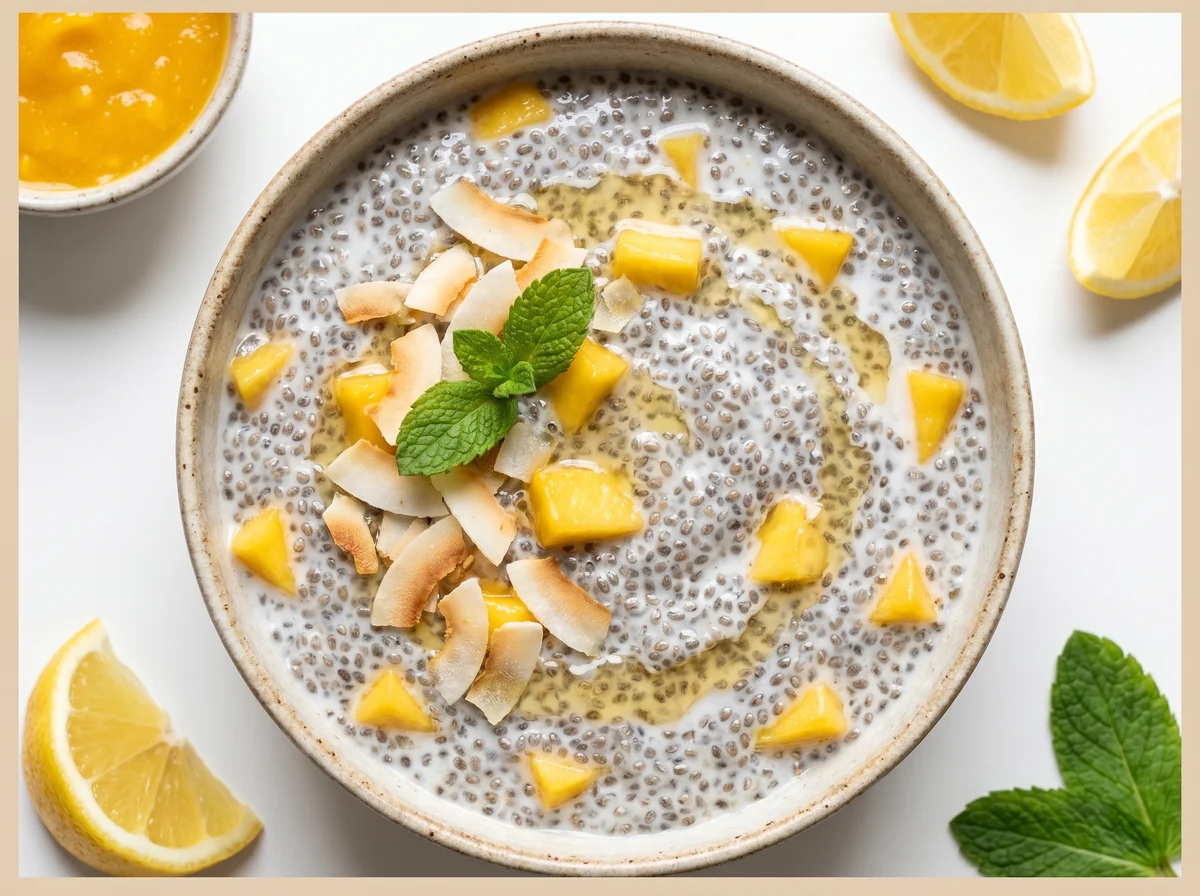
Mango Coconut Chia Pudding — a tropical, no-cook snack of chia seeds soaked overnight in coconut milk, layered with fresh mango puree for a creamy, fiber-rich treat. Contains coconut.
On hot mornings the soul craves something cool and refreshing that combines the sweetness of fruit with a light texture. Mango Coconut Chia Pudding is born of this craving — small, flavorless seeds transform into a creamy texture that cradles golden mango puree in tropical layers.
It differs from classic vanilla chia pudding in both flavor and liquid: here coconut milk replaces ordinary milk and mango leads the flavor instead of quiet vanilla. Prepare it in the evening and leave it to work on its own overnight, waking to a ready snack that asks nothing more of you than a spoon.
Preparation Steps
Make the pudding base
Whisk the chia seeds with the coconut milk, water, vanilla extract, and a pinch of salt in a bowl until the seeds are evenly distributed with no clumping — even distribution ensures a uniform set and prevents the seeds from collecting at the bottom.
Rest and stir again
Leave the mixture for ten minutes, then stir it vigorously a second time to break up any clumps that have begun to form — this second stir is the secret to a creamy, even set with no gel pockets.
Chill to set
Cover the bowl and refrigerate for at least four hours or overnight until the texture is thick and holds on a spoon — this time is necessary for the seeds to fully absorb the liquid and swell.
Blend the mango
Blend the ripe mango slices with the honey until a smooth, uniform puree forms — choosing a soft, ripe fruit gives natural sweetness that means no extra added sugar is needed.
Layer
Spoon a layer of chia pudding into the bottom of two glasses, then a layer of mango puree, then another layer of chia — wiping the rim of the glass for a neat appearance. Alternating the layers highlights the visual contrast and distributes the flavor in every spoonful.
Garnish and serve
Top with fresh mango cubes, toasted coconut flakes, and a mint leaf, and serve the pudding cold immediately — adding the garnish at serving time keeps the coconut crunchy rather than softening in the moisture.
Blood Sugar Impact
The glycemic index (GI) measures how quickly a food raises blood sugar, while the glycemic load (GL) measures how much a full serving raises it. Together they give the complete picture.
Glycemic Index
GI
42Low
Low0–55Medium56–69High70+
A low value (≤55) means a gradual rise in blood sugar — the most suitable range for diabetes and insulin resistance.
Glycemic Load
GL
10Low
Low0–10Medium11–19High20+
Glycemic load reflects the impact of the full serving. To lower it: take half a serving, or pair the recipe with a source of protein and fiber.
Nutritional Information
Per ServingMakes 2 servings · one serving is about 285 g of raw ingredients
Calories415 kcal21%of Daily Value*
Protein7 g14%of Daily Value*
Carbohydrates33 g12%of Daily Value*
Fat30 g38%of Daily Value*
Fiber10 g36%of Daily Value*
Sodium330 mg14%of Daily Value*
* Percent Daily Values are based on a 2,000-calorie diet per FDA food-label reference values — your daily needs may be higher or lower. Values are derived from the recipe's ingredients via the USDA database.
Troubleshooting
The most common problems when preparing Mango Coconut Chia Pudding, and how to fix them:
The pudding stayed liquid and did not set
The ratio of seeds to liquid is unbalanced or the time was too short. Add an extra tablespoon of chia, stir well, and return to the refrigerator for another hour until the texture firms up.
The seeds clumped into gel pockets
The second stir was skipped. Next time, stir vigorously ten minutes after the first mixing. To rescue the current batch, break up the clumps with a fork and return to the refrigerator.
The coconut milk layer separated oily
Canned coconut milk solidifies its fat when cold. Whisk it well before adding and melt any solid part by warming it briefly to room temperature.
Bland, not sweet enough
The mango was not ripe enough. Add a little honey to the mango puree, or choose a riper, more fragrant fruit next time.
A layer of water appeared on top of the pudding
This is natural water that sometimes separates. Stir it gently to reincorporate, and add slightly less water in the next batch.
Storage and Make-Ahead
Refrigerator
Store in an airtight container for up to three days. Add the fresh garnish at serving time only, not before.
Advance preparation
Prepare the chia base and the mango puree separately and assemble the layers at serving time for a neater presentation.
Freezer
The chia base can be frozen for up to two weeks, but the texture becomes slightly less smooth after thawing — stir well.
Food safety note
Do not leave it out of the refrigerator for more than two hours as it contains liquid that can spoil — follow the two-hour rule.
Tested Ingredient Substitutions
Original Ingredient
Tested Substitute
Ratio
Flavor Difference
Canned coconut milk
Unsweetened almond milk or oat milk
1:1
Reduces saturated fats and calories but makes the pudding slightly less creamy.
Mango
Fresh strawberry or peach puree
1:1
Changes the flavor and reduces the natural sweetness somewhat depending on the ripeness of the fruit.
Honey
Mashed date or omit entirely
To taste
With a ripe mango the sweetener can be omitted entirely, lowering the glycemic load.
Coconut flakes
Pumpkin seeds or pomegranate arils
As desired
An alternative for those avoiding coconut — adds a different crunch or freshness.
Chia seeds
Basil seeds (tukhm malanga)
1:1
They set faster and have a lighter texture with a similar neutral flavor.
How Much Does It Make? Scaling Guide
Ingredient
2 servings
4 servings
6 servings
Chia seeds (g)
40
80
120
Coconut milk (ml)
240
480
720
Mango puree (g)
150
300
450
Honey (ml)
10
20
30
EEINA Nutrition Tip
Choose a ripe mango that gives gently under a finger — it alone is enough to sweeten the dish and allows you to reduce or omit the honey entirely, lowering the glycemic load and keeping the sweetness completely natural.
Add This Recipe to Your Plan
The EEINA app saves your favorite recipes, calculates them from their real ingredients, and shows your daily numbers toward your goal. Try it free now.
Is this pudding suitable for people with diabetes?
It is not recommended as a regular option for people with diabetes, as the mango and sweetener raise the glycemic load. Anyone wishing to try it should omit the sweetener, reduce the mango, and consult their dietitian first.
How long does the pudding need to set?
A minimum of four hours in the refrigerator — overnight is ideal for the seeds to fully absorb the liquid and achieve a thick, spoon-holding texture.
Can I make it fully vegan?
Yes — replace the honey with maple syrup or mashed date, and all the other ingredients are already plant-based, making the dish fully vegan.
Why canned coconut milk and not coconut drink?
The canned variety is thicker and richer in fat, giving a creamy texture. The light drink produces a watery pudding. If using it, add a little more chia to compensate.
Can it be served to children?
Yes — it is a gentle snack, but serve in moderation as it contains natural sugar. It is best to omit the honey for children under one year of age.