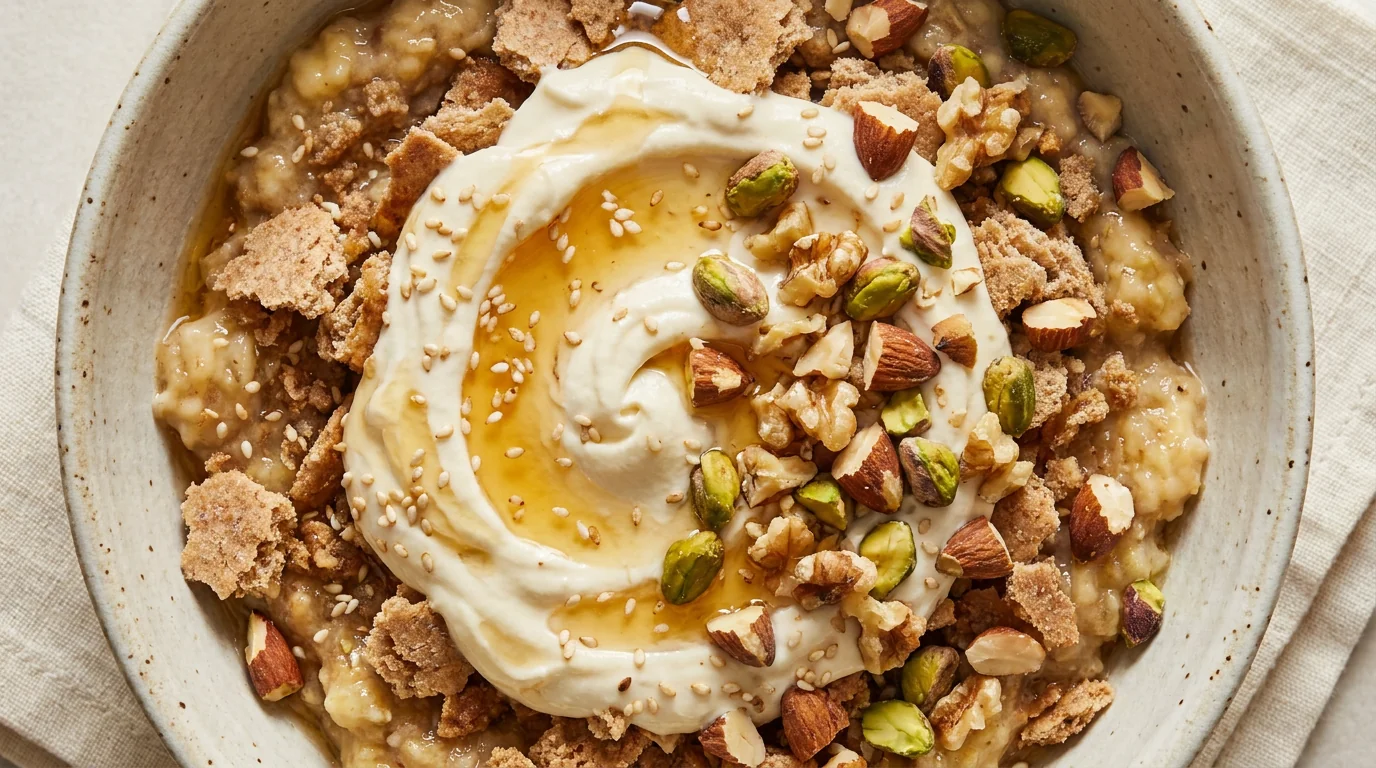
Maasoub is a morning staple, evoking the scent of grandma's house on a Friday morning. The classic version contains 720 calories, while this recipe preserves the same memory with 380 calories, changing only the quantity, not the taste.
Sources: USDA · SFDA · Sydney University · our methodology, Updated
As Made in Restaurants
The typical Hejazi method in breakfast restaurants: 4 loaves of white samoli bread, crumbled, 4 mashed ripe bananas, 3 tbsp ghee or vegetable shortening, 6 tbsp generous honey, and full-fat cream (30% fat) on top (1/2 cup for the whole recipe, i.e., 2 tbsp per bowl), and plenty of nuts. Served in a wide ceramic bowl with a cup of Arabic coffee.
Calories and GI rise for three reasons: white bread (refined flour, GI 75), generous ghee, and abundant honey. Very ripe bananas with high honey content cause a very rapid sugar spike, a particular issue for those with insulin resistance or type 2 diabetes.
720Calories/Serving
35gTotal Fat
75GI
42GL
65gSugar
As Made by EEINA
The same authentic Hejazi ingredients, with reduced quantities, not invented additions:
Whole wheat Arabic bread instead of white samoli. The only ingredient substitution. GI drops from 75 to 54, and fiber increases from 2g to 7g per 100g of bread. The texture remains cohesive, and the flavor is slightly deeper.
Reduced cream, 1/4 cup instead of 1/2 cup. Cream remains in the dish (as it's the soul of Maasoub) but at half the quantity, with a side of Greek yogurt for those who prefer higher protein without a full replacement.
Reduced ghee, 1 tbsp instead of 3 tbsp. Authentic ghee (not hydrogenated vegetable oil) remains for flavor but at one-third the quantity; one tablespoon is enough to spread the aroma without heaviness.
Reduced Sidr honey, 2 tbsp instead of 6 tbsp. Honey is essential for the authentic flavor but is concentrated sugar. Two tablespoons for the entire recipe, not per serving, and ripe bananas complete the natural sweetness.
380Calories/Serving
14gTotal Fat
52GI
22.4GL
22gSugar
↓ 340 Calories↓ 21g Fat↓ 23 GI Points↓ 43g Sugar
Preparing Maasoub
Prepare the Bread
If the bread is fresh, dry two loaves in the oven for 2 minutes at 160°C (95°F) without browning. It's best if the bread is from the previous day (this is the original method for Hejazi Maasoub; our grandmothers used leftover bread from dinner). Tear it by hand into small, almond-sized pieces.
2 minutes
Mash the Bananas
In a large bowl, peel the ripe bananas (medium ripeness, not completely yellow or full of brown spots). Mash with the back of a fork, not an electric mixer. The ideal texture is slightly coarse with small banana pieces, not a smooth puree.
2 minutes
Melt Ghee and Combine Bread
Melt 1 tbsp of ghee in a small pan over low heat without browning. Pour the melted ghee over the mashed bananas and stir. Add the bread pieces and stir gently with a large spoon until the bread absorbs the banana and ghee moisture, forming a cohesive mixture. The bread should retain some texture without becoming mushy.
3 minutes
Garnish with Cream and Honey
Divide the mixture among 4 small, deep bowls (traditional ceramic bowls if available). On each bowl: place 1 tbsp of fresh cream in the center, drizzle 1/2 tbsp of Sidr honey over it, add a handful of chopped nuts, and a sprinkle of toasted sesame seeds if desired. For the side: serve 2 tbsp of Greek yogurt for those who want extra protein.
3 minutes
Serve Immediately
Serve the Maasoub immediately after preparation, and do not let it sit for more than 10 minutes. The bread continues to absorb moisture, changing the texture to a thick puree. Eat with a large spoon, accompanied by a cup of Arabic coffee or mint tea.
2 minutes
Impact on Blood Sugar
The Glycemic Index (GI) measures how quickly blood sugar rises after eating, and the Glycemic Load (GL) measures the magnitude of that rise for a full serving. Both readings together provide an accurate picture.
Glycemic Index
GI
52Low
Low0–55Medium56–69High70+
A low GI (≤55) indicates a gradual rise in blood sugar, making it most suitable for individuals with diabetes or insulin resistance.
Glycemic Load
GL
22.4High
Low0–10Medium11–19High20+
Although the GI is low, the serving size increases the Glycemic Load. To reduce it: halve the portion, or pair the recipe with a protein and fiber source.
Comparing Three Versions of Maasoub
Maasoub can cater to various dietary needs, but each audience requires adjustments. Here's a comparison of three versions; choose the one that suits you best.
Comparison of three Maasoub versions: Traditional, EEINA Balanced, and Low Sugar
Version
Calories
Sugar
GI
Protein
Best For
Traditional (Restaurant)
720
65g
75
8g
Rare occasions for those without sugar concerns
EEINA Balanced
380
22g
52
10g
Daily family breakfast, and traditional Friday Hejazi breakfast
Low Sugar
290
12g
41
10g
Diabetics, sugar reducers, and pre-workout
The low-sugar version uses only half a banana per serving instead of a whole one, omits honey entirely, relying on the banana's natural sweetness, and adds half a teaspoon of cinnamon (which helps regulate blood sugar according to studies).
Toppings & Garnishes Preparation
Maasoub starts simple, but its beauty lies in the garnish. Here are four additions that complete the dish, all prepared in advance and lasting for days in the refrigerator.
Toasted Nuts
Essential Garnish · Must-Have
Ingredients (for 8 servings)
1/2 cup peeled almonds
1/2 cup walnuts
1/2 cup pistachios
(Optional) 2 tbsp cashews
Preparation in 8 minutes
In a dry pan over medium heat, toast the almonds for 3 minutes, stirring constantly. Add the walnuts and pistachios and toast for another 2 minutes until fragrant, without burning. Let cool completely, then chop coarsely with a knife or in a bag with a rolling pin.
Small handful = 80 caloriesKeeps for 2 weeks in an airtight container
Lightened Cream (Alternative)
For Traditional Recipe · Optional
Ingredients (for 4 servings)
1/2 cup full-fat Greek yogurt
2 tbsp fresh cream (optional)
A drop of natural rose water
Preparation in 2 minutes
If you want a taste closer to traditional cream without all the calories, mix Greek yogurt with 2 tbsp of cream and a drop of rose water. The result is a richer texture with 40% fewer calories than pure cream. Do not use artificial sweeteners.
2 tbsp = 70 caloriesAlways prepare fresh
Light Sesame Brittle
Optional crunchy addition from Hejazi tradition
Ingredients (for 8 servings)
1/4 cup white sesame seeds
1 tsp Sidr honey
Preparation in 4 minutes
A miniature version of Hejazi sesame brittle. In a dry pan, toast the sesame seeds over low heat for 2-3 minutes stirring constantly until golden. Turn off the heat, add honey, and stir for 30 seconds until the seeds are coated. Transfer to parchment paper to cool and form crunchy pieces. Crumble over the Maasoub.
1 tbsp = 45 caloriesKeeps for 1 week in a glass container
Arabic Coffee (for Serving)
Traditional Accompaniment · Essential
Ingredients (for 4 cups)
4 tsp light-roast Arabic coffee
3 cardamom pods, crushed
A pinch of cloves (optional)
4 cups water
Preparation in 15 minutes
In a dallah (coffee pot), boil the water and add the coffee. Let it simmer for 10 minutes over low heat. Add cardamom and cloves, then simmer for another 5 minutes. Strain into a serving dallah. Maasoub is incomplete without a cup of Arabic coffee on the side; this is the classic Hejazi pairing.
1 cup = 5 caloriesDo not store · Drink immediately
Full Nutritional Values
EEINA Serving (220g: Maasoub, 1 tbsp cream, nuts, 1/2 tbsp honey, and side of Greek yogurt)Based on USDA, University of Sydney, and Saudi Food Composition Table (SFCT)
EEINA's Maasoub is a balanced, hearty breakfast: complex carbohydrates from whole wheat bread, moderate protein from the side of Greek yogurt and nuts, healthy fats from nuts, and fiber from the whole wheat bread. Important: Choose medium-ripe bananas (yellow with light brown spots), not overly ripe ones, as this reduces sugar by about 30%. The balanced version is safe for diabetics with reduced honey to half a teaspoon. Recommended portion: one bowl as breakfast, once or twice a week.
If You Encounter a Problem
The top 6 issues encountered when making Maasoub for the first time, and their simple solutions:
The mixture is too sticky and won't hold its shape
The bread was too fresh and absorbed moisture too quickly. Add 2 tbsp of chopped toasted nuts to absorb the excess, and wait a minute before garnishing.
The Maasoub turned into a smooth puree, not chunky
You mashed the bananas in a food processor instead of using a fork. For the next batch: use only the back of a fork and leave small pieces. To salvage this batch: add extra crumbled bread pieces.
The taste isn't like grandma's
This is often due to the type of ghee used. Authentic ghee (not hydrogenated vegetable oil) provides a different depth of flavor. If you're using commercial ghee, try adding 1 tsp of natural butter with it to approximate the taste.
The bananas are too ripe and the sweetness is too intense
Very ripe bananas with many brown spots contain double the sugar. For the next batch: choose bananas that are yellow with light brown spots (medium ripeness). To salvage this batch: reduce the honey to just 1 tbsp for the entire recipe.
The cream separated (water and cream split)
You added it to a hot mixture. Fresh cream separates with heat. Let the mixture cool for 3-4 minutes before adding the cream, or add it only at the moment of serving.
Maasoub loses its texture if I wait before serving
This is normal, as the bread continues to absorb moisture. The Hejazi rule: do not prepare Maasoub more than 10 minutes before serving. If you want to prepare ahead, mix the bananas and ghee first, set the bread aside, and add it just minutes before serving.
Storage & Advance Preparation
Refrigerator (4°C / 40°F)
Banana and bread mixture: Do not store, as the texture changes quickly. Prepare and consume immediately.
Cream and yogurt sauce: 4 days in an airtight container.
Freezer (-18°C / 0°F)
Not suitable for freezing, as bananas become watery after thawing, and the bread loses its texture. This recipe is best enjoyed fresh.
Advance Preparation
Toasted nuts: 2 weeks in an airtight container.
Light sesame brittle: 1 week in a glass container.
Crumbled bread: 3 days in a sealed bag at room temperature.
Reheating
Maasoub is not reheated, as bananas oxidize and their flavor changes. The best method: prepare half the quantity now, and prepare the nuts and sesame for the next batch.
Tested Ingredient Substitutions
Original Ingredient
Tested Substitute
Ratio
Taste Difference
Fresh Arabic Cream
Thick labneh diluted with milk
Same quantity
Slightly lighter, less creamy
Sidr Honey
Saudi date molasses
Same quantity
Deeper flavor, slightly lower GI
Ghee
Full-fat natural butter
Same quantity
Less depth, slightly sweeter
Whole Wheat Arabic Bread
Day-old whole wheat toast bread
2 slices per loaf
Slightly different texture, same GI
Nuts (Almonds + Walnuts + Pistachios)
Raw nuts without pistachios
Same quantity
Less depth of flavor, toast in oven for 10 mins
Greek Yogurt
Regular yogurt strained for 2 hours in a cheesecloth
Same quantity
Almost identical result, more economical
How Much Does It Make? Scaling Guide
Maasoub is suitable for individual meals or large gatherings. The quantities here are adjusted for each number, and preparation time varies slightly with increased volume.
Servings
Bread
Bananas
Cream
Ghee
Honey
Time
2 (Individual x 2)
2 loaves
2 bananas
2 tbsp
1/2 tsp
1 tbsp
10 min
4 (Standard)
4 loaves
4 bananas
1/4 cup
1 tbsp
2 tbsp
12 min
8 (Large Family)
8 loaves
8 bananas
1/2 cup
2 tbsp
4 tbsp
15 min
12 (Guest Serving)
12 loaves
12 bananas
3/4 cup
3 tbsp
6 tbsp
20 min
For guests: prepare nuts a day in advance, dry the bread an hour before, and serve Maasoub in individual bowls rather than a large one (to maintain texture for each guest).
A Recipe from the Hejazi Kitchen
This balanced version of Maasoub is prepared daily in the homes of Mecca, Jeddah, and Taif, as learned by generations from their grandmothers. We've kept the authentic ingredients (bread, bananas, cream, ghee, honey, nuts) while reducing quantities for a balanced daily breakfast. No modern additions that don't belong to the original recipe have been included.
Recipe Reference
This recipe is based on the traditional Hejazi cuisine as prepared in the homes of Mecca, Jeddah, and Taif, and as served in authentic Hejazi breakfast restaurants. Nutritional data is calculated from USDA FoodData Central and the University of Sydney GI database.
Coming soon: standalone versions for audience-specific modifications: diabetic-friendly without honey, post-workout for athletes, for children, and for intermittent fasting.
Add This Recipe to Your Plan
EEINA saves your favorite recipes, suggests when to eat them (once a week for traditional Maasoub, daily for the low-sugar version), and builds your weekly plan with total sugar calculation.
What's the difference between Hejazi Maasoub and Yemeni Maasoub?
Hejazi Maasoub (from Mecca, Jeddah, Taif) is based on bread, bananas, honey, cream, and nuts; it's sweet and nutritious as a breakfast meal. Yemeni Maasoub, however, is entirely different. It's based on bread, fenugreek, ghee, and honey, resembling a dough with both salty and sweet notes, served in a large bowl and eaten with bread and spicy sauces. The name is the same, but they are distinct dishes.
Is it suitable for diabetics?
EEINA's balanced version (380 calories, GI 52, 22g sugar) is acceptable with caution for type 2 diabetics, one serving with reduced honey to half a teaspoon. The low-sugar version (380 calories, GI 52, 12g sugar) is safe as a daily breakfast. The traditional version (720 calories, GI 75) is not suitable for diabetics.
Why must the bread be day-old?
Fresh bread has high moisture content, so when mixed with bananas, it becomes a sticky paste. Day-old bread is relatively dry; it absorbs banana moisture gradually and maintains a cohesive texture. This is our grandmothers' method in the Hejaz; Maasoub was originally invented as a clever solution to use leftover bread instead of discarding it.
Can I use frozen bananas?
Not recommended, as thawed frozen bananas become watery and lose their texture. If fresh bananas are unavailable, leave them on the counter for a day to reach medium ripeness. Very ripe bananas (with many brown spots) can be used, but they increase sugar content, so adjust the quantity accordingly.
How long do pre-prepared ingredients last?
Toasted nuts last for 2 weeks in an airtight container in a dry place. Toasted sesame with honey lasts for 1 week in a glass container. The final mixture (bread and bananas) should not be stored and is prepared and consumed immediately.
Is Greek yogurt specifically required?
Greek yogurt is preferred because it's thicker and higher in protein (10g protein per 1/2 cup, double that of regular yogurt). It can be substituted with thick labneh diluted with milk, or regular yogurt strained for 2 hours. Do not use liquid regular yogurt, as it will make the Maasoub watery.