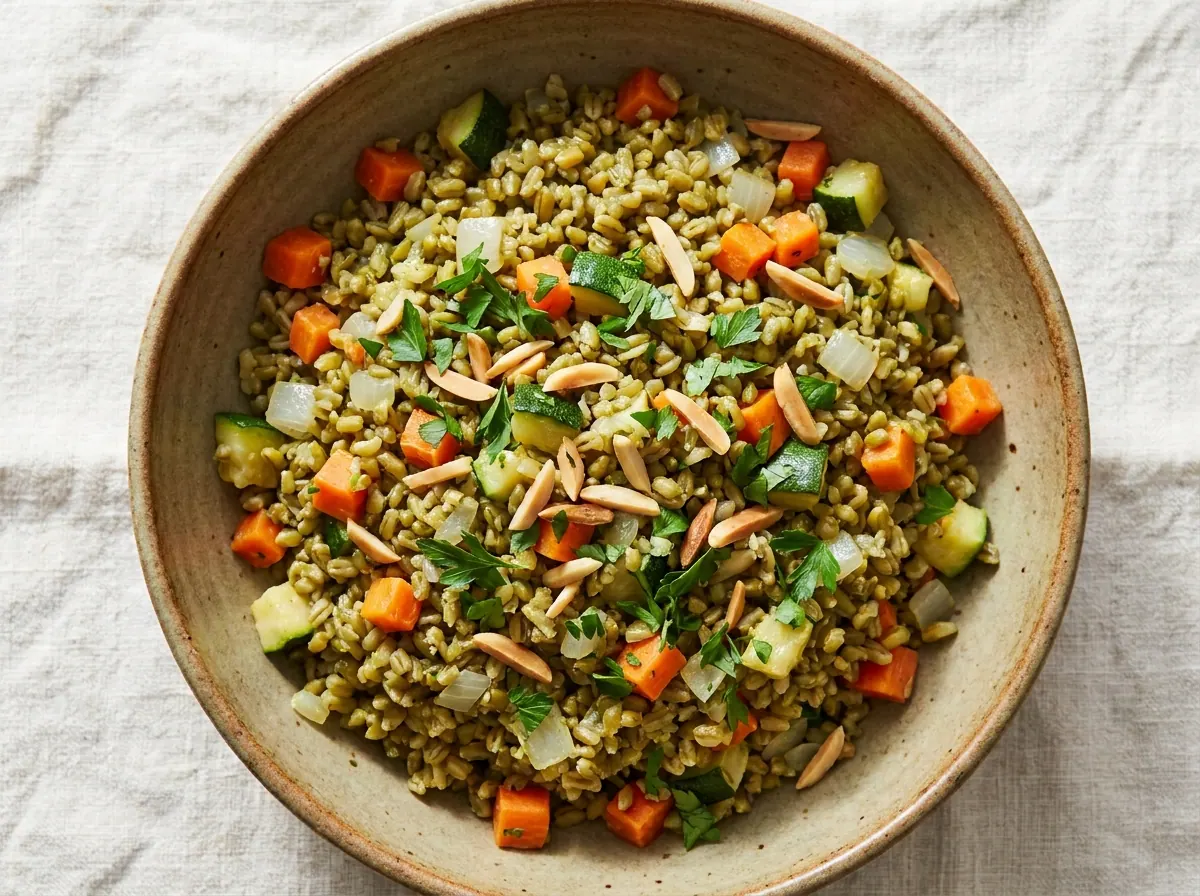
Freekeh (roasted green wheat) with vegetables — a whole grain with GI 38, rich in fiber and plant protein, cooked with carrots, zucchini, bell pepper, peas, and olive oil.
Freekeh is one of the most ancient grains of the Levantine and Saudi kitchen — green wheat harvested before it fully ripens, then toasted on an open fire. It takes on a distinctive smoky flavor and golden-green color from this process.
Its name comes from the Arabic word for rubbing, as the scorched husks are rubbed off the grain after toasting. Cooking it with vegetables transforms it into a complete dish: a whole grain rich in fiber and plant protein, with zucchini, carrots, bell pepper, and peas adding color and vitamins, and two tablespoons of olive oil completing the nutritional balance. The result is a warm, filling meal perfect for lunch or dinner.
Preparation Steps
Soak and clean the freekeh
Soak the freekeh in cold water for 10 to 15 minutes, then drain and remove any pebbles or chaff — freekeh is a coarse grain that needs cleaning.
Sauté the onion
Heat the olive oil in a pot and stir the onion until softened and translucent.
Add the vegetables
Add the carrot, bell pepper, and zucchini and stir for 3 to 4 minutes until slightly softened.
Toast the freekeh
Add the drained freekeh and stir it with the vegetables for 2 minutes to absorb the flavors and lightly toast.
Add the broth and spices
Pour in the hot broth and add the spices (cumin, black pepper, a pinch of cinnamon, and salt). Raise the heat to a boil.
Simmer gently
Reduce the heat, cover the pot, and cook over low heat for 25 to 30 minutes until the freekeh is cooked through, the liquid is absorbed, and the grains are tender but not mushy.
Add the peas
Stir in the peas in the last 7 to 8 minutes of cooking so they cook through while retaining their color.
Rest and serve
Leave the pot covered for 5 minutes after turning off the heat, then fold gently, garnish with parsley, and serve warm.
Blood Sugar Impact
The glycemic index (GI) measures how quickly a food raises blood sugar, while the glycemic load (GL) measures how much a full serving raises it. Together they give the complete picture.
Glycemic Index
GI
38Low
Low0–55Medium56–69High70+
A low value (≤55) means a gradual rise in blood sugar — the most suitable range for diabetes and insulin resistance.
Glycemic Load
GL
14Medium
Low0–10Medium11–19High20+
Glycemic load reflects the impact of the full serving. To lower it: take half a serving, or pair the recipe with a source of protein and fiber.
Nutritional Information
Per ServingMakes 4 servings · one serving is about 365 g of raw ingredients
Calories294 kcal15%of Daily Value*
Protein9 g18%of Daily Value*
Carbohydrates47 g17%of Daily Value*
Fat8 g10%of Daily Value*
Fiber11 g39%of Daily Value*
Sodium941 mg41%of Daily Value*
* Percent Daily Values are based on a 2,000-calorie diet per FDA food-label reference values — your daily needs may be higher or lower. Values are derived from the recipe's ingredients via the USDA database.
Troubleshooting
The most common problems when preparing Freekeh with Vegetables, and how to fix them:
Freekeh stayed hard and didn't cook through
Not enough liquid or too short a cooking time — freekeh is a coarse grain that needs more liquid than rice and more time. The rule from practice: 3 cups of liquid per cup of freekeh, and at least 25 minutes over low heat. If the liquid runs out and the grain is still firm, add half a cup of hot water and cover for 10 more minutes.
Freekeh turned sticky and mushy
Over-stirring during cooking or continuing to cook after it is done breaks the grain and releases its starch. Stir the freekeh just once after adding the broth, then leave it covered without stirring. Stop cooking as soon as the grain yields easily between two fingers while still holding its shape.
Slight bitter taste in the dish
Charred husks weren't washed off properly before cooking. Freekeh is toasted on an open fire and fine carbon particles can cling to it. To fix this next time: wash the freekeh in cold water 2 or 3 times until the water runs clear, and soak it before cooking to remove any excess smokiness.
Vegetables dissolved and disappeared into the dish
They were added too early with the broth and cooked for the entire duration. To keep the vegetables visible and intact: sauté the carrots, bell pepper, and zucchini briefly only at the start, and add the peas in the last 7 to 8 minutes. Soft, fast-cooking vegetables don't need half an hour on the heat.
Dish is dry with no cohesive texture
The liquid evaporated faster than the grain cooked because of high heat or an uncovered pot. Cook the freekeh covered over low heat so it absorbs the liquid gradually. If you notice drying early, reduce the heat and add a little hot broth — cold water stops the cooking and hardens the grain.
Flat flavor with no depth
Too few spices or added too late, or the freekeh was cooked in water instead of broth. From experience: broth adds depth that is hard to replicate with water, and a pinch of cinnamon with cumin distinguishes the dish. Add the spices with the broth at the start so the grain absorbs them, and adjust the salt at the end of cooking after the liquid has reduced.
Storage and Make-Ahead
Refrigerator (4°C)
Cooked freekeh: 3 to 4 days in an airtight container. The grain firms up more when chilled — reheat with a splash of water or broth to restore its tenderness. Dry freekeh: keeps in an airtight container in a cool, dry place for several months.
Freezer (-18°C)
Cooked freekeh freezes well for up to 3 months in airtight containers in individual portions. Thaw overnight in the refrigerator, then reheat with a little broth. Whole grains freeze better than rice.
Advance prep
Washing and soaking the freekeh: up to 1 hour before cooking — drain and keep in a dry container. Chopping the vegetables: up to 1 day ahead — store in a container in the refrigerator. Full cooking: can be prepared in a batch and stored chilled, as the flavor deepens the next day.
Serving
Serve warm. To reheat: over low heat with 2 tablespoons of water or broth, covered, or in the microwave with a splash of water and a cover. Do not leave at room temperature for more than 2 hours per food safety guidelines.
Tested Ingredient Substitutions
Original Ingredient
Tested Substitute
Ratio
Flavor Difference
Freekeh
Coarse bulgur
same amount, less liquid and shorter time
A similar low-GI whole grain [3], without the smoky flavor
Freekeh
Cooked quinoa
same amount, much shorter time
Gluten-free, neutral flavor, finer texture
Vegetable broth
Light chicken broth
same amount
Deeper flavor, slightly increases protein
Peas
Cooked chickpeas
same amount
Higher protein and fiber, denser texture
Olive oil
A smaller amount of ghee
1 spoon instead of 2
Traditional Saudi flavor, richer, higher in saturated fat
How Much Does It Make? Scaling Guide
Number of servings
Dried freekeh
Broth or water
Olive oil
Peas
2 (individual × 2)
0.5 cup
1.5 cups
1 tbsp
0.25 cup
4 (base)
1 cup
3 cups
2 tbsp
0.5 cup
8 (large family)
2 cups
6 cups
4 tbsp
1 cup
12 (entertaining)
3 cups
9 cups
6 tbsp
1.5 cups
EEINA Nutrition Tip
Freekeh is an excellent ally for people with diabetes: it is a low-GI whole grain rich in soluble fiber and resistant starch, both of which slow sugar absorption and extend satiety. Pair it with a protein source and non-starchy vegetables to keep the meal balanced and the glycemic load low.
Add This Recipe to Your Plan
The EEINA app saves your favorite recipes, calculates them from their real ingredients, and shows your daily numbers toward your goal. Try it free now.
What is the difference between freekeh and bulgur?
Both come from wheat, but freekeh is green wheat harvested early and then toasted, giving it a smoky flavor and higher protein, while bulgur is mature wheat that is boiled, dried, and cracked. Both are low-GI.
Is freekeh suitable for people with diabetes?
Very suitable — it is a whole grain with GI 38, low, rich in fiber and plant protein, raising blood sugar slowly. A moderate serving with vegetables and protein is a balanced choice.
Should I soak the freekeh before cooking?
It is recommended to wash it well and soak it for 10 to 15 minutes, as this cleans it of husks and excess smokiness and slightly shortens cooking time.
How long does cooked freekeh keep?
3 to 4 days in the refrigerator in an airtight container, and up to 3 months in the freezer. Reheat with a splash of water or broth.