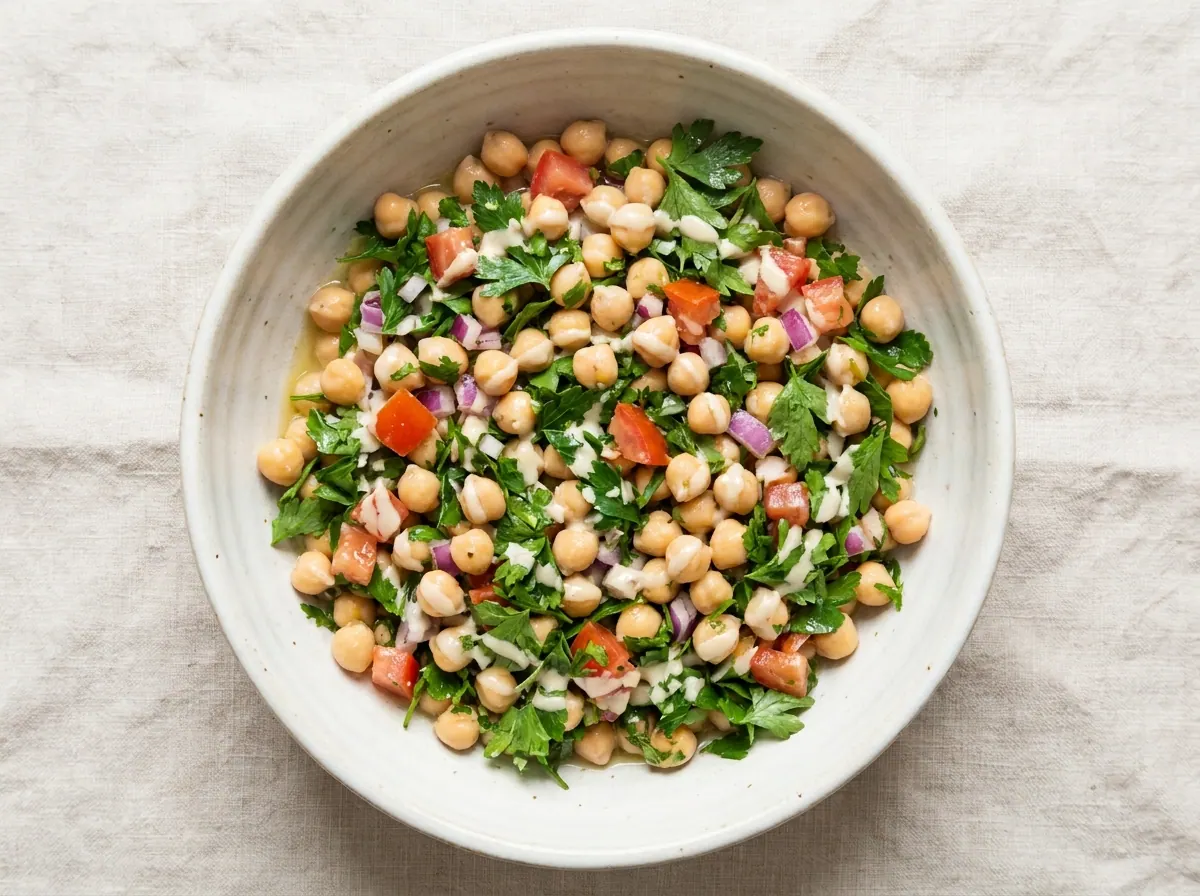
A cold Hummus-free chickpea salad built on whole boiled chickpeas with parsley, tomatoes, tahini dressing, and lemon. GI 24 — very low — rich in plant protein and fibre.
This chickpea and parsley salad is a simple Levantine appetiser that turns whole cooked chickpeas into the star of the dish rather than blending them into a dip. Keeping the beans whole preserves their texture and fibre.
Fresh parsley adds colour and flavour, while the tahini and lemon dressing ties everything together. Nutritionally, it combines plant protein and fibre from the chickpeas with vitamin C from the lemon, tomatoes, and parsley — a pairing that improves the absorption of non-haem iron from the chickpeas. A cold dish that comes together quickly and suits a light table.
Preparation Steps
Prepare the chickpeas
If using dried chickpeas, soak overnight then cook in unsalted water until tender (about 1 to 1.5 hours), drain, and leave to cool. For canned chickpeas, drain and rinse well under cold running water.
Chop the parsley and onion
Wash the parsley and dry it thoroughly, then chop finely. Chop the onion finely as well.
Dice the tomatoes
Cut the tomatoes into small cubes. It is best to remove the seeds to reduce excess liquid and keep the salad firm.
Make the tahini dressing
Whisk the tahini with the lemon juice, olive oil, and a little water until it forms a smooth, pourable dressing. Note that tahini seizes first before loosening — add liquid gradually.
Combine the ingredients
In a large bowl, combine the chickpeas with the parsley, tomatoes, and onion.
Dress and toss
Pour the tahini and lemon dressing over the ingredients, add the salt and cumin, then toss gently until everything is coated.
Taste and chill
Taste and adjust the acidity and salt. Ideally, leave in the refrigerator for ten minutes before serving so the flavours meld.
Serve
Serve cold as a starter or snack, with a sprinkle of parsley and a squeeze of lemon. Best eaten the day it is made so the parsley stays fresh.
Blood Sugar Impact
The glycemic index (GI) measures how quickly a food raises blood sugar, while the glycemic load (GL) measures how much a full serving raises it. Together they give the complete picture.
Glycemic Index
GI
24Low
Low0–55Medium56–69High70+
A low value (≤55) means a gradual rise in blood sugar — the most suitable range for diabetes and insulin resistance.
Glycemic Load
GL
6Low
Low0–10Medium11–19High20+
Glycemic load reflects the impact of the full serving. To lower it: take half a serving, or pair the recipe with a source of protein and fiber.
Nutritional Information
Per ServingMakes 4 servings · one serving is about 230 g of raw ingredients
Calories267 kcal13%of Daily Value*
Protein11 g22%of Daily Value*
Carbohydrates34 g12%of Daily Value*
Fat11 g14%of Daily Value*
Fiber10 g36%of Daily Value*
Sodium456 mg20%of Daily Value*
Potassium425 mg9%of Daily Value*
Phosphorus192 mg15%of Daily Value*
* Percent Daily Values are based on a 2,000-calorie diet per FDA food-label reference values — your daily needs may be higher or lower. Values are derived from the recipe's ingredients via the USDA database.
Troubleshooting
The most common problems when preparing Chickpea and Parsley Salad, and how to fix them:
The salad is watery at the bottom
The tomatoes were not de-seeded or drained. Tomatoes are the main source of liquid in this salad. For an immediate fix, spoon the mixture with a slotted spoon into the serving bowl and leave the liquid behind. Next time, remove the tomato seeds, dice small, and let them drain in a sieve for five minutes with a light pinch of salt before adding.
The tahini dressing seized and clumped
Tahini always seizes when acid or water is first added — this is normal behaviour. Do not give up and do not add more tahini. Keep whisking and add warm water one spoonful at a time; the texture will flip from clumped to smooth and pourable within a minute. Warm water works faster than cold to break the seize.
The chickpeas are hard under the tooth
Dried chickpeas were under-soaked or under-cooked. Dried chickpeas need a full overnight soak and then cooking in unsalted water until completely soft between finger and thumb. Salt during cooking slows the softening of the skin, so add it only after they are tender. If time is short, rinsed canned chickpeas are a ready solution.
The parsley looks wilted and pale
The parsley was washed but not dried, leaving water trapped that the acid and salt then wilted. Wash before chopping, then dry thoroughly with a clean towel or salad spinner, and chop finely with a sharp knife. Add the salt and lemon only ten minutes before serving, not an hour ahead.
The flavour is flat and lacks punch
Too little lemon, or the cumin is missing. The tested ratio is three tablespoons of fresh lemon juice per four servings, with a quarter teaspoon of ground cumin adding a warm, aromatic note that complements the chickpeas. Taste before serving and adjust the acidity and salt gradually.
The onion is pungent and dominates the dish
The quantity was too large or the onion was chopped coarsely. Chop it very finely so its flavour distributes, or soak it in cold water for a few minutes then drain to reduce its sharpness. Spring onion is a milder alternative for those who prefer a lighter bite.
Storage and Make-Ahead
Refrigerator (4°C)
Dressed salad: up to two days maximum in an airtight container. The parsley loses its freshness after one day but remains safe to eat. Cooked chickpeas alone: three to four days submerged in a little of their cooking liquid in an airtight container.
Freezer (-18°C)
Dressed salad is not suitable for freezing — the tomatoes and parsley turn watery after thawing. Cooked chickpeas alone freeze for up to three months and can be thawed in the refrigerator before use.
Advance preparation
Cook chickpeas: the day before, stored chilled in an airtight container. Tahini dressing: the day before in a sealed jar — stir and thin with a little water before using. Chopped vegetables: up to two hours ahead, with the parsley kept in a paper bag in the refrigerator. Final toss: only ten minutes before serving.
Serving
This is a cold dish — do not heat. For a later meal, leave it on the counter for five minutes before serving to take the chill off. Do not leave it out of the refrigerator for more than two hours, per USDA food safety guidelines.
Tested Ingredient Substitutions
Original Ingredient
Tested Substitute
Ratio
Flavor Difference
Tahini (sesame)
Extra extra-virgin olive oil
2 tablespoons in place of the tahini
Sesame-free, lighter texture, less intense flavour
Parsley alone
Parsley and fresh mint
Same total quantity
Fresher and lighter, a distinctive Levantine touch
Small onion
Chopped spring onion
Same quantity
Milder, a gentler flavour suited to cold salads
Lemon juice
Lemon juice and a pinch of sumac (tart purple spice)
Same amount of lemon plus 1 teaspoon sumac (tart purple spice)
Deeper acidity and a subtle pink hue
Regular tomatoes
Cherry tomatoes, halved
Same weight
Sweeter, less watery, and more elegant for guests
How Much Does It Make? Scaling Guide
Number of servings
Boiled chickpeas
Chopped parsley
Tomatoes
Lemon juice
2 (individual × 2)
1 cup
0.5 cup
1
1.5 tbsp
4 (base)
2 cups
1 cup
2
3 tbsp
8 (large family)
4 cups
2 cups
4
6 tbsp
12 (entertaining)
6 cups
3 cups
6
9 tbsp
EEINA Nutrition Tip
Pair the chickpeas with vitamin C: the non-haem iron in chickpeas is better absorbed in the presence of vitamin C. The lemon, tomatoes, and parsley in this recipe all provide that vitamin, so the dish is designed to maximise iron absorption from the chickpeas without any extra supplement.
Add This Recipe to Your Plan
The EEINA app saves your favorite recipes, calculates them from their real ingredients, and shows your daily numbers toward your goal. Try it free now.
It is ideal — its GI is 28 (very low) and the high fibre from the chickpeas slows glucose absorption. A generous serving is appropriate.
Can I use canned chickpeas?
Yes, drained and rinsed canned chickpeas are a quick and practical option. Rinse them well under cold running water to reduce the added sodium.
How long does it keep?
Up to two days in the refrigerator. The parsley loses its freshness after one day. For advance preparation, store the chickpeas and dressing separately and mix just before serving.
A tahini substitute for those avoiding sesame?
Extra extra-virgin olive oil gives a lighter texture and less intense flavour, and the dish remains completely sesame-free.
Sources: USDA · University of Sydney · Gulf GSO · SFDA · Our methodology · Updated on