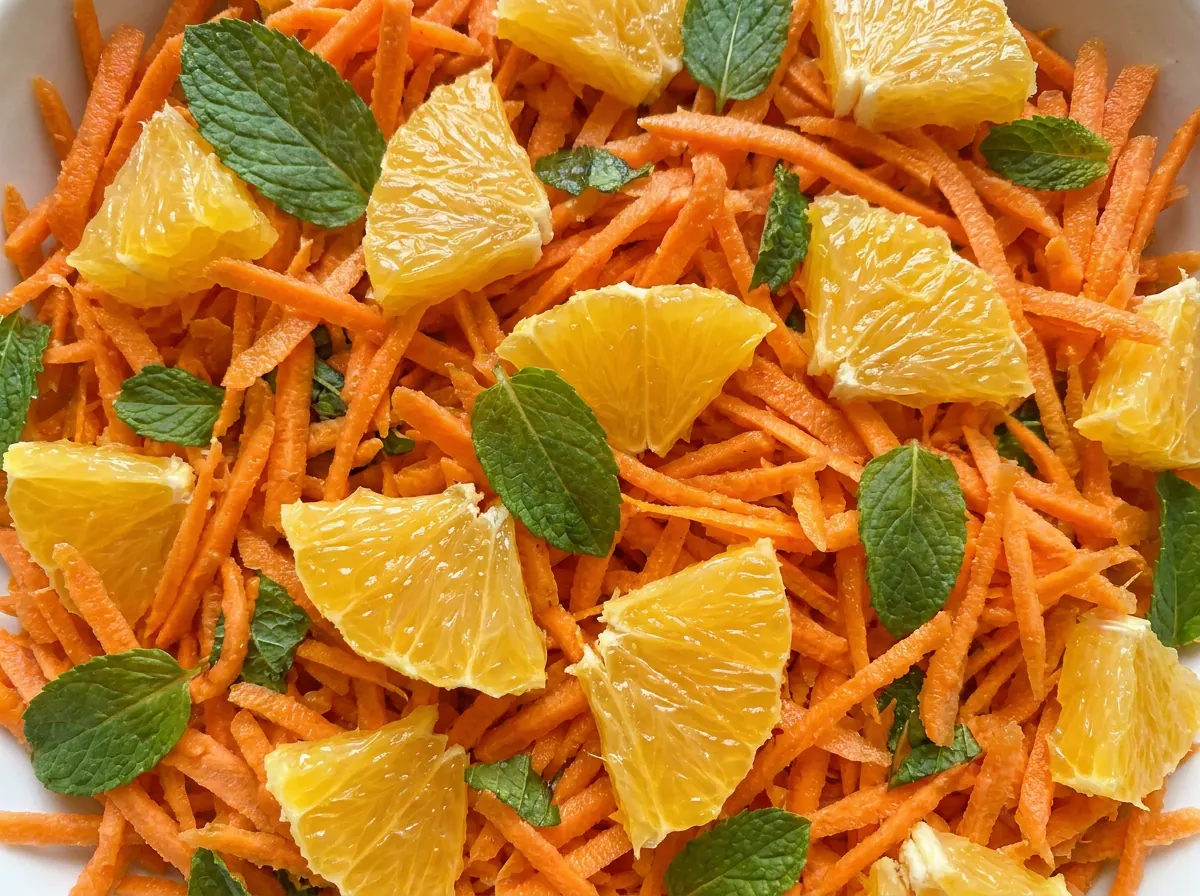
Classic Moroccan carrot and orange salad — freshly grated raw carrot with orange segments, olive oil, a touch of cinnamon, and mint. Refreshing, GI 45, rich in vitamin A and vitamin C.
Carrot and orange salad is a classic Moroccan dish that combines raw grated carrots with fresh orange segments in a balance of sweetness and acidity. Documented by Moroccan cook Choumicha, it is widespread in North African and Levantine kitchens as a refreshing side served cold.
Its secret is its simplicity: no cooking, no heating — just fresh carrots, orange, olive oil, and a touch of cinnamon and orange blossom water that give it a distinctive Moroccan aroma. Raw carrots retain their fiber and beta-carotene, and olive oil helps the body absorb these fat-soluble carotenoids.
Preparation Steps
Prepare the carrots
Wash the carrots well and peel them, then grate coarsely and place in the serving bowl.
Prepare the oranges
Peel the oranges and remove the white pith, then cut into thin slices or separate into segments, removing any seeds. Reserve any juice that runs off.
Make the dressing
In a small bowl, whisk together the orange juice, lemon juice, olive oil, honey, cinnamon, orange blossom water, and a pinch of salt until the dressing is well combined.
Add the oranges
Gently add the orange pieces to the grated carrots without breaking up the segments.
Dress and toss
Pour the dressing over the mixture and toss gently to coat the carrots and oranges, then taste and adjust acidity or sweetness as desired.
Chill and serve
Cover the bowl and refrigerate the salad for 20 to 30 minutes for the flavors to meld, then scatter the mint and a pinch of cinnamon over the top and serve cold.
Blood Sugar Impact
The glycemic index (GI) measures how quickly a food raises blood sugar, while the glycemic load (GL) measures how much a full serving raises it. Together they give the complete picture.
Glycemic Index
GI
45Low
Low0–55Medium56–69High70+
A low value (≤55) means a gradual rise in blood sugar — the most suitable range for diabetes and insulin resistance.
Glycemic Load
GL
9Low
Low0–10Medium11–19High20+
Glycemic load reflects the impact of the full serving. To lower it: take half a serving, or pair the recipe with a source of protein and fiber.
Nutritional Information
Per ServingMakes 4 servings · one serving is about 195 g of raw ingredients
Calories140 kcal7%of Daily Value*
Protein2 g4%of Daily Value*
Carbohydrates24 g9%of Daily Value*
Fat5 g6%of Daily Value*
Fiber5 g18%of Daily Value*
Sodium70 mg3%of Daily Value*
Potassium473 mg10%of Daily Value*
Phosphorus47 mg4%of Daily Value*
* Percent Daily Values are based on a 2,000-calorie diet per FDA food-label reference values — your daily needs may be higher or lower. Values are derived from the recipe's ingredients via the USDA database.
Troubleshooting
The most common problems when preparing Carrot and Orange Salad, and how to fix them:
The salad is watery at the bottom after refrigerating
Raw carrots and oranges release natural juice during chilling, and too much added juice makes it worse. For an immediate fix: use a slotted spoon to lift the mixture into the serving bowl and leave the liquid behind. Next time: reduce the orange juice added, drain the orange segments of their excess juice before mixing, and add the dressing just before serving rather than hours ahead.
The flavor is too sweet
The oranges were very ripe, or too much honey was used. Honey is optional and is only added to balance very acidic oranges. Fix: add an extra teaspoon of lemon juice to restore the acid balance, and omit honey entirely if the oranges are naturally sweet.
The carrots are hard and difficult to chew
The grating was too coarse, or large fibrous carrots were used. Choose medium-sized tender carrots and grate them on the coarse holes, not by cutting. For a softer texture, let the salad sit in the refrigerator for a full 30 minutes — the acid and salt gradually soften the carrots.
The orange blossom water aroma is overwhelming
You added more than half a teaspoon. Orange blossom water is very concentrated, and half a teaspoon for four servings is the maximum. Fix: add a little more carrot and orange to dilute the concentration. Next time, add it drop by drop and taste between additions.
The color is pale, not vibrant
The carrots are old or have lost their freshness. Fresh carrots are bright orange and firm. Choose shiny, firm carrots with no spots, and grate them right before serving because grated surfaces dry out and fade with prolonged air exposure.
The mint turned black and wilted
The mint was chopped early and mixed with the acid, which oxidized it. Chop and scatter the mint right before serving, not hours in advance. Keep whole leaves in the refrigerator wrapped in a damp cloth, and chop at the last moment to keep them green and fragrant.
Storage and Make-Ahead
Refrigerator (4°C)
Dressed salad: 1 day maximum in an airtight container. It loses its crunch and gets more watery after that, but remains safe. Undressed grated carrots: 2 days in a dry container lined with a paper towel to absorb moisture.
Freezer (-18°C)
Not suitable at all. Raw carrots and oranges turn into a watery mush after thawing. This is a fresh salad to be eaten the day it is made.
Advance preparation
Grated carrots: up to 2 hours ahead, stored dry in the refrigerator. Sliced oranges: up to 1 hour ahead, stored drained of their juice. Dressing: whisk and store in a glass, shake before adding. Final mixing: 30 minutes before serving for chilling.
Serving
A cold dish — do not reheat. Serve cold directly from the refrigerator with a scattering of fresh mint. Do not leave out of the refrigerator for more than 2 hours, per food safety guidelines [5].
Tested Ingredient Substitutions
Original Ingredient
Tested Substitute
Ratio
Flavor Difference
Honey
Finely chopped dates or omit
2 dates for 1 tablespoon honey
Deeper sweetness with a caramel note, or cleaner acidity when omitted
Orange blossom water
Rose water or omit
Same amount
A rosy aroma instead of the blossom, or a cleaner flavor when omitted
Cinnamon
Cinnamon and a pinch of cumin
Same amount of cinnamon
A more pronounced earthy Moroccan depth
Mint
Chopped fresh cilantro
Same amount
A sharper herbal note, North African character
Lemon juice
Local yellow lemon juice
Same amount
Softer and less sharp acidity
How Much Does It Make? Scaling Guide
Number of servings
Carrots
Orange
Olive oil
Cinnamon
2 (individual × 2)
200 g
1
1 tbsp
1 pinch
4 (base)
400 g
2
1.5 tbsp
0.25 tsp
8 (large family)
800 g
4
3 tbsp
0.5 tsp
12 (entertaining)
1200 g
6
4.5 tbsp
0.75 tsp
EEINA Nutrition Tip
Olive oil is not optional here: carrot beta-carotene is a fat-soluble vitamin, and the presence of a tablespoon of olive oil noticeably increases the body's absorption compared to a fat-free salad. So keep the oil even if you reduce the honey to cut calories.
Add This Recipe to Your Plan
The EEINA app saves your favorite recipes, calculates them from their real ingredients, and shows your daily numbers toward your goal. Try it free now.
Yes. Its glycemic index is low (25) and its glycemic load is very low (4), with fiber from the carrots and oranges that slows sugar absorption. To reduce sugar further, omit the honey.
Can it be made without orange blossom water?
Absolutely. Orange blossom water is an optional Moroccan aromatic touch that does not affect the nutritional value. It can be substituted with rose water or omitted entirely.
Should the carrots be cooked?
No. This is a raw grated carrot salad, and cooking changes its character and raises its glycemic index. Raw carrots retain their crunch and fiber.
How long does it keep in the refrigerator?
One day maximum after dressing. For longer storage, keep the carrots, oranges, and dressing separate and mix 30 minutes before serving.
Sources: USDA · University of Sydney · Gulf GSO · Our methodology · Updated on