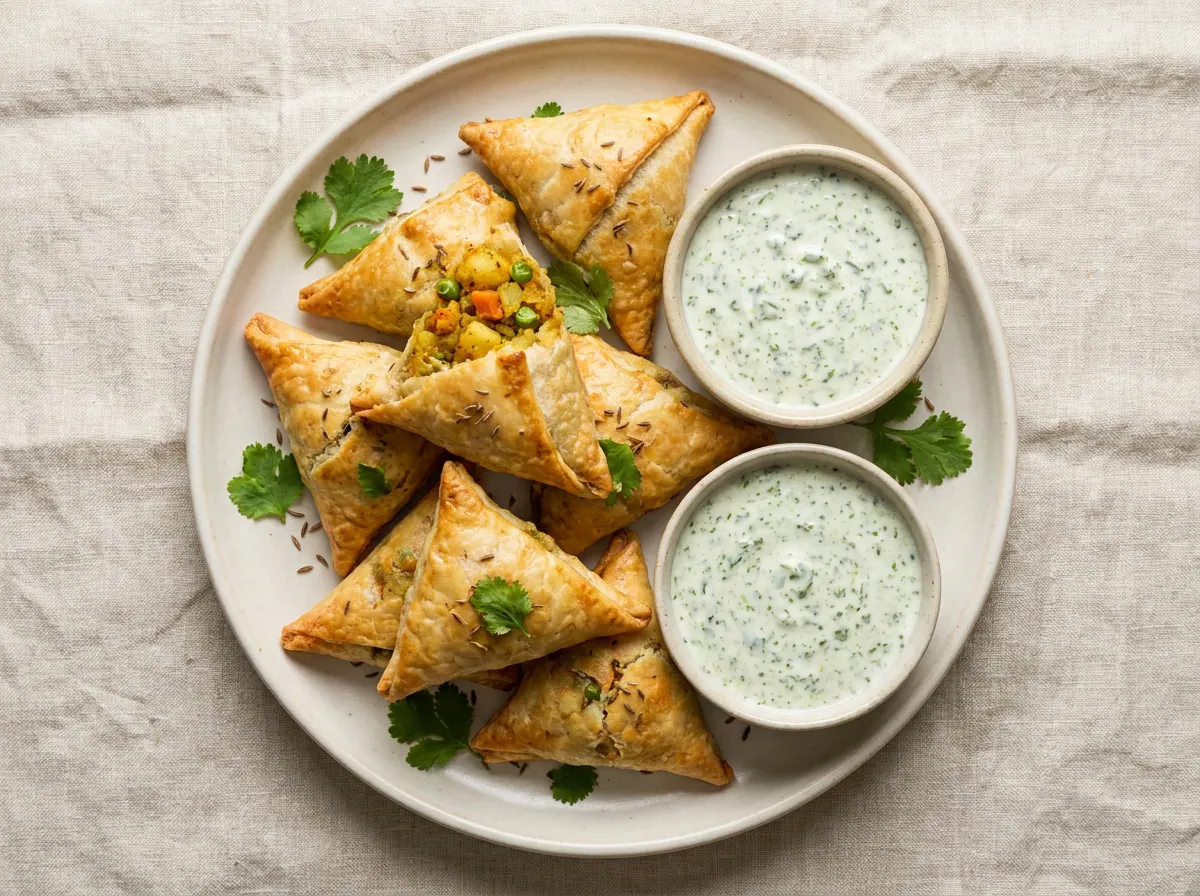
Baked vegetable samosa instead of fried. A filling of potato, peas, and carrot with warm spices, baked in the oven so the fat and calories drop noticeably while the crispness remains. 118 calories per piece.
The samosa is a beloved triangle on Ramadan and hospitality tables, but the fried version soaks up deep-frying oil so its fat and calories rise noticeably. The idea here is simple: keep the flavor and the crispness, and swap the frying pan for the oven.
The filling is pure vegetable: mashed potato, peas, and carrot with warm spices of cumin, coriander, and turmeric. Baking drops the oil absorption, so the fat and calories fall by a noticeable amount compared with the fried version, while the outer layer stays golden and crisp.
Preparation Steps
Boil and mash the potato
Boil the potato until tender, drain it, mash it coarsely, and let it cool a little. Cooling the potato raises the resistant starch and slightly lowers the glycemic response.
Sauté the vegetables
Heat a spoon of oil, sauté the onion until it wilts, then add the carrot and peas and stir for two minutes until tender.
Season the filling
Add the cumin, ground coriander, turmeric, salt, and pepper, then add the mashed potato and the fresh cilantro and mix until the flavor is uniform. Lift off the filling and let it cool completely.
Prepare the sealing paste
Make a sticky paste by mixing the flour with a little water until it becomes paste-like, to seal the edges.
Fill and fold the sheets
Lay out the samosa sheet, place a spoon of the filling, and fold it into a triangle sealed tightly by brushing the edges with the sticky paste.
Arrange and brush
Arrange the samosas on a parchment-lined tray, and brush or spray them with a very thin layer of olive oil on both sides.
Bake
Bake in an oven preheated to 200 degrees Celsius for 20 to 25 minutes, or air-fry at 180 degrees for 12 to 15 minutes, flipping them halfway until golden and crisp.
Serve
Serve them warm with a soup or a large green salad to slow the glycemic response and balance the meal.
Blood Sugar Impact
The glycemic index (GI) measures how quickly a food raises blood sugar, while the glycemic load (GL) measures how much a full serving raises it. Together they give the complete picture.
Glycemic Index
GI
67Medium
Low0–55Medium56–69High70+
A low value (≤55) means a gradual rise in blood sugar — the most suitable range for diabetes and insulin resistance.
Glycemic Load
GL
13Medium
Low0–10Medium11–19High20+
Glycemic load reflects the impact of the full serving. To lower it: take half a serving, or pair the recipe with a source of protein and fiber.
Nutritional Information
Per ServingMakes 8 servings · one serving is about 85 g of raw ingredients
Calories118 kcal6%of Daily Value*
Protein3 g6%of Daily Value*
Carbohydrates22 g8%of Daily Value*
Fat2 g3%of Daily Value*
Fiber2 g7%of Daily Value*
Sodium510 mg22%of Daily Value*
* Percent Daily Values are based on a 2,000-calorie diet per FDA food-label reference values — your daily needs may be higher or lower. Values are derived from the recipe's ingredients via the USDA database.
Troubleshooting
The most common problems when preparing Baked Vegetable Samosa, and how to fix them:
The samosa is dry and its crust is cracked after baking
The pastry dried out before baking, or there was not enough surface oil. The baked samosa relies on a thin layer of oil to take on color and crispness, so without oil it cracks. Brush both sides with a light oil brush before baking, and cover the unfilled sheets with a damp, wrung-out towel so they do not dry out while folding.
The filling came out of the edges during baking
The sealing was not tight, or the filling was warm and loosened the pastry. Knead the flour with water until it becomes a strong sticky paste, and wipe it on every edge before pressing. Most important: let the filling cool completely before filling, because steam from a hot filling opens the folds.
The bottom cooked while the top stayed pale
The tray is close to the bottom of the oven, or the pieces were not flipped. Place the tray on the middle rack, and flip the samosas halfway through baking so both sides color evenly. In the air fryer, arrange them with spaces between them so the hot air circulates around each piece.
The filling is watery and loosened the pastry
The potato was not drained well, or the frozen peas were added with their ice. Drain the potato after boiling and let it steam off for two minutes before mashing, and thaw the frozen peas and drain off their water. A dry, cohesive filling holds the fold and does not wet the pastry.
The filling tastes bland despite the spices
The spices were added without toasting, or the salt is too little. Toast the cumin, ground coriander, and turmeric for seconds in the onion oil before adding the vegetables, as the heat releases their aromatic oils. Adjust the salt on the cooled filling and taste it before filling, since the flavor fades a little after baking.
The samosa did not crisp and stayed soft
The oven was not preheated, or the oil layer was thick so it cooked instead of crisping. Preheat the oven for ten minutes before putting it in at 200 degrees, and brush the oil as a light spray, not a soak. For maximum crispness: raise the heat a few degrees in the last three minutes while watching so it does not burn.
Storage and Make-Ahead
The fridge (4°)
Baked: two to three days in a sealed container. They lose crispness, restored by reheating in the oven, not the microwave. Unbaked (filled): one day covered in the fridge before baking.
The freezer (-18°)
The raw filled samosa freezes excellently for up to a month. Arrange them spread out on a tray until they firm up, then move them to a bag. Bake them straight from frozen with five minutes added to the baking time.
Make-ahead
The filling: prepare it a day ahead and keep it cold in a sealed container. The folding: fold the samosas and freeze them raw, which is better than storing them baked. The baking: just before serving so they arrive hot and crisp.
Reheating
Reheat them in an oven at 180 degrees for five to seven minutes to restore the crispness. Avoid the microwave, as it makes them soft. Do not leave the baked ones out of the fridge for more than two hours.
Tested Ingredient Substitutions
Original Ingredient
Tested Substitute
Ratio
Flavor Difference
Refined-flour pastry
Whole-wheat pastry
Same count
Higher fiber, darker color, a more grainy flavor
Vegetable filling alone
Adding boiled minced chicken
Replace a third of the potato
Higher protein, a richer and more filling stuffing
Green peas
Sweet corn or mashed white beans
Same weight
Corn is sweeter, beans are denser and higher in protein
Sealing flour
Cornstarch and water
Same amount
Gluten-free, similar adhesion
Fresh cilantro
Chopped parsley
Same amount
A calmer flavor, less herbal sharpness
How Much Does It Make? Scaling Guide
Number of pieces
Chips
potatoes
Peas
Spices (of each)
4 (light meal)
4 sheets
125 g
50 g
0.5 tsp
8 (base)
8 sheets
250 g
100 g
1 tsp
16 (gathering)
16 sheets
500 g
200 g
2 tsp
24 (large gathering)
24 sheets
750 g
300 g
3 tsp
EEINA Nutrition Tip
Baking lowers the fat, not the sugar: the baked samosa is lighter in fat and calories than the fried one, but it stays high on the glycemic index because the potato and pastry starch are what raise the sugar. For people with diabetes and insulin resistance: one or two pieces with a large salad plate and protein, not a full samosa meal.
Add This Recipe to Your Plan
The EEINA app saves your favorite recipes, calculates them from their real ingredients, and shows your daily numbers toward your goal. Try it free now.
Is the baked samosa really healthy compared with the fried one?
Lighter in fat and calories by 40 to 50 percent because it does not soak up deep-frying oil. But it stays high on the glycemic index because of the potato and pastry, so it is a better choice, not a completely light one.
Is it suitable for people with diabetes?
In strict moderation. The glycemic index is high (75), so the most suitable is one or two pieces with a salad and protein to slow the response, no more. Whole-wheat pastry improves the situation a little.
Do I need an air fryer?
No, an ordinary oven is enough at 200 degrees for 20 to 25 minutes. The air fryer is faster (12 to 15 minutes at 180) and gives a clearer crispness with less oil.
Which kind of pastry do I buy?
Ready samosa sheets, square or strip-shaped, are available frozen. Choose whole wheat whenever found to raise the fiber, and keep them covered so they do not dry out while folding.
Sources: University of Sydney · Gulf GSO · Our methodology · Updated on