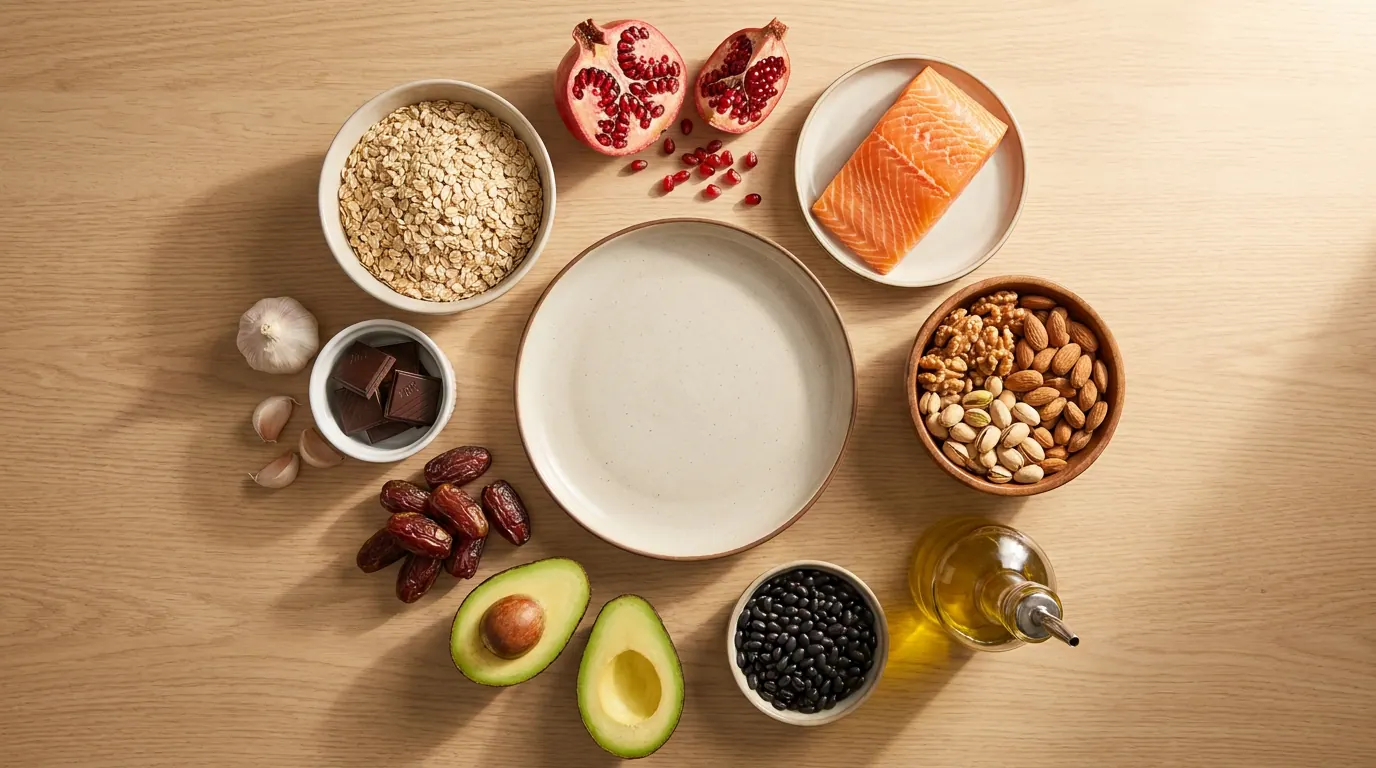
Your body breaks down and rebuilds every hour of your life. Your mission is to make the rebuilding greater.
Between the ages of 20 and 50, humans naturally lose about 3-8% of their muscle mass per decade. This is called sarcopenia, and it starts silently, then reveals itself suddenly in stair-climbing fatigue, grip weakness, and early bone fragility. The good news: smart training and adequate protein can halt this decline at any age, even into your 70s.
Muscle is like a bank account. Every year that passes without a deposit, you withdraw something. But you always have the right to deposit—in the gym, at the table, in bed.
1. Saudi Numbers in Facts
Because those who don't know their map get lost, we started with documented Saudi figures:
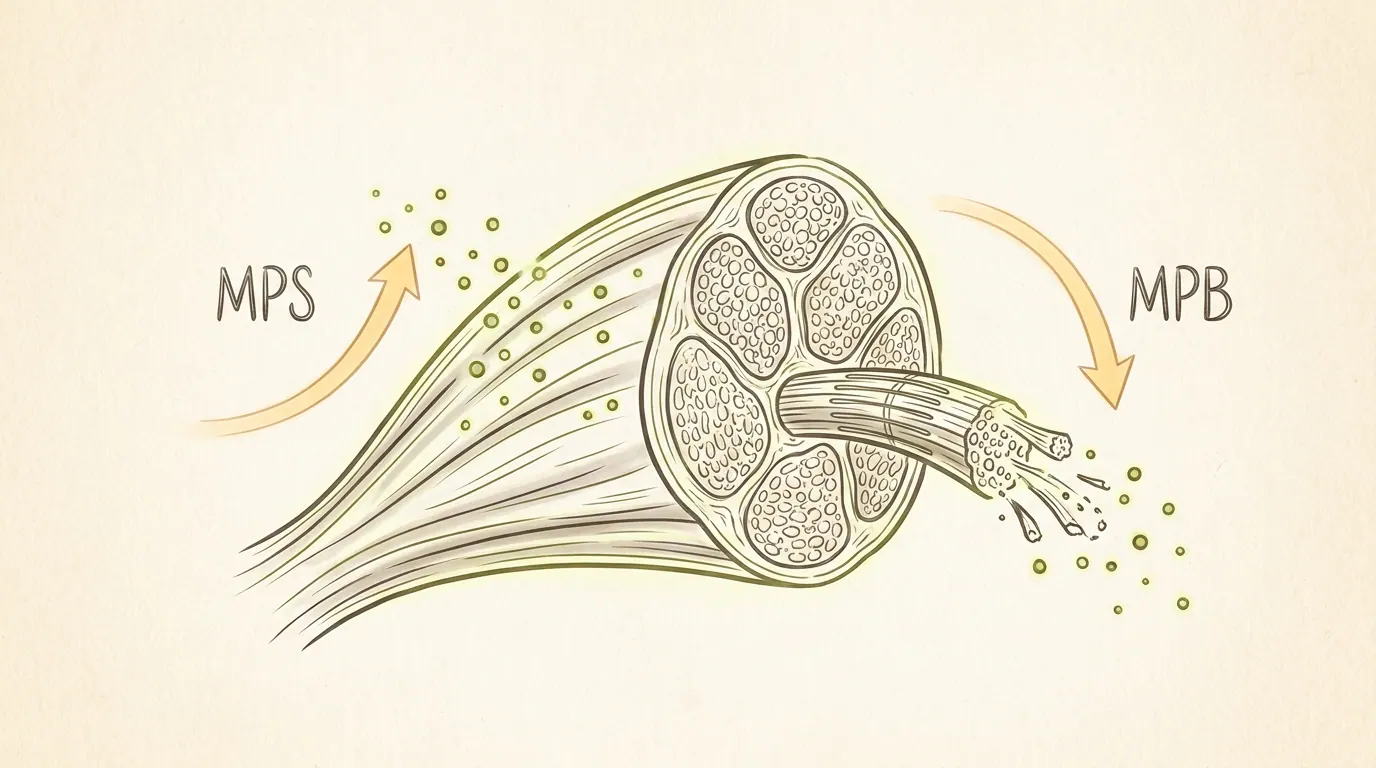
2. The Science of Building: MPS & MPB
Your body is in a constant anabolic-catabolic flux. Two simple hormones govern the outcome:
- MPS (Muscle Protein Synthesis) = Muscle Building. Rises after resistance training and a protein meal.
- MPB (Muscle Protein Breakdown) = Muscle Degradation. Rises during prolonged fasting, chronic stress, and lack of sleep.
The rule of growth is simple: MPS must be greater than MPB throughout the week. Two hours of excellent training cannot compensate for 23 hours of nutritional neglect and sleep deprivation.
3. The 4 Hormones That Seal the Deal
Training and nutrition raise or lower four hormones that are the cornerstones:
Testosterone — The Primary Building Hormone
Rises 20-40% after heavy compound resistance training (squats, deadlifts). Caffeine with protein and dietary cholesterol (eggs, moderate red meat) supports it. Less than 6 hours of sleep reduces it by 10-15%.
Growth Hormone (GH) — The Growth Hormone
Highest peaks during the first 90 minutes of deep sleep, and after high-intensity, short-rest training. Mild fasting (12-14 hours) naturally elevates it.
IGF-1 — GH's Hand in the Muscle
The liver secretes this in response to GH, transmitting the building signal to the fibers. Sufficient protein (especially Leucine) is a prerequisite for its effectiveness.
Cortisol — The Double-Edged Sword
Essential in short bursts of training, but chronic elevation (stress, poor sleep, aggressive fasting, extreme diets) breaks down muscle. Managing cortisol is 60% of the building battle.
4. Calories: Lean Bulk with Honest Numbers
Building muscle requires a slight surplus, not a feast. Every calorie above your true needs turns into fat, not muscle.
| Level | Possible Monthly Gain | Daily Surplus | Target TDEE |
|---|---|---|---|
| Beginner (1st Year) | 0.7 - 1.2 kg | +300 Calories | +10% |
| Intermediate (Years 2-3) | 0.3 - 0.6 kg | +200 Calories | +7% |
| Advanced (Year 4+) | 0.1 - 0.2 kg | +100 Calories | +3% |
5. Protein: The First Pillar
This is the most important chapter in the encyclopedia. To build muscle: 1.6 to 2.2 grams of protein per kilogram of body weight. Modern evidence (Schoenfeld 2024 · Morton 2023) settles on 1.6g as the minimum for building, and 2.2g as a ceiling beyond which no further benefit is gained.
Distribution is as important as quantity:
- 4 meals per day, each with 30-50 grams of protein.
- Intervals between meals of 3-5 hours to allow MPS to rise again.
- Each meal needs 2.5-3 grams of Leucine (the stimulation threshold). Eggs, chicken, dairy, and whey protein achieve this easily.
- The last meal before bed is crucial. Slow-digesting casein or full-fat Greek yogurt can fulfill this.
6. Personal Protein Calculator
Enter your weight and goal to calculate your daily requirement and its distribution across four meals:
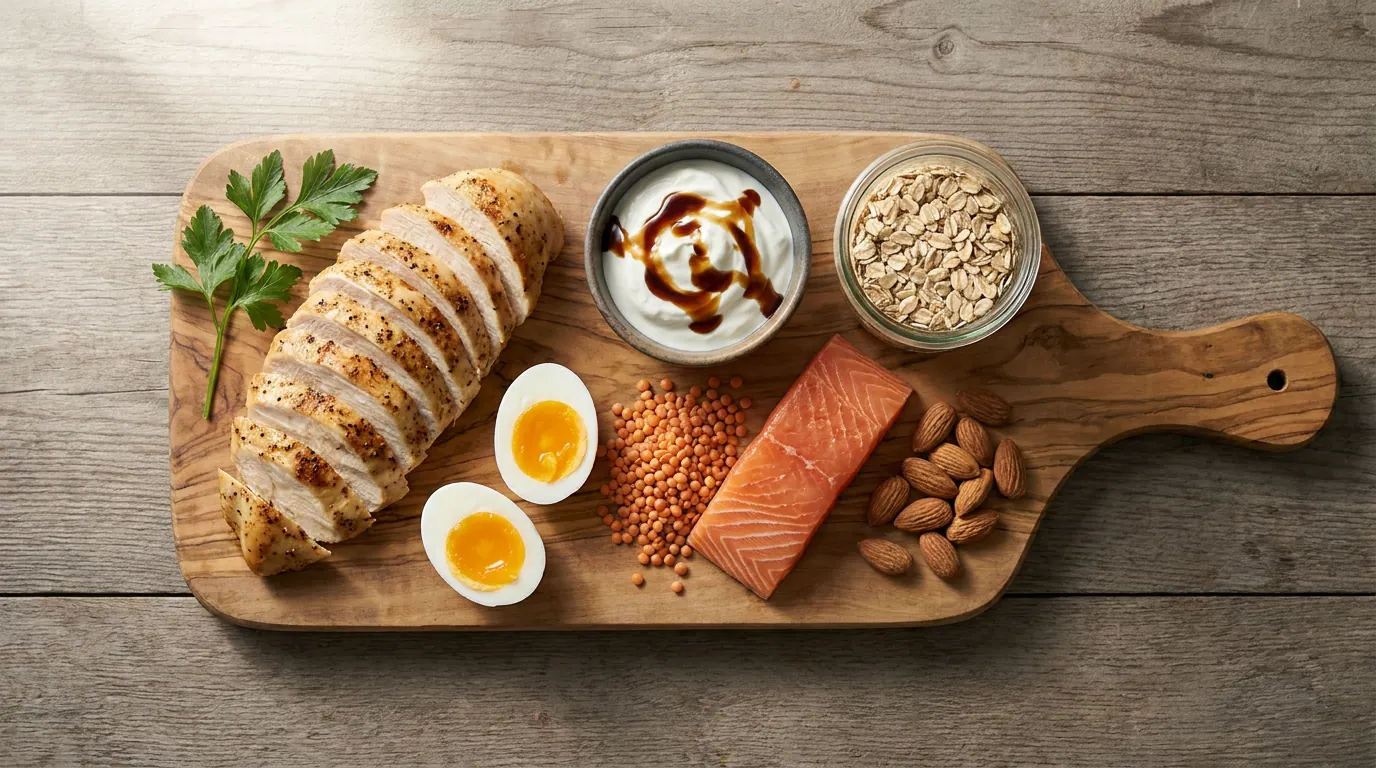
Equivalent Sources: 150g chicken breast, or 5 eggs, or 250g full-fat Greek yogurt, or 1 scoop whey protein + 2 eggs.
7. Carbohydrates & Fats: Not the Enemies
Most people who fail at muscle building wrongly blame carbohydrates and fats:
Carbohydrates
They are the primary fuel for heavy training and replenish muscle glycogen stores. Lack of them reduces strength and raises cortisol. Rule: 4-7g/kg daily on training days, less on rest days. Preferred sources: White rice around training, oats and sweet potatoes throughout the day, dates immediately post-workout.
Fats
Essential for testosterone and healthy cholesterol production. 0.8-1.2g/kg daily is sufficient. Excellent Saudi sources: Extra virgin olive oil, almonds and walnuts, fatty fish, egg yolks, avocados, and moderate amounts of coconut oil.
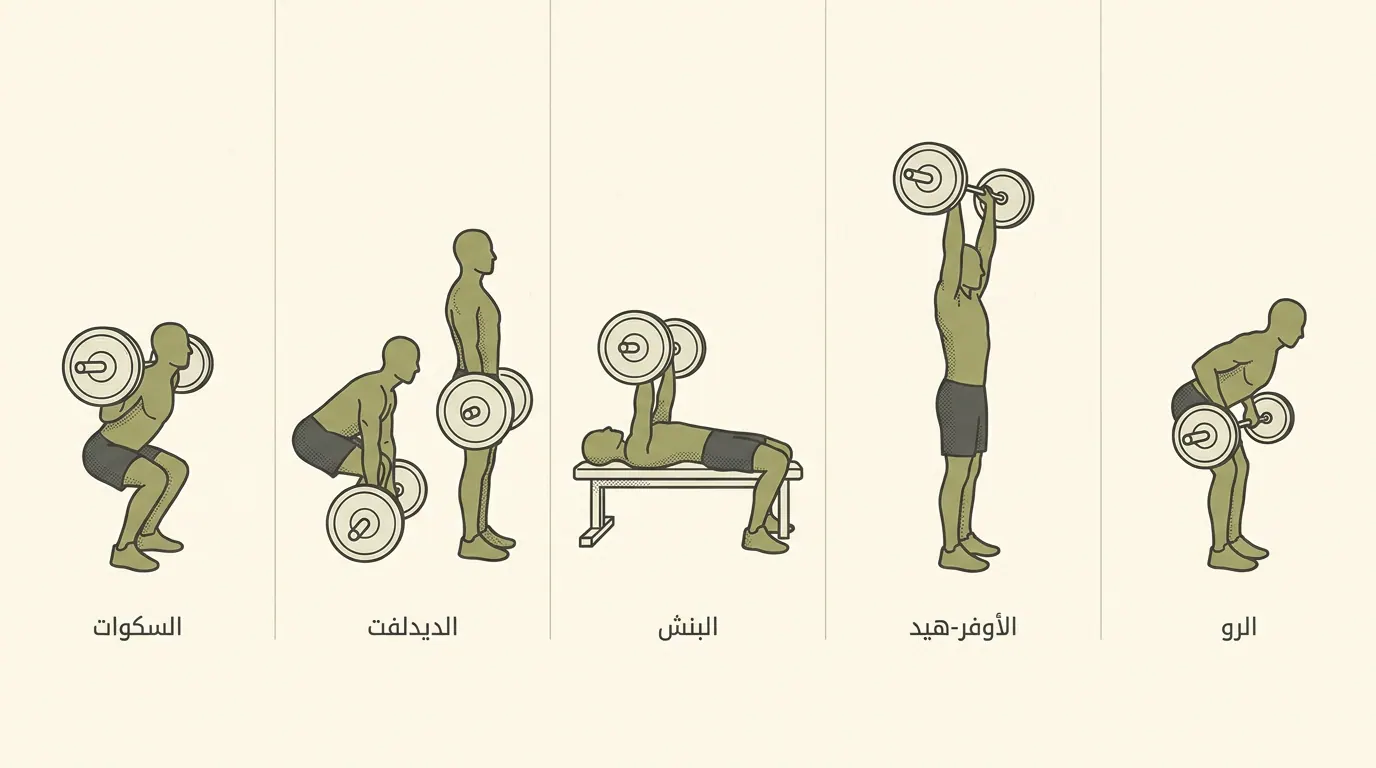
8. The Big 5: The 5 Exercises That Build the Entire Body
If your time is limited and the priority is building real mass, these 5 compound exercises are sufficient for 80% of the results:
Progressive Overload — The Most Important Principle in the Entire Chapter
Muscles don't grow without a reason. The sole reason for growth is a new challenge every week. To achieve this, there are four methods:
- Increase Weight: +2.5kg every two weeks at least for leg exercises, +1kg for upper body exercises.
- Increase Reps: If the weight is stable, add a new rep.
- Increase Sets: Gradually go from 3 to 4 to 5 sets.
- Decrease Rest Time: From 3 minutes to 2, to 90 seconds with the same weight.
Record every workout in a notebook or app. If you don't record, you won't know if you're progressing.
9. Weekly Volume: How Many Sets Per Muscle?
Modern evidence (Schoenfeld Meta-analysis 2024) settles on:
| Muscle Group | Minimum | Optimal | Ceiling |
|---|---|---|---|
| Chest | 8 | 12-16 | 22 |
| Back | 10 | 14-20 | 25 |
| Shoulders | 8 | 12-16 | 20 |
| Legs | 8 | 12-18 | 22 |
| Biceps + Triceps | 4 each | 8-12 each | 16 |
Each set performed with 6-12 reps close to failure (RIR 1-2). More than the ceiling adds no growth and increases injury risk.
Suggested Weekly Split
- Beginner (Months 1-3): Full Body 3 times/week — each workout includes squat + bench + row + core.
- Intermediate (Months 4-12): Upper/Lower 4 times/week — two upper body days, two lower body days.
- Advanced (Year 1+): Push/Pull/Legs 6 times/week, or PPL with a rest day.
Deload — Recovery Week Every 6-8 Weeks
Every 6-8 weeks, reduce weights by 50% and volume by 40% for a full week. This clears accumulated fatigue, lowers cortisol, and resets the nervous system. Those who ignore deloads get injured. Those who adhere to them progress longer.
10. Sleep: The True Muscle Factory
If you have a choice between an extra workout and extra sleep, choose sleep. The evidence is strong:
- Less than 7 hours of sleep reduces MPS by 18% and increases cortisol by 21% (Sleep Medicine 2024).
- Less than 5 hours of sleep reduces testosterone by 15% in just one week (JAMA 2023).
- A 20-40 minute nap after lunch boosts GH and improves recovery.
Pillars of Muscle-Building Sleep
- A completely dark room, temperature 18-20°C.
- No screens an hour before bed. Blue light disrupts melatonin.
- Last caffeine intake before 2 PM. Afternoon coffee disrupts deep sleep even if you fall asleep.
- Casein or full-fat Greek yogurt before bed—nourishes overnight building.
11. Chronic Cortisol: The Silent Muscle Killer
Cortisol in moderation activates training. In excess, it breaks down muscle, stores belly fat, and prevents deep sleep. Causes of chronic elevation:
- Training more than 5-6 times a week with high intensity without deloading.
- Daily fasting longer than 16 hours combined with heavy training.
- High caffeine intake (more than 4 cups daily) with poor sleep.
- Work stress + financial anxiety + social pressure without release.
Lowering it: Daily light walking for 30-45 minutes (not high-intensity running), 5 minutes of diaphragmatic breathing in the morning, 7-9 hours of sleep, and complete rest days during the week.
12. Supplements: What Works & What Doesn't
The global supplement industry exceeds $160 billion. Most of it is hot air and marketing. This list is ordered by strength of evidence:
| Supplement | Dosage | Reliability | Benefit |
|---|---|---|---|
| Creatine Monohydrate | 3-5g/day, anytime | Tier A | Increases strength by 5-15% within 4 weeks. The most studied supplement in history (1000+ studies). |
| Whey Protein | 25-40g post-workout or to compensate for meal gaps | Tier A | Fast absorption, high Leucine, convenient. Not magic, but the most efficient fast protein source. |
| Vitamin D3 | 2000-4000 IU if deficient | Tier A | Deficiency is common in Saudi Arabia (sun paradox) and reduces strength and testosterone. |
| Caffeine | 3-6mg/kg 45 mins before training | Tier A | Increases strength by 5-7% in the next workout. Don't use it daily to avoid losing its effect. |
| Beta-Alanine | 3-5g/day divided | Tier B | Delays fatigue in exercises lasting 60 seconds to 4 minutes. Useful for those who favor high hypertrophy. |
| Citrulline Malate | 6-8g 60 mins before training | Tier B | Increases blood flow and improves the pump. The effect is moderate but real. |
| HMB · BCAAs · Glutamine | Any dosage | Tier C | Evidence is weak for those eating enough protein. Save your money for food. |
13. The Saudi Context: Ramadan, Hajj, and the Local Table
Ramadan Training — The Maintenance Protocol
Fasting for 14-16 hours daily doesn't prevent building, but it requires smart timing:
- Training: 45 minutes before Iftar, or 2 hours after. Avoid heavy training while fasting and fatigued.
- Suhur: Eggs + Greek yogurt + oats + almonds. This provides protein for 14 hours.
- Iftar: Two dates + water, then prayer, then a full meal: Kabsa + salad + yogurt.
- Before Bed: Casein scoop or 200g full-fat Greek yogurt.
- Expectation: Maintain what you've built, not significant growth. This is a victory in Ramadan.
Hajj & Umrah — How Not to Lose a Month
The long walks during Hajj consume 4000+ calories daily. The body breaks down muscle if you don't consume enough protein:
- Two whey protein scoops in your backpack—with water.
- Dates with almonds every two hours for carbohydrates.
- Chicken/Kabsa in the main meal, don't rely solely on bread.
- Upon return: One week of deload, then return to your program with light weights for a week, then full intensity.
Kabsa & Saudi Rice — Friends of Building
Kabsa contains fast carbohydrates (white rice) + protein (chicken/meat)—an excellent post-heavy workout combination. The key:
Preparation: 200g chicken breast, 1 cup cooked rice, large salad with olive oil, yogurt. This is a champion's meal, not a lazy one.
Arabic Coffee — Timing That Makes a Difference
Arabic coffee (cardamom + saffron + a little caffeine) 30 minutes before training boosts focus without jitters. However, excessive consumption after 4 PM disrupts sleep. Have your share in the morning and early afternoon only.
14. 7 Common Myths
15. 12-Week Protocol for Beginners
This is your complete plan in three layers: Daily, Weekly, and Phase (3 months):
Daily Rhythm
- 1.8g/kg Protein across 4 meals.
- 7-8 hours of continuous sleep.
- 2 liters of water minimum.
- 30-45 minutes of walking (not a substitute for training).
- Workout log (Strong app or paper).
- A pre-sleep meal with casein/Greek yogurt.
Weekly Rhythm
- 3 Full Body workouts with a rest day in between.
- Each workout: Squat + Bench + Row + Core + isolation exercise.
- Increase +2.5kg on leg exercises, +1kg on upper body.
- Side-view photo every Saturday for tracking.
- Adjust calories based on scale (goal: +0.2-0.4kg/week).
- One "off-plan" meal for psychological relief.
Phased Rhythm
- 1 Deload week every 6-8 weeks (Weight -50%, Volume -40%).
- Measure your body with a tape (chest, waist, thigh, arm, calf) every 4 weeks.
- Full blood panel after 3 months: Testosterone, Vitamin D, B12, Ferritin, Lipid Panel.
- Recalculate TDEE—it increases by 50-100 calories as your body grows.
- Change accessory exercises every 8-12 weeks for variety.
- Assess results: Beginners gain 5-8kg of lean mass in the first year.
12 months of mastery is better than 5 years of fumbling. Those who succeed aren't the smartest, but the most committed.
16. Frequently Asked Questions
I'm over 40, can I still build muscle?
Yes, and powerfully. Newbie gains work at any age. The only difference is you need higher protein (2g/kg), longer recovery, and patience for slower growth. A 70-year-old lifter can increase their mass (Tufts University studies).
How long before I see results in the mirror?
Feeling stronger in 2 weeks. A change in the mirror in 6-8 weeks. Noticed by others in 4-6 months. A complete transformation in 12-18 months. Patience is key to everything.
Can I build muscle with only home weights?
Up to an intermediate level—yes. A pair of adjustable dumbbells (2-24kg) + a pull-up bar + a bench. After a year, you'll need a gym to reach heavier weights.
Is whey protein necessary?
No. It's just convenient. If you reach 1.8g/kg with food, skip it. If one or two meals are short on protein, one scoop is enough. It's not magic.
How do I differ from a Cardio Bunny?
Cardio alone reduces weight but leaves muscles weak and the physique "soft." Resistance + light cardio = a strong body, active metabolism, and a solid physique. Choose the latter.
How do I know if my program is working?
Three signs: (a) Your weights are increasing every two weeks, (b) Your clothes are tight on the shoulders and loose on the waist, (c) A side-view photo every 4 weeks shows progress. If one is lacking, re-evaluate your calories or protein.
Should I train on Eid or during travel?
No, consider it a natural deload. A full week of rest every 8 weeks loses you nothing; it brings you back stronger. Vacations are important for sleep and cortisol.
Conclusion
Muscle building is not a secret, a conspiracy, or a magic supplement. It's a simple equation: consistent resistance training, adequate protein, good sleep, and annual patience. Those who succeed are those who commit for a full year without interruption. The result: a stronger body, faster metabolism, better mood, and independence that lasts into your 70s.
The plate before the gym, and sleep before the plate. Whoever understands this order understands muscle.