What is Collagen, Anyway?
Collagen is the most abundant protein in your body, and its fibrous structure forms connective tissue. You find it in bones, skin, muscles, tendons, and cartilage, acting as the scaffolding that holds your tissues together, gives your skin its plumpness, and your joints their flexibility.
Practically speaking: As you age, your body's production gradually decreases, leading to wrinkles and weakened joint support. This is where the idea of "replacing what's lost with a pill" was born. However, this logical leap is simpler than what actually happens in the body, as you'll see in the next section.
Why Your Body Digests It into Amino Acids
When you eat collagen, it doesn't remain collagen. Your body breaks down the collagen proteins you consume into amino acids and distributes them where protein is most needed, not necessarily to your skin. This applies even to supplements: your stomach and intestines break them down like any other protein.
This is also why topical collagen creams fail: collagen fibers are too large to penetrate the outer layers of the skin. The practical takeaway: Don't imagine collagen traveling as a single piece to your face. Any potential benefit comes from providing the body with building blocks and perhaps signals that stimulate its cells, not from delivering ready-made collagen.
Hydrolyzed Collagen Peptides — What's the Difference?
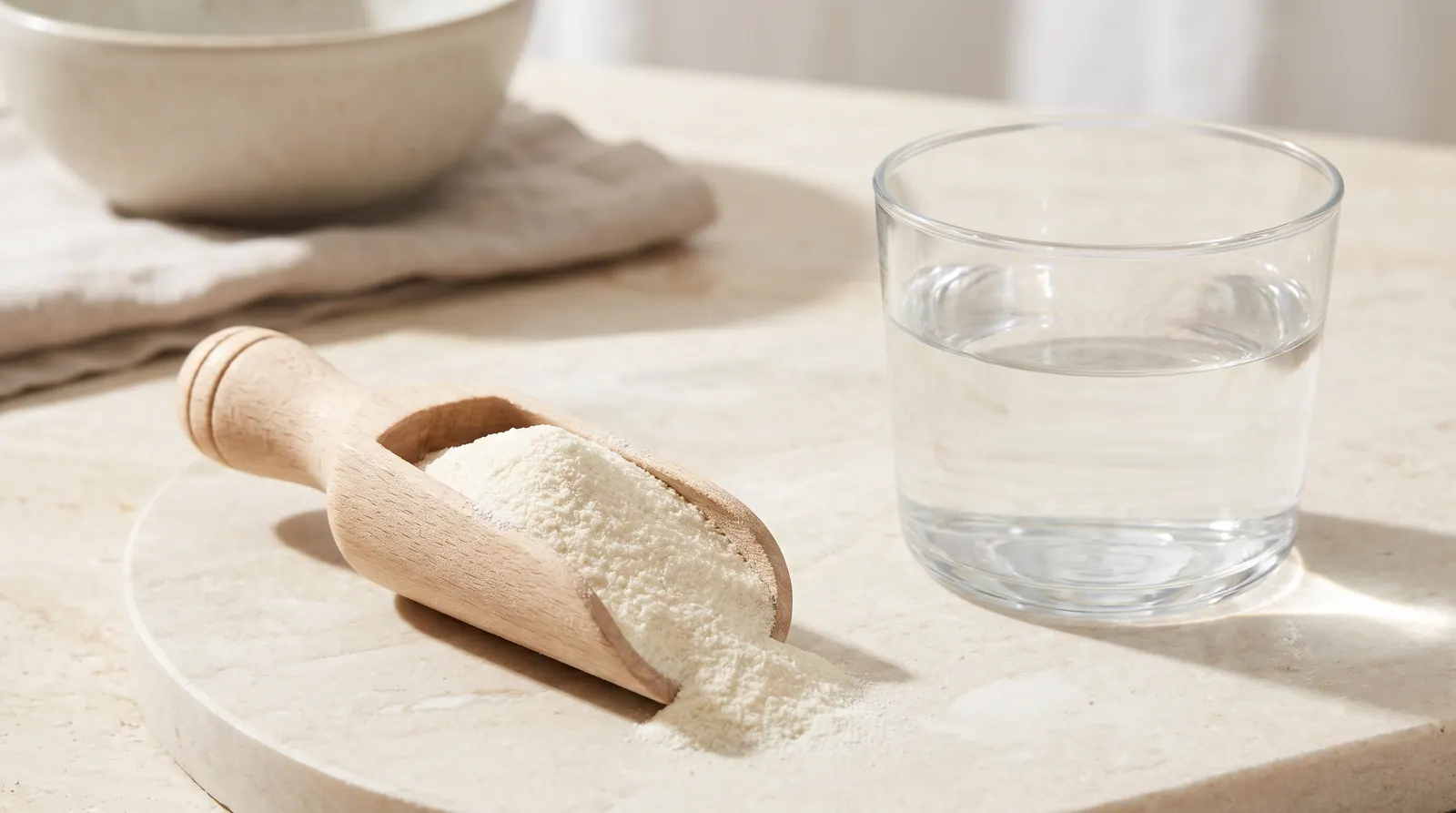
Most supplements today aren't raw collagen but "collagen peptides" or "hydrolyzed collagen," both terms referring to the same thing: collagen that has been pre-fragmented into smaller pieces for easier absorption. This low-molecular-weight form is what most clinical trials test.
Practically speaking: Pre-fragmentation makes absorption easier, which is the basis for the promising studies we'll see. But note that "easier absorption" doesn't automatically mean "reaches your skin and becomes collagen there." The claim needs evidence, and the evidence, as you'll see, is promising but limited.
Are You a Real Candidate for Trying the Supplement? — Self-Assessment
This is a guiding assessment to help you differentiate between a potential need and marketing hype. It does not replace consulting a doctor or nutritionist. Choose what applies to you:
What Does Skin Evidence Say?
This is where collagen has its strongest case. A double-blind, placebo-controlled trial on 66 women aged 35-55, taking a daily dose of hydrolyzed collagen for eight weeks, found statistically significant improvements in skin elasticity compared to placebo, which persisted for four weeks after stopping.
Other studies support this trend: a trial on 64 women with a daily dose for twelve weeks increased skin hydration from week six and improved wrinkles by week twelve. Another on 112 women with a daily dose for eight weeks found higher elasticity, hydration, and smoothness compared to placebo. The practical takeaway: the trend is promising and real, but note the pattern — improvement after weeks, not days, in specific populations, with measurable differences, not radical transformations.

What Does Joint Evidence Say?
The evidence here is weaker than for skin but present. A double-blind, placebo-controlled trial on 147 athletes with activity-related joint pain, taking a daily dose of hydrolyzed collagen for 24 weeks, showed improvements in pain markers compared to placebo in an active group without diagnosed joint disease.
Practically speaking: This result is in a specific context—active athletes, long duration, and subjective pain measurement. Do not generalize it to all joint pain or consider it a treatment for osteoarthritis or inflammation. If you have persistent joint pain or a diagnosed condition, see a doctor first. The supplement is a potential option under their supervision, not a substitute for treatment.
Vitamin C's Role in Collagen Synthesis
Here's a fact many overlook: your body needs Vitamin C to synthesize collagen in the first place. Vitamin C is a cofactor for enzymes that stabilize collagen structure, helping to convert proline and lysine into their hydroxylated forms (hydroxyproline and hydroxylysine) that give collagen its stability. Severe Vitamin C deficiency impairs this synthesis, as historically seen in scurvy.
Collagen synthesis also requires zinc, copper, and amino acids like proline and glycine. The practical message: Before spending money on a collagen supplement, ensure your body's collagen factory has its building blocks—varied protein, citrus fruits, bell peppers, and leafy greens. Collagen without Vitamin C is like bricks without mortar.

Where to Find It in Your Food — Broth and Protein Generally
In food, collagen is naturally found only in animal products: meats and fish containing connective tissue, and fish bones and skin. This is the origin of bone broth's popularity as a traditional source. However, what's more important for building is ensuring the collagen building blocks through varied protein and co-nutrients, rather than just ingesting ready-made collagen:
| Source | What it Provides |
|---|---|
| Bone Broth | Animal collagen from bones and connective tissue |
| Meats and Poultry with Skin | Animal collagen, glycine, and proline |
| Fish and Fish Skin | Collagen and high-quality protein |
| Egg Whites | Proline, a building block for collagen |
| Citrus Fruits, Strawberries, Bell Peppers | Vitamin C, a synthesis cofactor |
| Leafy Greens and Broccoli | Vitamin C and supportive antioxidants |
| Legumes, Nuts, and Seeds | Zinc, copper, and plant-based protein |
| Cashews and Sesame Seeds | Copper, necessary for collagen production |
Practically speaking: Don't chase ready-made collagen as much as you ensure its production. A plate with animal protein or fish, alongside citrus or bell peppers, gives your body the building blocks and the cofactor together.

Plant-Based Collagen — A Gentle Myth
There is no collagen in plants. Collagen is an animal protein synthesized in connective tissues like bones, skin, and cartilage, and plants lack these tissues and the machinery to produce them. Therefore, plant-based or vegan collagen does not exist as you might expect.
So, what are these products? Often, they are blends of collagen-building components: Vitamin C, zinc, copper, and amino acids that support your body's ability to produce its own collagen. This is indeed beneficial, but it's not collagen, and the labeling is misleading. Practically speaking: If you are vegan, your goal isn't "plant-based collagen" but ensuring the building blocks from your diet, which are abundantly available in plants.
Who Might Benefit and Who Might Not
Those interested in skin elasticity and willing to commit for weeks, or those with activity-related joint pain with an understanding of the limited context, or those with a protein-deficient diet that's hard to diversify, might try the supplement. These individuals would try it with realistic expectations, not expecting a miracle.
Who likely doesn't need it: Those who consume sufficient and varied protein with adequate Vitamin C, as their body already finds its building blocks. The practical rule: The supplement is not the first step nor a magic solution. Start with your plate. If you try the supplement, do so with modest expectations and consult your doctor if you are pregnant, on chronic medication, or have a health condition.
What Science Really Says
Studies on collagen peptides for skin are promising and real, with some finding improvements in elasticity, hydration, and wrinkles after weeks. However, the broader picture calls for humility: most collagen supplement research is funded, partially or fully, by related industries, making it difficult to assess their true efficacy.
Furthermore, supplements are not subject to regulatory review for safety and efficacy before being sold, with concerns about some containing heavy metals. The practical conclusion: Don't promise yourself a transformation from a collagen pill. Treat it as a limited, evidence-based supportive option, and make your foundation a plate that builds your collagen from protein and Vitamin C—this is cheaper and more reliable.
Five Common Collagen Myths
Promises larger than the evidence circulate around collagen. Here are the most prominent, and what reliable sources say:
"The collagen I swallow goes directly to my skin."
"Collagen cream replaces what my face has lost."
"Plant-based collagen exists, just like animal collagen."
"Collagen supplements are proven and guaranteed to work for everyone."
"As long as I take collagen, my rest of my diet doesn't matter."
Practical Tips to Implement Today
Before you get to the full protocol, here are small guidelines from the core of the above, building collagen from your plate and making the supplement decision informed, not rushed:
- Ensure varied protein daily. Meats, fish, eggs, and legumes provide your body with collagen building blocks like glycine and proline, the foundation of any real structure.
- Make Vitamin C present on your plate. A citrus fruit, bell pepper, strawberry, or leafy green with your meal is a crucial cofactor for collagen synthesis.
- Don't forget zinc and copper. Legumes, nuts, seeds, cashews, and sesame seeds support collagen production, so diversify your sources instead of focusing on one element.
- Consider bone broth a gentle source, not medicine. It provides animal collagen within a balanced diet but isn't a magic bullet for skin or joints.
- Don't be fooled by the word "plant-based" on a collagen container. There is no collagen in plants; what you buy are building blocks, which you can find in your food much cheaper.
- If you try the supplement, manage your expectations. Results in studies appear after weeks, not days, with measurable differences, not radical transformations.
- Understand that supplements are not regulated like medicine. Choose a reputable brand and beware of exaggerated promises, as supplements are not reviewed for safety and efficacy before sale.
- Start with your plate before the shelf. Don't buy a supplement until you've ensured your protein and Vitamin C intake are sufficient; the foundation is cheaper and more reliable.
EEINA's Protocol for Building Collagen from Your Plate
A practical plan combining the above into three tiered layers. Start layer by layer, and note your response to know what works for you.
The protocol is based on collagen digestion mechanisms, synthesis requirements, and limited peptide evidence.
Build Collagen Building Blocks
Four daily habits.
Decide Consciously, Not Hype-Driven
Before buying any supplement.
Try and Evaluate Under Guidance
If you decide to try.
Golden Rule: The goal isn't a pill you swallow to nourish your skin, but a plate that provides your body with collagen building blocks and its cofactor. Supplements are a limited, evidence-based supportive option, not a first step or a miracle.

Frequently Asked Questions
Does collagen supplement go directly to my skin?
Have studies proven that collagen peptides improve skin?
What is the role of Vitamin C with collagen?
Does plant-based collagen exist?
Who might benefit from collagen supplements and who might not?
When to See a Doctor — Red Flags
Collagen is, in most cases, a matter of aesthetics and well-being, but some symptoms go beyond that and require immediate medical evaluation:
- Severe, swollen, or persistent joint pain, or loss of mobility, requires diagnosis, not a supplement.
- Unusual skin changes: rashes, sores, or slow wound healing require a doctor's assessment of the cause.
- Symptoms suggesting nutritional deficiency like bleeding gums or easy bruising may require Vitamin C assessment, not collagen.
- Allergic reactions after a supplement like rash, swelling, or shortness of breath; stop immediately and seek emergency care if needed.
- Pregnancy, breastfeeding, chronic medication, or a health condition before starting any collagen supplement.
- Concerns about product quality, as supplements are not reviewed for safety before sale, and some may contain heavy metals.
Start Your Next Step with EEINA
Collagen-Building Meal Plans
Saudi recipes combining varied protein with Vitamin C in your day, to nourish your body's collagen factory.
Get Your Plan ←Broth & Protein Recipes
Easy ideas for bone broth and animal protein with Vitamin C-rich vegetables on your plate.
Try Them ←EEINA App
Tracks your daily protein and Vitamin C intake, reminding you of meals that build collagen from its true source.
Download Now ←