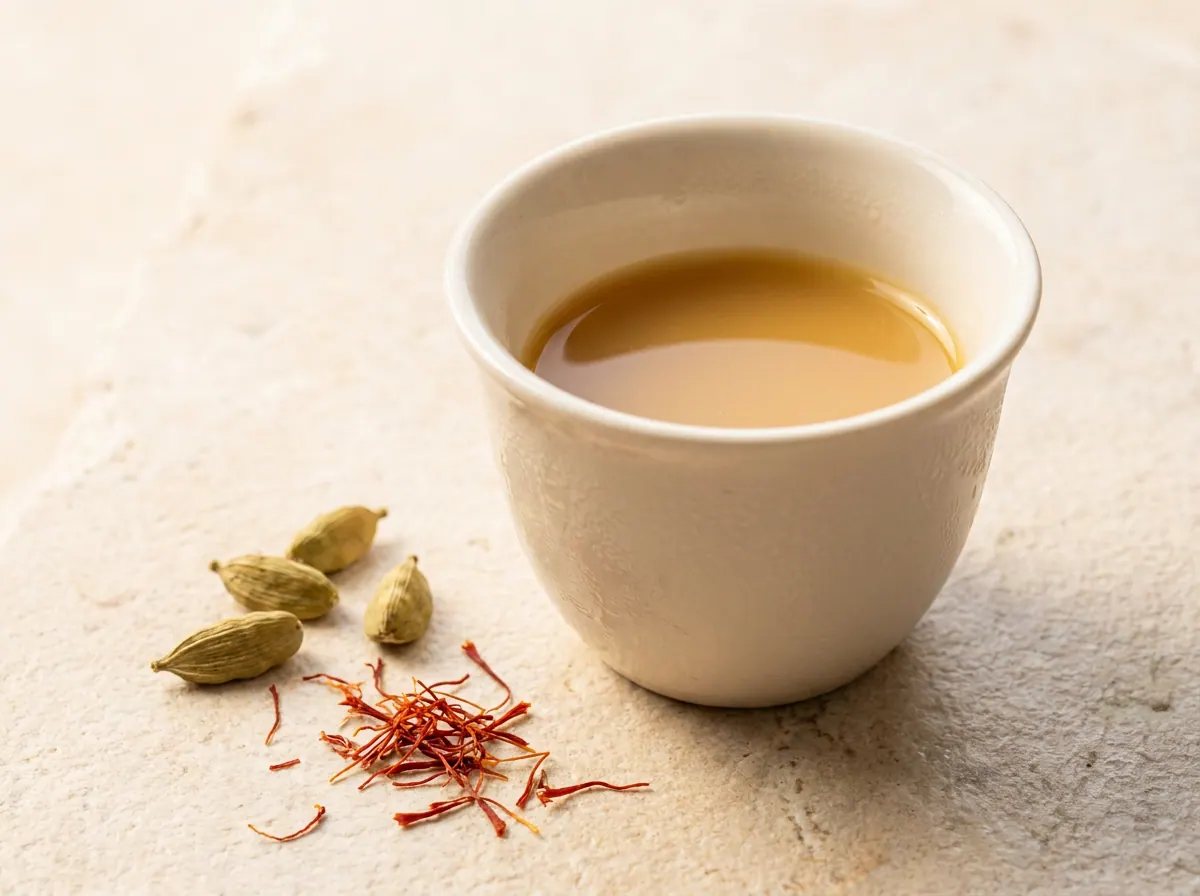
Traditional Saudi Arabic coffee — lightly roasted beans brewed with cardamom and saffron in a dallah, served without sugar or milk. A beverage listed on UNESCO's Intangible Cultural Heritage List, GI zero when unsweetened.
Arabic coffee in Saudi Arabia is a symbol of hospitality before it is a beverage. Lightly roasted beans brew slowly in a dallah, perfumed with cardamom and saffron, then poured into a small finjan always offered to the right, alongside dates. It is listed on UNESCO's Intangible Cultural Heritage list and is described internationally as a light coffee served without sugar or milk.
What makes it nutritionally distinctive is that it is a pure black coffee: without sugar or milk, it is virtually devoid of calories and carbohydrates, carrying almost no glycemic burden. Cardamom adds flavour and aromatic compounds; saffron adds its distinctive golden colour. All of this holds on one condition: it is not sweetened, because any added sugar changes the picture entirely.
Preparation Steps
Boil the water
Bring the water to a boil in a dallah or saucepan over medium heat.
Add the coffee
Add the lightly roasted Arabic coffee and stir, then lower the heat and allow the mixture to simmer gently for 10 to 12 minutes without excessive stirring.
Add the cardamom
Remove from the heat and let the grounds settle briefly, then add the ground cardamom.
Steep with saffron
Add the cloves, saffron, and rose water if using, and leave the coffee to steep a few minutes so the golden colour and flavour can develop fully.
Strain
Strain the clear coffee into the serving dallah to separate it from the grounds.
Serve
Serve hot in small finjan cups without sugar or milk, traditionally alongside dates.
Blood Sugar Impact
The glycemic index (GI) measures how quickly a food raises blood sugar, while the glycemic load (GL) measures how much a full serving raises it. Together they give the complete picture.
Glycemic Index
GI
0Low
Low0–55Medium56–69High70+
A low value (≤55) means a gradual rise in blood sugar — the most suitable range for diabetes and insulin resistance.
Glycemic Load
GL
0Low
Low0–10Medium11–19High20+
Glycemic load reflects the impact of the full serving. To lower it: take half a serving, or pair the recipe with a source of protein and fiber.
Nutritional Information
Per ServingMakes 6 servings · one serving is about 125 g of raw ingredients
Calories0 kcal0%of Daily Value*
Protein0 g0%of Daily Value*
Carbohydrates0 g0%of Daily Value*
Fat0 g0%of Daily Value*
Fiber0 g0%of Daily Value*
Sodium0 mg0%of Daily Value*
* Percent Daily Values are based on a 2,000-calorie diet per FDA food-label reference values — your daily needs may be higher or lower. Values are derived from the recipe's ingredients via the USDA database.
Troubleshooting
The most common problems when preparing Saudi Qahwa with cardamom and saffron, and how to fix them:
The coffee came out dark instead of golden
Dark-roast beans were used instead of light-roast, or it was simmered too long. Saudi Arabic coffee relies on lightly roasted beans — that is what gives it its pale golden colour. Choose beans described as light roast and stick to a gentle simmer of ten to twelve minutes. saffron deepens the golden tone, not the brown.
The cardamom flavour is faint and doesn't come through
The cardamom was added early with the coffee and its aromatic oils evaporated during the long simmer. Add the ground cardamom after removing the dallah from the heat and let it steep in the residual warmth for a few minutes. Freshly grinding a pod just before adding gives a cleaner flavour than pre-ground cardamom.
Grounds seep into the finjan
The coffee was poured immediately without letting the grounds settle, or it was poured without straining. Leave the dallah for a minute or two after simmering so the grounds sink to the bottom, then strain the clear coffee into the serving dallah. Pouring slowly from a low height minimises disturbing the sediment.
The coffee is excessively bitter
Too many beans or too long a simmer. The balanced ratio is about three tablespoons of coffee per three cups of water. Use slightly less coffee next time and keep to a gentle simmer, not a rolling boil. Cloves and rose water balance the bitterness without sweetening.
The saffron gave no colour or flavour
The saffron was added to lukewarm coffee or the quantity was too small. saffron needs heat and steeping time to release its colour and compounds. Add the threads to the coffee while it is still hot after removing from the heat, and leave it to steep for a few minutes. A small pinch is all you need — excess gives a medicinal taste.
Storage and Make-Ahead
Refrigerator (4°C)
Strained coffee: store in a sealed container for one day maximum. It loses some of its cardamom and saffron aroma after a few hours but remains safe. Reheat gently over low heat without re-boiling to avoid increasing bitterness.
Freezer (-18°C)
Not recommended. Freezing does not benefit an aromatic beverage best enjoyed fresh, and its delicate flavour dissipates after thawing. Arabic coffee is a brew-and-serve drink.
Advance preparation
Spice blend: grind the cardamom and saffron in advance and store in a sealed container away from light. Coffee: grind fresh before use for the best flavour; store any remainder in a sealed container.
Serving
Serve hot in small finjan cups, traditionally with dates. A well-insulated dallah keeps it warm for hours during hospitality. Do not leave it on a continuous flame — it will become increasingly bitter.
Tested Ingredient Substitutions
Original Ingredient
Tested Substitute
Ratio
Flavor Difference
saffron
Extra clove or dried lemon peel
1 extra clove
Loses the golden colour; warmer, more pungent flavour
Darker colour and stronger flavour, moves away from the traditional golden character
Rose water
Orange blossom water
same amount
A different floral fragrance, lighter than rose water
How Much Does It Make? Scaling Guide
Number of cups
Light-roast coffee
Water
Cardamom
saffron
3 (small pitcher)
1.5 tbsp
1.5 cups
0.25 tsp
3 strands
6 (base)
3 tbsp
3 cups
0.5 tsp
5–6 strands
12 (entertaining)
6 tbsp
6 cups
1 tsp
10–12 strands
18 (large dallah)
9 tbsp
9 cups
1.5 tsp
~18 strands
EEINA Nutrition Tip
Coffee without sugar is the secret to its neutrality on blood glucose: Saudi coffee is traditionally served without sugar, and that is precisely what makes it suitable for people with diabetes and for calorie reduction. Every spoonful of sugar added converts it from a zero-glycemic-load beverage into a source of fast sugar. Keep to the tradition — the dates alongside are enough sweetness.
Add This Recipe to Your Plan
The EEINA app saves your favorite recipes, calculates them from their real ingredients, and shows your daily numbers toward your goal. Try it free now.
It does not raise blood sugar when unsweetened, because it is a black coffee virtually free of carbohydrates. This holds only as long as it is not sweetened — any added sugar changes this entirely.
Is it suitable for people with diabetes?
Suitable without sweetening, as its glycemic load is zero. That said, caffeine content should be considered, and moderation is advised — especially alongside medications or other health conditions.
Why is it served without sugar or milk?
This is the documented tradition of Saudi Arabic coffee — it is served black and light alongside dates, which provide the accompanying sweetness.
What is the difference between light and dark roast here?
Arabic coffee uses light-roast beans, giving it its golden colour and lighter flavour. One study found higher antioxidant activity in lightly roasted beans compared to dark-roasted ones.