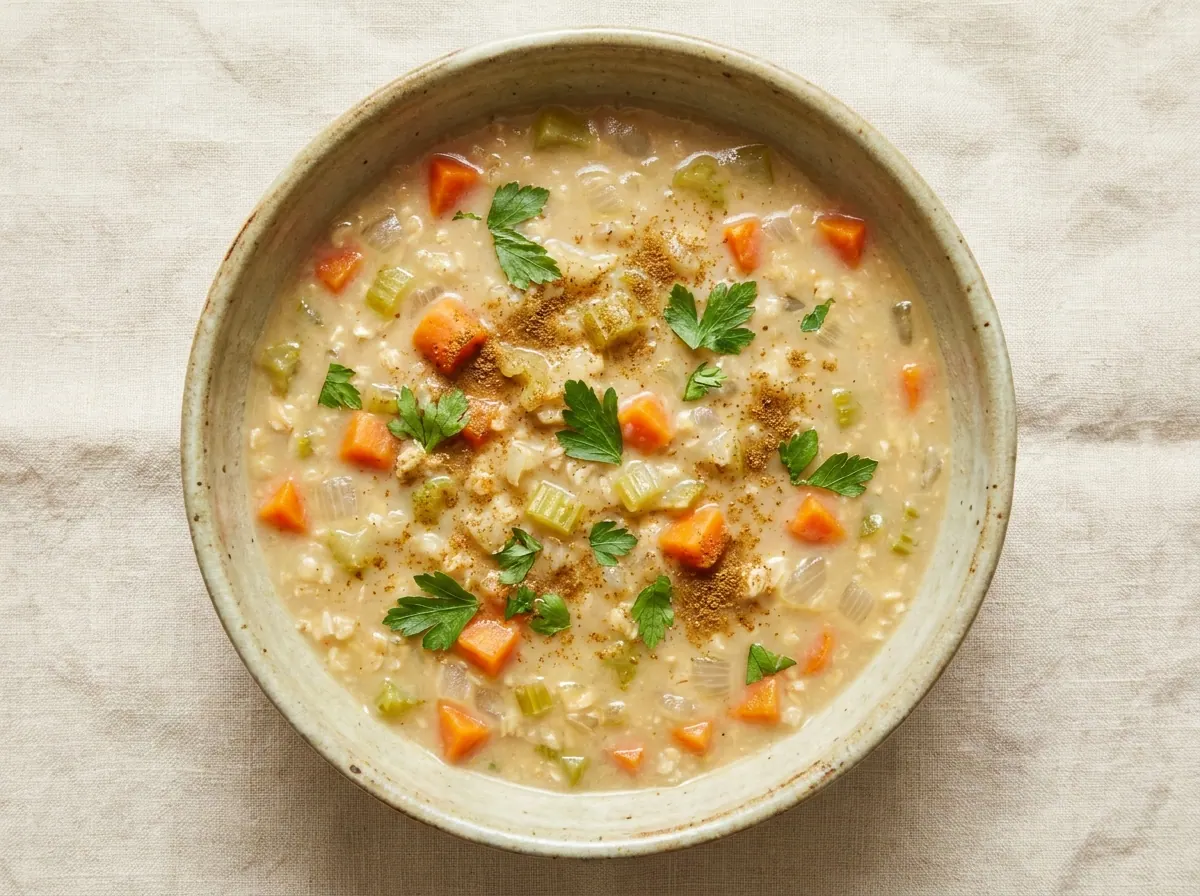
A warming soup of whole oats and vegetables — carrots, celery and onion — thickened naturally by the oat starch without flour or cream. High in fibre and suitable for weight-management and heart-health goals.
This soup came from a simple question: what if the thickening agent in a classic vegetable soup were whole oats instead of flour or cream? The answer turned out to be better than expected — oats dissolve gently into the hot stock, releasing their natural starch and giving the soup a silky, satisfying body without any fat or refined carbohydrate.
Carrots, celery and onion add colour and sweetness; cumin and turmeric give it a warm, golden hue and a gentle spiced aroma. It is the kind of soup that needs only a thick slice of whole-grain bread to become a complete meal.
Preparation Steps
Sauté the aromatics
Heat the olive oil in a large pot over medium heat. Add the diced onion and cook, stirring, for 3 to 4 minutes until softened and translucent. Add the garlic and cook for 30 seconds more until fragrant. Building this aromatic base before adding liquid deepens the flavour of the finished soup.
Add the vegetables
Add the diced carrots and sliced celery and stir well. Cook for 2 minutes so the vegetables absorb the aromatics. The brief sauté caramelises their surfaces slightly and adds depth.
Add the spices
Sprinkle in the ground cumin and turmeric and stir for 30 seconds until the spices are fragrant and evenly coat the vegetables. Toasting the spices briefly in oil before adding liquid releases their fat-soluble flavour compounds.
Add the stock and oats
Pour in the vegetable stock and bring to a boil over high heat. Once boiling, add the whole rolled oats and stir well. Reduce the heat to medium, season with salt and pepper, and cook uncovered for 15 minutes, stirring occasionally. The oats will swell and release their starch, thickening the soup naturally.
Adjust the consistency
After 15 minutes, check the soup's consistency. If it is too thick, add a splash of hot water or stock and stir. If you prefer a smoother texture, blend half the soup and stir it back into the pot. A blended-and-whole combination gives a creamy body while retaining some texture.
Finish and serve
Taste and adjust the seasoning. Add the lemon juice if desired for brightness. Ladle into bowls and garnish with fresh parsley or coriander. Serve hot.
Check the oats
The soup is ready when the oats are fully tender and have absorbed the stock. Run a spoon through the soup — it should leave a brief trail that closes slowly, indicating the right starchy thickness.
Blood Sugar Impact
The glycemic index (GI) measures how quickly a food raises blood sugar, while the glycemic load (GL) measures how much a full serving raises it. Together they give the complete picture.
Glycemic Index
GI
13Low
Low0–55Medium56–69High70+
A low value (≤55) means a gradual rise in blood sugar — the most suitable range for diabetes and insulin resistance.
Glycemic Load
GL
1Low
Low0–10Medium11–19High20+
Glycemic load reflects the impact of the full serving. To lower it: take half a serving, or pair the recipe with a source of protein and fiber.
Nutritional Information
Per ServingMakes 4 servings · one serving is about 505 g of raw ingredients
Calories125 kcal6%of Daily Value*
Protein2 g4%of Daily Value*
Carbohydrates14 g5%of Daily Value*
Fat7 g9%of Daily Value*
Fiber3 g11%of Daily Value*
Sodium1552 mg67%of Daily Value*
Potassium363 mg8%of Daily Value*
Phosphorus52 mg4%of Daily Value*
* Percent Daily Values are based on a 2,000-calorie diet per FDA food-label reference values — your daily needs may be higher or lower. Values are derived from the recipe's ingredients via the USDA database.
Troubleshooting
The most common problems when preparing Oat and Vegetable Soup, and how to fix them:
The soup is too thick and gluey
Too many oats or cooked for too long. Add hot stock or water and stir over gentle heat until you reach the consistency you want.
The soup is watery and thin
Too much liquid. Simmer uncovered for 5 more minutes to reduce, or add 2 tablespoons of ground oats dissolved in a little cold water.
The vegetables are mushy and falling apart
Cut into larger pieces and add them after the stock has come to a boil. Carrots need about 15 minutes — do not add them at the very start.
The soup tastes bland
Toast the cumin and turmeric in the oil before adding the vegetables. Season with salt at the end, not the beginning, and finish with a squeeze of lemon juice to lift all the flavours.
The oats formed lumps
Add the oats to boiling stock while stirring continuously, and stir again 2 minutes after adding. Rolled oats blend smoothly if stirred in early and given enough liquid.
Storage and Make-Ahead
Refrigerator
Store in an airtight container for up to 3 days. The soup thickens considerably as the oats continue absorbing liquid — add a splash of stock when reheating and stir well.
Freezer
Freeze in individual portions for up to 2 months. The texture may change slightly on thawing; stir vigorously after reheating. Best frozen before adding fresh herbs.
Reheating
Reheat gently over low to medium heat with a splash of water or stock. Bring to a simmer before serving, as soups with oats need to be piping hot all the way through.
Safety
Do not leave at room temperature for more than 2 hours. Cool quickly before refrigerating by spreading into a shallow container.
Tested Ingredient Substitutions
Original Ingredient
Tested Substitute
Ratio
Flavor Difference
Whole rolled oats
Steel-cut oats
Use 75 g
Adds more texture but needs 10 extra minutes of cooking. Less creamy but more chewy.
Carrots
Butternut squash or sweet potato
1:1 by volume
Sweeter flavour and a richer golden colour. Cut into similarly sized pieces.
Vegetable stock
Low-sodium chicken stock
1:1
No longer vegetarian, but adds more depth for those who eat poultry.
Celery
Fennel
1:1
Adds a mild anise flavour that pairs well with the cumin and turmeric.
Cumin + turmeric
Za'atar spice blend
1 tsp
A Levantine twist that gives the soup a herby, tangy profile.
How Much Does It Make? Scaling Guide
Number of servings
Carrots
Vegetable stock
Carrots
Olive oil
2 (individual × 2)
75 g
0.75 liter
1
1 tbsp
4 (base)
150 g
1.5 liters
2
2 tbsp
6 (family)
225 g
2.25 liters
3
3 tbsp
8 (entertaining)
300 g
3 liters
4
4 tbsp
EEINA Nutrition Tip
Use low-sodium or homemade stock — many commercial stocks are high in sodium, which undermines the heart-health benefit of the oats. If you want more protein, add a cup of cooked chickpeas or lentils in the last 5 minutes of cooking.
Add This Recipe to Your Plan
The EEINA app saves your favorite recipes, calculates them from their real ingredients, and shows your daily numbers toward your goal. Try it free now.
Oats are naturally gluten-free but are often processed alongside wheat and can be cross-contaminated. If you have coeliac disease or severe gluten sensitivity, use oats labelled certified gluten-free.
Is it suitable for people with diabetes?
Yes — the combination of soluble oat fibre (beta-glucan) and vegetable fibre gives it a low glycaemic load. Serve a moderate portion alongside a protein source for the best blood-sugar effect.
Can I make it fully smooth like a blended soup?
Yes — blend the entire pot with a stick blender until completely smooth. The oat starch makes it naturally thick and velvety, so no cream is needed.
Can I add protein?
Absolutely. Add cooked chickpeas, lentils or shredded chicken breast in the last 5 minutes of cooking for a more complete meal.
Why does the soup thicken so much after refrigerating?
Oats continue to absorb liquid even when cold. This is normal — simply add a splash of hot water or stock when reheating and stir until it loosens to your preferred consistency.
Sources: USDA · University of Sydney · Gulf GSO · Our methodology · Updated on