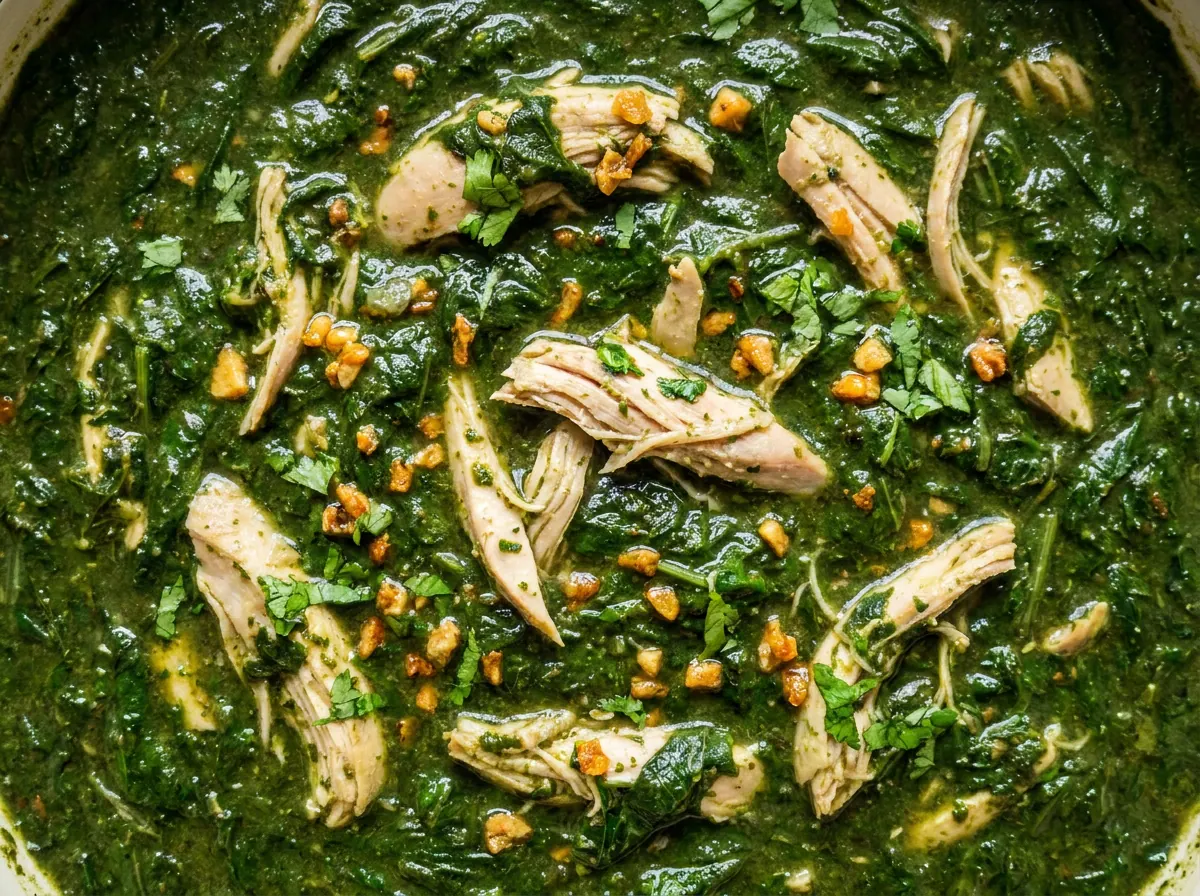
Molokhia (jute leaf stew) with chicken, garlic, and coriander, served over white rice in the Egyptian-Levantine style. Rich in iron and protein — GI 64 for the mixed meal with rice.
Molokhia is a dish deeply rooted in Egyptian and Levantine cuisine, based on the leaves of the jute plant (Corchorus olitorius) finely chopped and cooked in chicken broth with garlic and coriander. It has been a staple on the tables of Egypt, Lebanon, and across the Arab world for centuries, passed down as a family recipe from generation to generation.
The secret of its flavour is the taqlia: minced garlic sauteed in ghee with coriander until fragrant, then poured over the pot. Traditionally served over white rice with lemon wedges — it is the rice that determines the meal's impact on blood sugar, not the light leafy molokhia itself.
Preparation Steps
Poach the chicken
Poach the chicken thighs in water with a peeled medium onion, 2 bay leaves, 3 cardamom pods, and a little salt until cooked through (about 30 minutes). Remove the chicken and set aside. Strain the broth, keep it, and discard the onion, bay leaves, and cardamom.
Prepare the molokhia and the taqlia
If frozen, allow the molokhia to thaw; if fresh, wash, dry thoroughly, and chop finely. Meanwhile, finely mince 6 garlic cloves and chop half a cup of fresh green coriander (about 20 g), and keep them ready for the taqlia.
Cook the molokhia in the broth
Add the molokhia to the simmering broth over low heat and stir gently. Cook without vigorous boiling to prevent clumping (about 10 to 15 minutes).
Prepare the taqlia
In a small pan, heat the ghee and fry the minced garlic with the ground dried coriander and the fresh chopped coriander until fragrant. This is the taqlia — it is the soul of the dish.
Add the taqlia
Pour the taqlia over the molokhia pot and stir. Leave the mixture over low heat for a few more minutes.
Brown the chicken
Optional step: brown the poached chicken pieces in the oven or in a pan for deeper flavour, then return them to the pot or serve alongside.
Final seasoning
Adjust the salt and add 2 tablespoons of lemon juice just before serving.
Serve
Serve the molokhia hot over cooked white rice with lemon wedges, and optionally with finely chopped onion soaked in vinegar alongside.
Blood Sugar Impact
The glycemic index (GI) measures how quickly a food raises blood sugar, while the glycemic load (GL) measures how much a full serving raises it. Together they give the complete picture.
Glycemic Index
GI
64Medium
Low0–55Medium56–69High70+
A low value (≤55) means a gradual rise in blood sugar — the most suitable range for diabetes and insulin resistance.
Glycemic Load
GL
31High
Low0–10Medium11–19High20+
Glycemic load reflects the impact of the full serving. To lower it: take half a serving, or pair the recipe with a source of protein and fiber.
Nutritional Information
Per ServingMakes 4 servings · one serving is about 425 g of raw ingredients
Calories464 kcal23%of Daily Value*
Protein35 g70%of Daily Value*
Carbohydrates52 g19%of Daily Value*
Fat13 g17%of Daily Value*
Fiber3 g11%of Daily Value*
Sodium132 mg6%of Daily Value*
* Percent Daily Values are based on a 2,000-calorie diet per FDA food-label reference values — your daily needs may be higher or lower. Values are derived from the recipe's ingredients via the USDA database.
Troubleshooting
The most common problems when preparing Molokhia with Chicken, and how to fix them:
Molokhia clumped into sticky balls
The most common cause: vigorous boiling after adding the leaves. Cook on very low heat with gentle stirring — strong boiling causes the leaves to bunch together. For an immediate fix: lower the heat and lightly beat the surface with a hand whisk to break up the clumps. Next time: add the leaves to warm broth then raise the heat gradually, and do not allow a rolling boil.
Molokhia is too watery and thin
Too much broth for the quantity of leaves. Egyptian molokhia should be between a soup and a sauce in consistency. To fix: leave it to simmer uncovered for a few extra minutes until some liquid evaporates and the texture firms up. Do not add starch as it changes the traditional taste.
Flavour of the molokhia is flat without depth
The taqlia is weak or was added cold. The taqlia is the soul of the dish: garlic sauteed in hot ghee with coriander until golden and fragrant, then poured over the pot while still sizzling. If the garlic was cooked until burnt it will turn bitter, so the limit is light golden — not dark brown.
Garlic burnt and turned bitter
Heat too high or left too long. Minced garlic turns from golden to burnt in seconds. Saute it over medium heat, stir constantly, and remove it the instant it turns golden and fragrant. If it burnt, the safest approach is to start fresh with a clean batch of garlic, as bitterness transfers to the entire pot.
Chicken is dry and tough
Poached over high heat for too long. Thighs stay tender over low heat — vigorous boiling tightens the fibres. For deeper flavour: poach only until cooked through, then brown in the oven for a few minutes per side rather than prolonging the poach. Keep the broth — it is more valuable to the dish than the chicken.
Molokhia colour faded and is no longer bright green
Cooked too long or boiled vigorously. The bright green colour is preserved when the leaves are cooked for just a few minutes over low heat. Excessive cooking turns the colour to a dull olive. Add the leaves in the final stages of cooking, turn off the heat after 10 to 15 minutes, and do not keep the pot on the heat after it is done.
Storage and Make-Ahead
Refrigerator (4°C)
Cooked molokhia: maximum three days in an airtight container. Store the rice separately and reheat each at serving time. Cooked chicken: up to three to four days in the refrigerator per USDA recommendations for cooked poultry.
Freezer (-18°C)
Cooked molokhia freezes well for up to two months in an airtight container. Thaw in the refrigerator the night before reheating. Freeze the rice separately. The taqlia is best made fresh when reheating.
Meal prep
Broth: poach the chicken and strain the broth a day ahead and refrigerate. Fresh molokhia chopping: wash, dry, chop, and refrigerate for up to one day. Final step: cook the leaves in the broth and add the taqlia just 30 minutes before serving for best colour and flavour.
Reheating and serving
Reheat the pot over low heat with stirring, without vigorous boiling to prevent the leaves from clumping. Do not leave molokhia out of the refrigerator for more than two hours per the USDA food safety rule. Add a fresh taqlia before serving for stronger aroma.
Tested Ingredient Substitutions
Original Ingredient
Tested Substitute
Ratio
Flavor Difference
Fresh molokhia
Frozen molokhia
same weight
Easier to find, similar texture — add directly after thawing
Chicken thighs
Skinless chicken breast
same weight
Less fat and higher protein, but dries out faster so poach moderately
White rice
Brown rice or whole grain
same quantity
Lowers the glycaemic index and glycaemic load, deeper flavour and higher fibre
Ghee
Extra-virgin olive oil
same quantity
Unsaturated monounsaturated fats better for the heart, lighter flavour
Chicken (for a vegetarian version)
Vegetable broth and cooked chickpeas
same quantity of broth
Vegetarian version with plant protein — lighter flavour that needs more garlic in the taqlia
How Much Does It Make? Scaling Guide
Number of servings
Molokhia
Chicken
Garlic
Cooked rice
2 (individual × 2)
250 g
250 g
3 cloves
300 g
4 (base)
500 g
500 g
6 cloves
600 g
8 (large family)
1 kg
1 kg
12 cloves
1200 g
12 (entertaining)
1.5 kg
1.5 kg
18 cloves
1800 g
EEINA Nutrition Tip
It is the rice that moves blood sugar, not the molokhia: the green leaves and chicken both have a very low glycaemic index, while a large portion of rice is what raises the glycaemic load to high. For people with diabetes and insulin resistance: reduce the rice to half a cup, or replace it with a whole grain, and the dish's flavour will remain the same with a much lower glycaemic load.
Add This Recipe to Your Plan
The EEINA app saves your favorite recipes, calculates them from their real ingredients, and shows your daily numbers toward your goal. Try it free now.
Very close. Frozen is easier to find and is added directly after thawing. Fresh requires washing, drying, and chopping, and gives a slightly brighter colour with brief cooking.
Is it suitable for people with diabetes?
The molokhia and chicken alone are an excellent low-glycaemic choice. The challenge is the accompanying rice. Reduce the rice to half a cup or substitute a whole grain to bring the glycaemic load into a moderate range.
Why does my molokhia always clump?
Vigorous boiling is the cause. Cook it over very low heat with gentle stirring, and add the leaves to warm broth then raise the heat gradually.
Can it be made vegetarian?
Yes. Replace the chicken broth with vegetable broth and add cooked chickpeas for protein, and increase the garlic in the taqlia to compensate for the depth the chicken imparts.
Sources: USDA · University of Sydney · Gulf GSO · Our methodology · Updated on