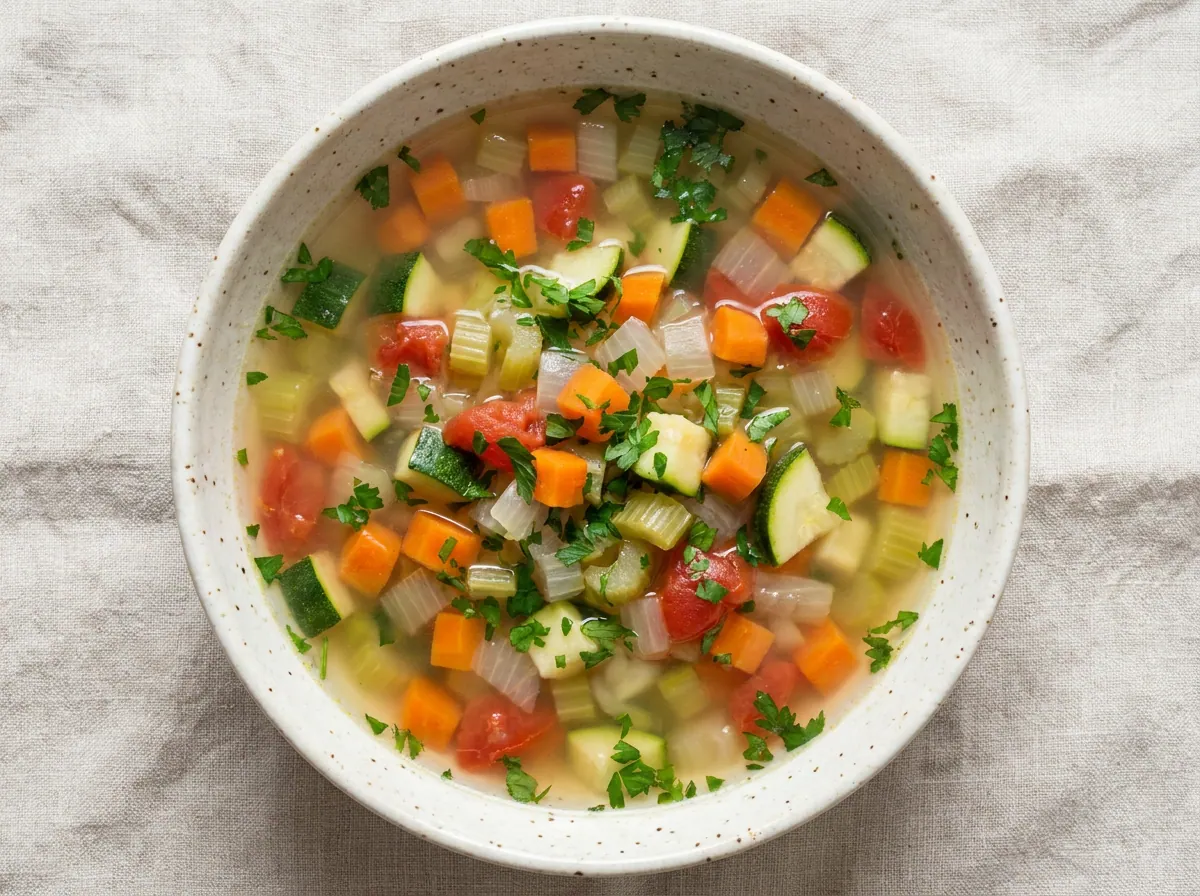
Mixed vegetable soup is a simple dish made from whatever is in the refrigerator, but its real secret lies in what it does not contain. The classic version loaded with potatoes, peas, and pasta turns it into a heavy starchy dish, while our recipe relies solely on low-carbohydrate vegetables, keeping it light on the stomach and on blood sugar alike.
The result is very low energy density — few calories per gram thanks to the high water content. This is exactly what makes a bowl of soup before a meal fill the stomach and reduce how much is eaten afterwards, a mindful eating behaviour that supports weight management [3].
Preparation Steps
Soften the onion and garlic
Heat the olive oil in a pot over medium heat. Add the onion and garlic and stir until softened but not browned.
Add the carrot and celery
Add the carrot and celery and stir for 2 minutes until the flavours begin to open up.
Add the tomatoes
Add the tomatoes and stir until they break down a little and release their liquid.
Pour in the broth
Pour in the vegetable broth, raise the heat to a boil, then reduce to a gentle simmer.
Cook the zucchini
Add the zucchini and let the soup simmer gently until the vegetables are tender but not falling apart.
Season
Season with salt, black pepper, and cumin. Taste and adjust.
Serve
Serve hot, garnished with fresh parsley or coriander. For a thicker consistency, mash a small ladleful of the cooked vegetables and stir back into the pot.
Blood Sugar Impact
The glycemic index (GI) measures how quickly a food raises blood sugar, while the glycemic load (GL) measures how much a full serving raises it. Together they give the complete picture.
Glycemic Index
GI
13Low
Low0–55Medium56–69High70+
A low value (≤55) means a gradual rise in blood sugar — the most suitable range for diabetes and insulin resistance.
Glycemic Load
GL
1Low
Low0–10Medium11–19High20+
Glycemic load reflects the impact of the full serving. To lower it: take half a serving, or pair the recipe with a source of protein and fiber.
Nutritional Information
Per ServingMakes 4 servings · one serving is about 545 g of raw ingredients
Calories95 kcal5%of Daily Value*
Protein3 g6%of Daily Value*
Carbohydrates13 g5%of Daily Value*
Fat4 g5%of Daily Value*
Fiber3 g11%of Daily Value*
Sodium1498 mg65%of Daily Value*
Potassium470 mg10%of Daily Value*
Phosphorus66 mg5%of Daily Value*
* Percent Daily Values are based on a 2,000-calorie diet per FDA food-label reference values — your daily needs may be higher or lower. Values are derived from the recipe's ingredients via the USDA database.
Troubleshooting
The most common problems when preparing Mixed Vegetable Soup, and how to fix them:
Vegetables fell apart and the soup turned cloudy
The simmer was too vigorous and the cooking time too long. Delicate vegetables like zucchini need a gentle simmer, not a rolling boil, and should be added after the firmer carrots. For next time: keep the heat at the lowest setting after the first boil, add the zucchini in the final third of cooking, and turn off the heat as soon as a fork pierces it easily.
Bland, flat flavour
Weak broth or too little seasoning. A light fat-free broth needs support: sauté the onion and garlic well at the start as they are the flavour base, add cumin and black pepper, and a squeeze of lemon juice at the end wakes up all the flavours without adding calories.
Soup is too salty
Ready-made vegetable broth is often high in sodium and salt was added on top. Next time: use low-sodium or homemade broth and season only at the end after tasting. To fix immediately: add a cup of water and a few extra carrot pieces that simmer briefly to absorb and balance the saltiness.
Soup is watery and thin
Too high a broth-to-vegetable ratio. For a thicker consistency without starches: remove a ladleful of the cooked vegetables, mash them and return them to the pot — this thickens the soup naturally. Or leave the pot uncovered for the last 5 minutes to let some liquid evaporate.
Colour faded and turned grey
Green vegetables cooked too long. Zucchini and celery lose their vibrant colour with prolonged heat. Keep the cooking time within the stated range and garnish with fresh parsley or coriander at serving time to restore the lively green colour.
Carrot is still hard while the zucchini is cooked
Both were added at the same time, but carrot needs longer. The rule: firm vegetables (carrot and celery) go in first, soft ones (zucchini) go in later. If this happens: remove the zucchini temporarily, let the carrot finish cooking, then return the zucchini for one final minute only.
Storage and Make-Ahead
Refrigerator (4°C)
Cooked soup: three days in an airtight container after cooling completely. It thickens slightly when cold — add a splash of water when reheating. Uncooked vegetables: cut and stored in a container, two days before cooking.
Freezer (-18°C)
Freezes well for up to three months in airtight containers. The texture remains acceptable as it contains no starch. Zucchini softens slightly after thawing, which is normal.
Meal prep
Chopping vegetables: one day ahead, stored in a container in the refrigerator. Full cooking: the soup's flavour actually improves the next day, making it ideal for advance preparation.
Reheating
Heat over low heat until it simmers lightly, or in the microwave for 2 minutes with a stir in between. Do not leave it out of the refrigerator for more than two hours after cooking.
Tested Ingredient Substitutions
Original Ingredient
Tested Substitute
Ratio
Flavor Difference
Celery
Sliced leek stalk
same quantity
Free from the celery allergen — sweeter and milder flavour
Zucchini
Green squash or small eggplant cubes
same weight
Firmer texture, slightly deeper flavour
Vegetable broth
Water and a low-sodium stock cube
same quantity
More economical — watch the added salt in the cube
Fresh tomatoes
Canned diced tomatoes
1 cup per 2 tomatoes
Deeper colour, more pronounced acidity, available year-round
Cumin
Dried thyme or a bay leaf
a pinch or 1 leaf
Mediterranean character instead of Middle Eastern
How Much Does It Make? Scaling Guide
Number of servings
Mixed vegetables
Broth
Olive oil
2 (individual × 2)
Half the quantity
3 cups
0.5 tbsp
4 (base)
The full quantity
6 cups
1 tbsp
8 (large family)
Double
12 cups
2 tbsp
12 (entertaining)
3×
18 cups
3 tbsp
EEINA Nutrition Tip
A bowl of soup before a meal is a smart strategy: start your meal with a bowl of this soup and its high water content fills the stomach with very few calories, so you eat less afterwards without feeling deprived. A simple habit that supports long-term weight management [4].
Add This Recipe to Your Plan
The EEINA app saves your favorite recipes, calculates them from their real ingredients, and shows your daily numbers toward your goal. Try it free now.
Yes, very much so. The glycaemic load is very low (GL 3) since it contains no starch, so its effect on blood sugar is minimal. A bowl before the meal is an excellent choice.
Does it help with weight loss?
Yes — only 95 calories per serving with high water content that fills the stomach. A bowl before a meal reduces how much is eaten afterwards, a mindful eating behaviour that supports weight management.
How long does it keep in the refrigerator?
Three days in an airtight container after cooling. It also freezes for up to three months since it contains no starch.
How do I make it thicker without starch?
Mash a ladleful of the cooked vegetables and return them to the pot, or leave the pot uncovered for the last 5 minutes to let some liquid evaporate.
Sources: USDA · University of Sydney · Gulf GSO · Our methodology · Updated on