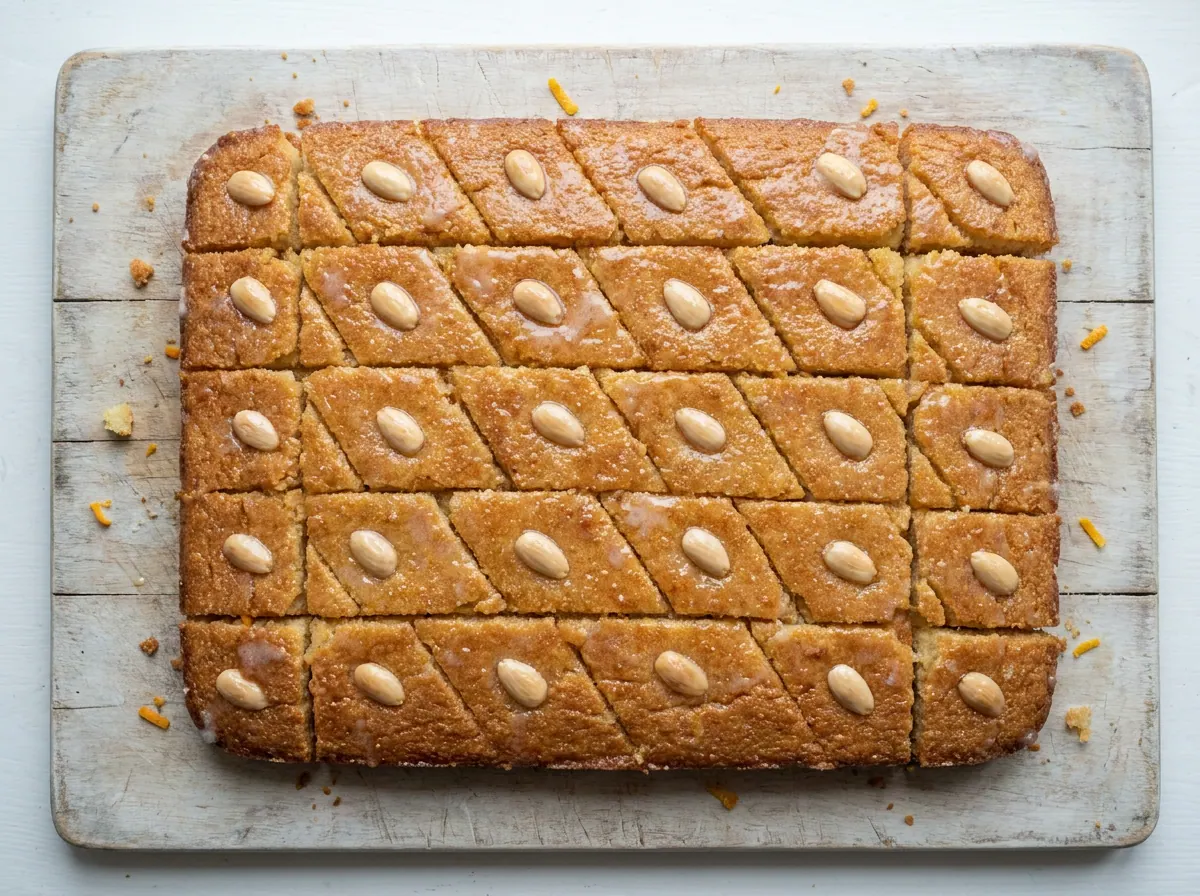
A traditional baked semolina basbousa made with yogurt, most of the syrup replaced by stevia, and a light drizzle of diluted syrup for moisture. A celebration sweet best enjoyed in a small portion; GI 62, medium.
Basbousa (also known as nammoura and hareesa) is a time-honoured semolina sweet found across Egypt, the Levant, Saudi Arabia, and the Gulf. Its foundation is simple: baked semolina moistened with sugar syrup straight from the oven, topped with almonds or coconut.
This version is baked with yogurt — an authentic and widely used method that yields a tender crumb without excess fat. The lightening here is honest, not invented: most of the syrup was replaced by a stevia substitute in the batter, and only half the usual syrup amount is kept for moisture. The result is less added sugar, but it remains a celebration sweet to be enjoyed in small portions — not a daily option.
Preparation Steps
Mix the dry ingredients
Melt the butter. Mix the semolina with the coconut or ground almonds, baking powder, and stevia substitute in a bowl.
Knead and rest
Add the yogurt, melted butter, and orange blossom water. Knead until the mixture is uniform, then leave it to rest for thirty minutes so the semolina absorbs the moisture.
Spread and score
Spread the mixture in a greased tray to a thickness of about two centimetres. Score into diamonds or squares before baking, and press a whole almond onto each piece.
Bake
Bake at 180°C for twenty-five to thirty minutes until the top is golden.
Prepare the diluted syrup
While it bakes, bring the water, a little honey or sugar, and a few drops of lemon to a boil until slightly thickened. Leave to cool.
Apply the light syrup
As soon as the basbousa comes out of the oven, pour the cold diluted syrup over it in a reduced amount (half the usual quantity) for light moisture — not full soaking.
Cool and serve
Leave it to absorb the syrup and cool for twenty minutes before serving in small portions. Serve warm or at room temperature with tea or Arabic coffee.
Blood Sugar Impact
The glycemic index (GI) measures how quickly a food raises blood sugar, while the glycemic load (GL) measures how much a full serving raises it. Together they give the complete picture.
Glycemic Index
GI
62Medium
Low0–55Medium56–69High70+
A low value (≤55) means a gradual rise in blood sugar — the most suitable range for diabetes and insulin resistance.
Glycemic Load
GL
20High
Low0–10Medium11–19High20+
Glycemic load reflects the impact of the full serving. To lower it: take half a serving, or pair the recipe with a source of protein and fiber.
Nutritional Information
Per ServingMakes 12 servings · one serving is about 70 g of raw ingredients
Calories208 kcal10%of Daily Value*
Protein5 g10%of Daily Value*
Carbohydrates34 g12%of Daily Value*
Fat6 g8%of Daily Value*
Fiber2 g7%of Daily Value*
Sodium73 mg3%of Daily Value*
* Percent Daily Values are based on a 2,000-calorie diet per FDA food-label reference values — your daily needs may be higher or lower. Values are derived from the recipe's ingredients via the USDA database.
Troubleshooting
The most common problems when preparing Light Basbousa with Yogurt and Stevia, and how to fix them:
Basbousa came out dry and hard
Two common causes: the batter was not rested before baking, or the baking time was too long. The semolina needs thirty minutes of rest to absorb the yogurt moisture before going into the oven, so each grain cooks from the inside. Watch colour, not just time — as soon as the top turns golden, take it out; every extra minute dries it further.
Bottom is soggy and top is underdone
The layer is too thick, or the oven temperature is too low. Spread the mixture to only two centimetres so it bakes evenly. If your oven bakes more from the top, move the tray to the middle rack and give it five extra minutes while monitoring the bottom with a spatula.
Pieces crumbled when cut after baking
You cut the basbousa while still hot. The rule in the kitchen: score the diamonds or squares before baking while still batter, then let them cool for twenty minutes after the syrup before lifting the pieces. Cooling firms the crumb and gives clean edges.
Flavour is pale and not sweet enough
Stevia substitutes vary in sweetness intensity between brands. Follow the amount stated on the pack equivalent to one-third cup sugar, and taste the batter before baking. For a clearer sweetness without raising sugar much, add a small teaspoon of honey to the diluted syrup, not to the batter.
Too much syrup was poured and it became soggy
You poured the full syrup, or it was hot on top of hot basbousa. This is a light version using only half the syrup — the rule is cold syrup on hot basbousa, poured slowly and evenly for moisture, not soaking. If too much syrup was added, keep extra on the side; the pieces absorb gradually over half an hour.
Storage and Make-Ahead
Room temperature
Two days in an airtight container away from moisture. The basbousa stays tender on the first day and firms slightly on the second.
Refrigerator (4°C)
Five days in an airtight container. Remove a piece fifteen minutes before serving to return to its tender texture, or warm it briefly in the microwave.
Freezer (-18°C)
One full month. Wrap pieces individually then place in a container. Thaw in the refrigerator overnight and warm slightly before serving to restore softness.
Meal prep
Bake the basbousa without syrup and keep it for two days, then pour the cold diluted syrup only thirty minutes before serving so the edges stay firm.
Tested Ingredient Substitutions
Original Ingredient
Tested Substitute
Ratio
Flavor Difference
Low-fat yogurt
Greek yogurt whisked with a little water
same amount
Thicker texture and higher protein, slightly more tangy flavour
Stevia substitute
White sugar or coconut sugar
one-third cup
Full traditional sweetness, but added sugar and glycemic load will rise
Desiccated coconut
Ground almonds
same amount
Deeper almond flavour and a slightly softer crumb
Butter
Clarified ghee
same amount
More pronounced traditional ghee flavour and stronger aroma
Almonds for decoration
Pistachios or pine nuts
same count
Different colour and shape for entertaining — distinctive nut flavour
How Much Does It Make? Scaling Guide
Number of servings
Semolina
Yogurt
Butter
Almonds for decoration
6 (half tray)
1 cup
0.5 cup
1.5 tbsp
6
12 (base)
2 cups
1 cup
3 tbsp
12
24 (family celebration)
4 cups
2 cups
6 tbsp
24
36 (large gathering)
6 cups
3 cups
9 tbsp
36
EEINA Nutrition Tip
Lightening it does not make it an everyday food: replacing sugar with stevia and reducing the syrup lowers added sugar, but baked semolina remains a starchy food with a medium index. Treat it as a celebration sweet — one small piece alongside a meal or an unsweetened drink, especially for people with diabetes.
Add This Recipe to Your Plan
The EEINA app saves your favorite recipes, calculates them from their real ingredients, and shows your daily numbers toward your goal. Try it free now.
Only one small piece at a time, and alongside a meal. It is a medium-index celebration sweet (GI 62) — not a daily option despite the stevia.
Why is the index medium even though I reduced the sugar?
Because the base is baked wheat semolina moistened with light syrup, and cooked, moistened starch digests faster. Stevia reduces added sugar but does not change the nature of the starch.
Can I make it completely without syrup?
Yes — it can be served as a dry semolina cake, but it loses the characteristic moisture of basbousa. The light soaking with half the syrup is a good balance between authenticity and lightening.
How long does it keep?
Two days at room temperature, five days in the refrigerator, and one month in the freezer. Take it out before serving to restore its softness.
Sources: USDA · University of Sydney · Gulf GSO · Our methodology · Updated on