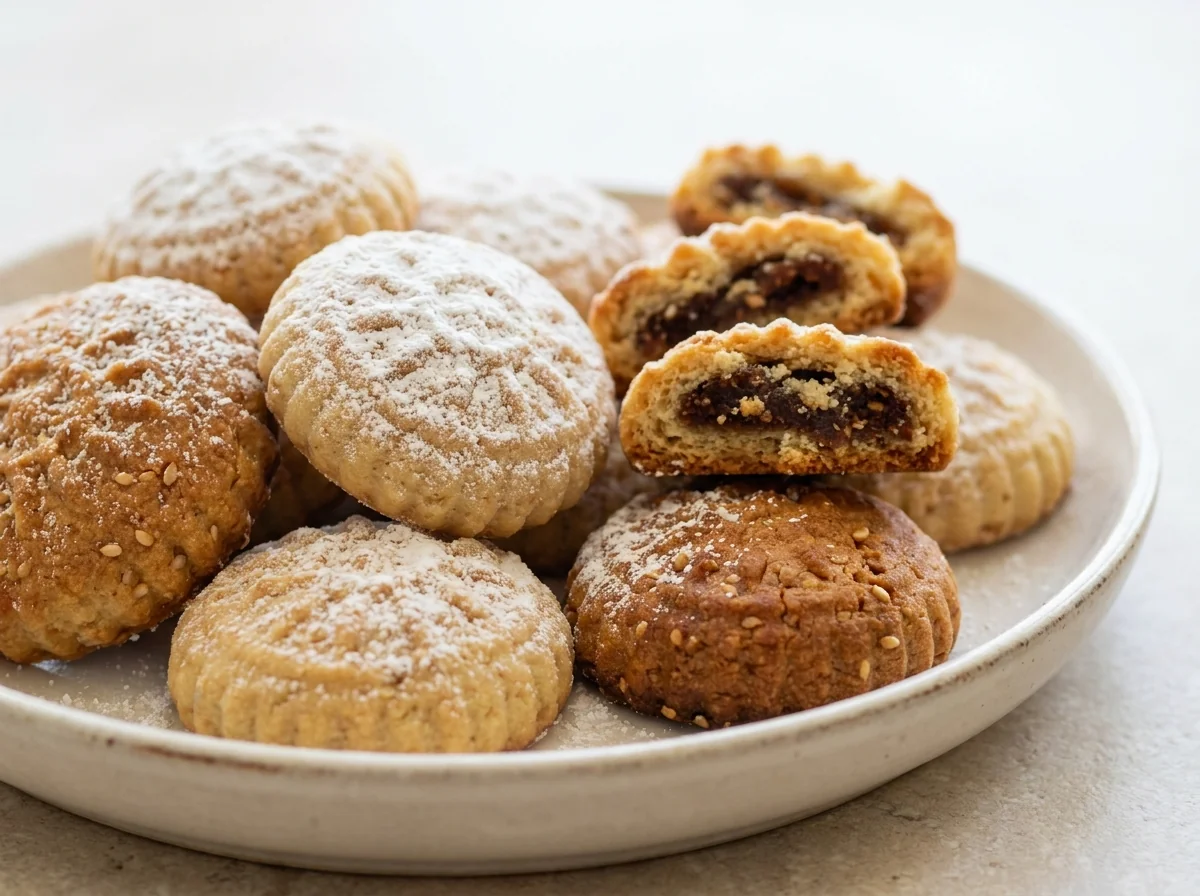
Kahk el Eid is one of the most time-honored traditions of the Egyptian kitchen, with roots reaching back to ancient Egypt, where its patterns were found on temple walls, then it flourished in the Fatimid era when it was distributed to people during the holidays. It is the symbol of Eid al-Fitr in Egypt, with families gathering to make it and stamp it with the tweezer before the Eid.
Its dough is rich in ghee and kahk spices of mahlab and anise, and it is filled with date paste, Turkish delight, or nuts, then dusted with powdered sugar. Its aroma alone is enough to remind Egyptians of the joy of the Eid.
Preparation Steps
Mixing the dry ingredients
Mix the flour with the yeast, sugar, kahk spices, sesame, and salt in a wide bowl, for the mahlab and anise are what give kahk its distinctive aroma.
Rubbing in the ghee
Add the softened ghee and rub it into the flour by hand until it is fully absorbed and the mixture resembles wet sand, for the abundance of ghee is the secret to the crumbliness of kahk.
Kneading and resting
Add the warm water gradually and knead until a soft, smooth dough comes together, then cover it and leave it to rest for an hour in a warm place.
Preparing the filling
Knead the date paste until it softens and roll it into small, even balls, and a little ghee can be added to it to make shaping easier.
Shaping and stamping
Take a ball of dough, open a hollow in it, place a ball of date paste inside, and seal it well, then press its surface with a kahk tweezer or a fork to make the traditional patterns.
Baking and dusting
Arrange them on a lined tray and bake them in an oven preheated to 175 degrees for about twenty to twenty-five minutes until their bottoms turn golden while their tops stay pale, then leave them to cool completely and dust them with powdered sugar.
Blood Sugar Impact
The glycemic index (GI) measures how quickly a food raises blood sugar, while the glycemic load (GL) measures how much a full serving raises it. Together they give the complete picture.
Glycemic Index
GI
65Medium
Low0–55Medium56–69High70+
A low value (≤55) means a gradual rise in blood sugar — the most suitable range for diabetes and insulin resistance.
Glycemic Load
GL
12Medium
Low0–10Medium11–19High20+
Glycemic load reflects the impact of the full serving. To lower it: take half a serving, or pair the recipe with a source of protein and fiber.
Nutritional Information
Per ServingMakes 30 servings · one serving is about 40 g of raw ingredients
Calories158 kcal8%of Daily Value*
Protein2 g4%of Daily Value*
Carbohydrates20 g7%of Daily Value*
Fat8 g10%of Daily Value*
Fiber1 g4%of Daily Value*
Sodium26 mg1%of Daily Value*
Potassium90 mg2%of Daily Value*
Phosphorus27 mg2%of Daily Value*
* Percent Daily Values are based on a 2,000-calorie diet per FDA food-label reference values — your daily needs may be higher or lower. Values are derived from the recipe's ingredients via the USDA database.
Troubleshooting
The most common problems when preparing Kahk el Eid (Egyptian Eid Cookies with Date Filling), and how to fix them:
The kahk cracked and the filling came out
It was not sealed well or the filling was too much. Use a moderate ball of date paste and seal the dough tightly around it before stamping.
The texture is hard and not crumbly
There was too little ghee or too much kneading. Provide plenty of ghee and rub it well into the flour, and knead only until it comes together without overdoing it.
The top browned and dried out
The heat was too high or the baking too long. Bake at 175 degrees and watch the bottom, and take it out when the bottom turns golden while the top stays pale.
Storage and Make-Ahead
Room temperature
Keep it in an airtight container at room temperature for two to three weeks, and add the powdered sugar at serving so it stays visible.
Freezing
Freeze it baked without sugar in an airtight container for two months, thaw it at room temperature, and dust it with sugar at serving.
Tested Ingredient Substitutions
Original Ingredient
Tested Substitute
Ratio
Flavor Difference
date paste filling
Turkish delight or nuts with honey
same weight, 300 g
Turkish delight and nuts are other traditional kahk fillings, and nuts add an allergen
ghee
softened butter
same weight, 220 g
Ghee is closer to the traditional flavor, while butter gives a lighter color
kahk spices
mahlab alone or a blend of mahlab and cinnamon
same amount, 6 g
Mahlab is the main flavor, and anise reinforces it
powdered sugar
leaving it undusted
as desired
Plain kahk without sugar is a less sweet option
How Much Does It Make? Scaling Guide
Ingredient
Half amount
Base amount (base)
Double
Flour
225 g
450 g
900 g
Ghee
110 g
220 g
440 g
Instant yeast
1.5 g
3 g
6 g
Kahk spices
3 g
6 g
12 g
Date paste
150 g
300 g
600 g
Powdered sugar
15 g
30 g
60 g
EEINA Nutrition Tip
Keep the top of the kahk pale and do not let it brown, for it cooks from the bottom, and its pale top is the mark of the right texture. And do not dust it with powdered sugar until it has cooled completely, for the sugar melts on hot kahk and disappears.
Add This Recipe to Your Plan
The EEINA app saves your favorite recipes, calculates them from their real ingredients, and shows your daily numbers toward your goal. Try it free now.
They are a blend that distinguishes the aroma of Egyptian kahk, based on ground mahlab and anise, sometimes with sesame added, and they are what give kahk its aroma tied to the Eid.
Why should the top of the kahk stay pale?
Because the kahk cooks from the bottom, and a pale top is the mark of the right crumbly texture, while browning means high heat or over-baking that dries it out.
When do I add the powdered sugar?
After the kahk has cooled completely, for the sugar melts and disappears on hot kahk, and we add it again at serving so it stays visible and white.