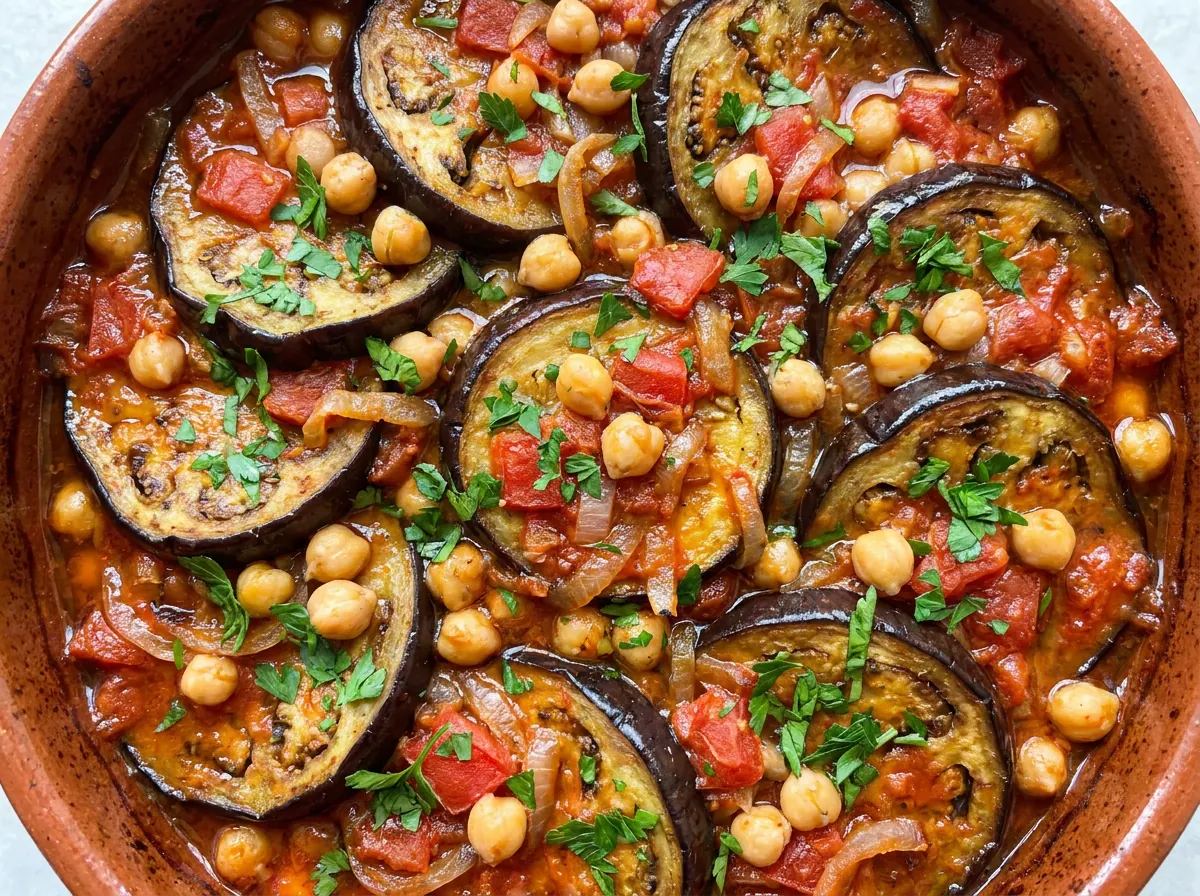
Levantine Eggplant Musaqqa (al-Maghmour) — a traditional vegan dish of baked eggplant and chickpeas submerged in tomato sauce. GI 22, rich in fiber and potassium, no meat and no bechamel.
Levantine eggplant Musaqqa, known in Lebanon and Palestine as al-Maghmour, is an ancient vegan dish that brings together eggplant, chickpeas, tomatoes and onion. The Arabic name 'maghmour' describes the state of the eggplant and chickpeas when they are completely submerged in the tomato sauce.
It differs radically from Greek Moussaka: no bechamel and no layers of meat. It is traditionally served at room temperature as part of a mezze spread. The addition of chickpeas is a Lebanese-Palestinian characteristic that distinguishes this version and gives it plant-based protein and fiber.
Preparation Steps
Bake the eggplant
Preheat the oven to 200°C. Brush the eggplant slices with a little olive oil, spread on a baking sheet, and bake for 15 to 20 minutes until tender and golden without frying.
Sauté the onion and garlic
In a pot over medium heat, heat the remaining olive oil and stir the onion until wilted and translucent, then add the garlic for one minute until fragrant.
Cook the sauce
Add the grated tomatoes, tomato paste, salt, black pepper and cinnamon, bring to a boil, then reduce the heat and allow the sauce to thicken slightly (5 to 7 minutes).
Add the chickpeas
Add the drained cooked chickpeas and stir them into the sauce, then add half a cup of hot water to adjust the consistency.
Arrange and submerge
In a baking dish or the same pot, arrange the baked eggplant slices and submerge them completely in the tomato and chickpea sauce (hence the name: al-maghmour, 'the submerged').
Final bake
Cover the dish and bake in the oven for 25 to 30 minutes, or simmer over low heat on the stovetop, until the flavors meld and everything is fully cooked.
Rest and serve
Leave to rest, then serve warm or at room temperature, garnished with parsley, alongside whole-wheat bread or as part of a mezze spread.
Blood Sugar Impact
The glycemic index (GI) measures how quickly a food raises blood sugar, while the glycemic load (GL) measures how much a full serving raises it. Together they give the complete picture.
Glycemic Index
GI
22Low
Low0–55Medium56–69High70+
A low value (≤55) means a gradual rise in blood sugar — the most suitable range for diabetes and insulin resistance.
Glycemic Load
GL
6Low
Low0–10Medium11–19High20+
Glycemic load reflects the impact of the full serving. To lower it: take half a serving, or pair the recipe with a source of protein and fiber.
Nutritional Information
Per ServingMakes 4 servings · one serving is about 380 g of raw ingredients
Calories286 kcal14%of Daily Value*
Protein9 g18%of Daily Value*
Carbohydrates36 g13%of Daily Value*
Fat13 g17%of Daily Value*
Fiber11 g39%of Daily Value*
Sodium815 mg35%of Daily Value*
Potassium681 mg14%of Daily Value*
Phosphorus148 mg12%of Daily Value*
* Percent Daily Values are based on a 2,000-calorie diet per FDA food-label reference values — your daily needs may be higher or lower. Values are derived from the recipe's ingredients via the USDA database.
Troubleshooting
The most common problems when preparing Eggplant Musaqqa with Chickpeas, and how to fix them:
Eggplant came out oily and heavy
It was fried in oil rather than baked — eggplant is a sponge that absorbs oil eagerly. The correct and lower-calorie method: brush the slices lightly with oil and bake in a 200°C oven. To reduce bitterness, sprinkle with salt and leave for fifteen minutes then pat dry before baking.
Sauce is watery and did not thicken
The tomatoes released their water and were not cooked enough, or the water was added too early and in excess. Simmer the tomato sauce over medium heat for five to seven minutes until it thickens and concentrates, and only add hot water after the chickpeas and in just enough quantity to adjust the consistency without thinning it.
Chickpeas remained hard
Home-cooked chickpeas were not cooked enough before adding. Chickpeas need a full overnight soak then simmering until they are tender between the fingers. If using canned chickpeas, they are already cooked — simply drain and rinse. To rescue a hard batch: extend the final bake by ten extra minutes with the lid on.
Dish tastes bland and lacks depth
The cinnamon and garlic were insufficient, or the salt was added at the end and did not penetrate. Cinnamon is the hallmark of Levantine Musaqqa — do not skip it. Add salt and spices with the sauce rather than at the end, and give the dish the full baking time for the flavors to meld. A little extra tomato paste deepens the color and taste.
Eggplant fell apart and dissolved in the sauce
Over-baked before submerging, or sliced too thin. Bake the slices only until tender and golden, not until they collapse, and make them about a centimeter thick. Be gentle when arranging in the dish — the final gentle bake is enough to cook them through without disintegrating them.
Dish cold and heavy after refrigerating
This is natural — Musaqqa is traditionally served at room temperature rather than very hot. But if you prefer it warm, heat gently over low heat or in the oven before serving, and a drizzle of fresh olive oil and parsley revives a chilled dish.
Storage and Make-Ahead
Refrigerator (4°C)
Finished Musaqqa: three to four days in an airtight container. The flavor improves the next day as the flavors meld. Baked eggplant alone: two days in the refrigerator, to be assembled with the sauce when cooking.
Freezer (-18°C)
Freezes well for up to a month in an airtight container. The eggplant texture softens slightly after thawing but the flavor remains excellent. Thaw in the refrigerator overnight before reheating.
Meal prep
Baking the eggplant: one day ahead, stored in a container in the refrigerator. The chickpea sauce: up to two days ahead, stored separately. Final assembly and bake: at serving time, thirty minutes in the oven is sufficient.
Serving
Serve warm or at room temperature — it is most delicious when the flavors have settled. Do not leave out of the refrigerator for more than two hours per food safety guidelines [4].
Tested Ingredient Substitutions
Original Ingredient
Tested Substitute
Ratio
Flavor Difference
Cooked chickpeas
Canned chickpeas, drained and rinsed
Same quantity
Faster preparation, comparable flavor, slightly higher sodium before rinsing
Baked eggplant
Baked zucchini slices
Same weight
Lighter and softer, sweeter flavor, silkier texture than eggplant
Grated tomatoes
Canned crushed tomatoes
Same quantity
Practical out of season, more stable sweetness — reduce the tomato paste
Cinnamon
Seven-spice baharat blend
Same amount
A broader, deeper Levantine flavor beyond cinnamon alone
Sliced onion
Finely chopped onion
Same quantity
Melts into the sauce, silkier texture with no visible pieces
How Much Does It Make? Scaling Guide
Number of servings
Eggplant
Cooked chickpeas
Tomatoes
Olive oil
2 (individual × 2)
1 large
0.75 cup
1.5
1.5 tbsp
4 (base)
2
1.5 cups
3
3 tbsp
6 (family)
3
2.25 cups
4.5
4.5 tbsp
8 (entertaining)
4
3 cups
6
6 tbsp
EEINA Nutrition Tip
Bake the eggplant — do not fry it. Eggplant absorbs oil voraciously when fried, sending calories soaring. Baking with a light brush of oil preserves the taste and texture, keeps the dish light and makes the Musaqqa a heart-friendly, weight-friendly choice.
Add This Recipe to Your Plan
The EEINA app saves your favorite recipes, calculates them from their real ingredients, and shows your daily numbers toward your goal. Try it free now.
What is the difference between Musaqqa and Greek Moussaka?
Levantine Musaqqa is fully vegan — no bechamel and no meat — and is usually served at room temperature as part of a mezze spread. Greek Moussaka has layers of meat and bechamel sauce and is served hot.
Why is it called al-Maghmour?
Because the eggplant and chickpeas are completely submerged in the tomato sauce. 'Maghmour' in Arabic means the covered or dipped — a precise description of the state of the ingredients in the dish.
Is it suitable for people with diabetes?
Yes — its GI is 30, low, and its GL is 5, low, with no rice, bread or potatoes, and the chickpeas add fiber and protein that slow carbohydrate absorption.
Can I use canned chickpeas?
Yes — drained and rinsed canned chickpeas work perfectly and save time. If cooking dried chickpeas at home, soak overnight then simmer until tender before adding.
Sources: USDA · University of Sydney · Gulf GSO · Our methodology · Updated on