Why the Scale Stalls Despite Your Commitment
At the beginning of your journey, weight loss often feels easy and rapid, then it gradually slows down until it stops. The reason isn't singular but a combination of factors: your body has become lighter, requiring fewer calories for basic functions; your metabolism has adapted to the deficit by lowering its burn rate; you may have lost some muscle mass that contributes to your metabolism; and small, unnoticed calories may be creeping in, along with water retention that masks your progress.
Practically speaking: Don't interpret a plateau as a sign of failure. It's an indication that the equation that worked for your initial weight no longer suits your new weight. What helped you lose the first 10 kg won't necessarily help you lose the next 10 kg in the same way. So, instead of despairing or drastically cutting your food intake, first understand the dominant factor for you, then address it calmly.
Metabolic Adaptation — How Your Body Lowers Its Burn Rate
When you lose weight, your metabolism slows down for two reasons. The first is obvious: a smaller body requires less energy. However, there's a deeper reason called metabolic adaptation or adaptive thermogenesis, where your metabolism drops slightly more than what can be explained by mass loss alone. The extent of this adaptation varies across studies, and a systematic review suggests it might be small or weaken after weight stabilization, but it could explain some of the slowdown in weight loss for certain individuals.
Practically, this explains why, with each stage of weight loss, you need to recalibrate your calorie intake for your current weight, not your previous one. Adaptation is real, but it's not an excuse to give up. It's a valid reason to recalibrate, preserve muscle mass (which slows this decline), and sometimes give your body periods of balance.

Water Retention Tricks the Scale
You might actually be losing fat while the scale number remains constant because water is masking your progress. As fat cells empty their contents, they may temporarily fill with water. Water retention is also influenced by salt, hormones, the menstrual cycle, time of day, and even new exercise. The result is that the scale jumps and stalls for reasons unrelated to fat loss.
Practically: Don't weigh yourself daily and get upset by every number. Daily weight is noise; the trend over two to three weeks is the signal. Weigh yourself under the same conditions, in the morning on an empty stomach, and monitor the average, not the daily figure. When the scale stalls for a week, first ask: Is this water, or a true stall? Measure your waist and look at your photos before making a judgment.
Hidden Calories Creep In
One of the most common, and least admitted, reasons for a plateau is that you're eating more than you think. Over the weeks, small calories sneak in: a bit more oil, a slightly larger portion, nibbles while cooking, a drink you didn't log, a weekend splurge that negates the deficit of the weekdays. These small discrepancies are enough to halt weight loss without you noticing.
Practically: Before blaming your metabolism, honestly review your food log for a full week. Weigh your food instead of estimating portions, log everything including nibbles and drinks, and calculate your weekend intake just as you do your weekdays. Accurate tracking is often the key to breaking a plateau and frequently makes all the difference.
Is Your Plateau Real or Temporary? — A Self-Assessment
This assessment is a guide to identify factors that might explain your scale stalling. It does not replace evaluation by a nutritionist or doctor. Choose what applies to you:
Recalibrate Your Calories for Your New Weight
The first practical step after ensuring your tracking is accurate is to recalibrate your calorie intake. A lower weight burns fewer calories, so the deficit that led to weekly loss no longer exists. Recalculate your needs based on your current weight, then make a moderate, not drastic, reduction. Practical guidelines recommend not going below a safe threshold; less than about 1200 calories daily may not be enough to prevent constant hunger, and severe restriction increases muscle loss and deepens adaptation.
Practically: Don't starve yourself out of spite for the scale. Reduce intake by a small amount and give the change two weeks before judging, monitoring the trend rather than the daily number. If your tracking is accurate and your weight is far from the safe threshold, increasing physical activity might be more beneficial than further reducing food intake.
Protein and Fiber — Allies in Breaking Plateaus
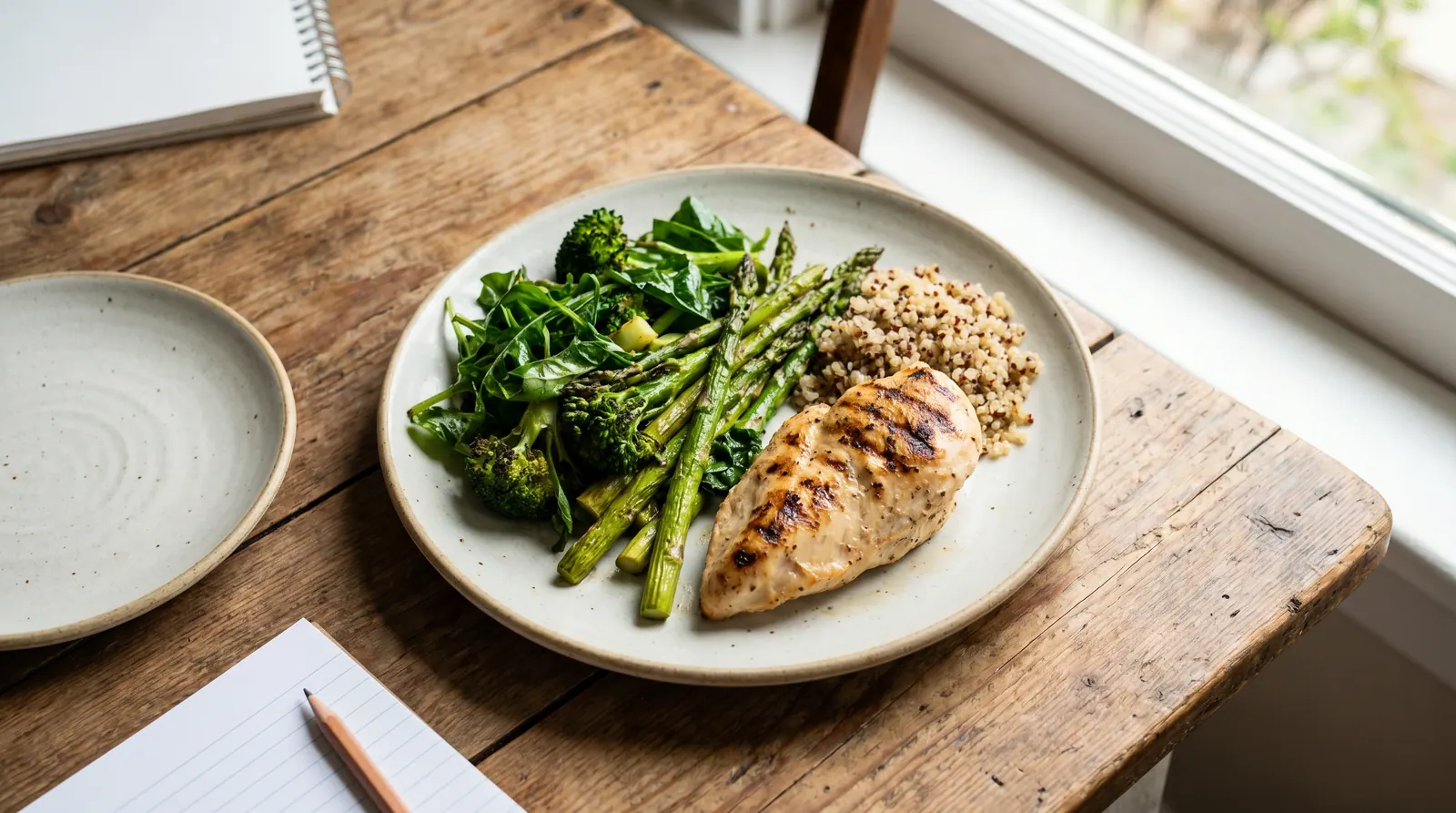
When you reduce calories, muscle mass is at risk of loss, and muscle is what keeps your metabolism high. Therefore, protein becomes your primary tool: a systematic review and meta-analysis indicates that adults consuming higher protein during calorie restriction retain more muscle mass and lose more fat compared to those consuming normal protein levels.
Fiber is protein's partner in satiety: it slows digestion and prolongs the feeling of fullness, helping you stay within your calorie goals without overwhelming hunger. Practically: Include a protein source in every meal, such as eggs, dairy, lentils, chicken, and fish, and add vegetables, legumes, and whole grains for fiber. This combination protects your muscle and curbs your hunger simultaneously, proving more effective than blind calorie reduction.
Resistance Training Protects Your Muscle
If muscle loss slows your metabolism, building muscle protects it. Practical guidelines recommend incorporating weightlifting or resistance exercises to increase muscle mass and burn additional calories simultaneously, along with regular aerobic activity for at least 150 minutes of moderate intensity per week.
Practically: You don't need a fancy gym or a complex program. Bodyweight exercises at home, or light weights, two to three times a week are sufficient to start. The goal isn't to build massive muscle, but to protect what you have during weight loss, keeping your metabolism higher and preventing the scale from stalling for avoidable reasons.

Diet Breaks — Wisely, Not Wildly
One idea supported by research is that breaking up dieting with periods of balance may mitigate metabolic adaptation. In a study on obese men, researchers compared continuous calorie restriction with intermittent restriction spread over weight loss periods interspersed with balance periods. The weight loss and fat loss were greater in the intermittent group.
However, be aware: a balance period is not a return to old habits or a weekend free-for-all. It's a calculated increase in calories to maintenance levels for a week or two, followed by a return to a deficit. Practically, if you're struggling with excessive hunger and fatigue, a short, calculated balance period might be more beneficial than continuing with a deficit that exacerbates adaptation. Consult a nutritionist to design one that suits you.
Measure Beyond the Scale
The scale is a weak single indicator when it stalls, as it conflates fat, water, muscle, and food in your gut. You might lose fat and gain muscle, keeping the number constant while your body actually changes. Therefore, rely on more accurate measures: waist circumference is an important indicator of abdominal fat and risk for heart disease and metabolic issues, and is used to monitor the effectiveness of weight loss.
Practically: Measure your waist every two weeks using the same method, take monthly photos in the same lighting and posture, and notice how your clothes fit and your strength and energy levels in workouts. When the scale stalls but these metrics improve, you are progressing despite the number. The scale is part of the picture, not the whole picture.

What Science Actually Says About Plateaus
The most compelling evidence for the depth of metabolic adaptation comes from a study that followed contestants who lost significant weight. By the end of the competition, after thirty weeks, the average weight loss was about 58 kg, and resting metabolism decreased by about 610 calories daily. More importantly, metabolic adaptation—the excess drop beyond what weight loss alone explains—amounted to about 499 calories daily and persisted six years later.
However, this doesn't mean a plateau is an unbreakable destiny. On the other hand, a classic study found that many who believed their metabolism was slow were actually underestimating their food intake by about 47% and overestimating their activity, rather than having a metabolic issue. The practical takeaway: Adaptation is real, inaccurate tracking is also real, and breaking a plateau starts with honesty with yourself, followed by intelligent recalibration, not despair.
Five Common Weight Plateau Myths
Half-truths and misleading advice often circulate around plateaus, promising more than they deliver or causing more despair than necessary. Here are the most common ones, and what the evidence says:
"A weight plateau means the diet has failed and there's no point in continuing."
"If my scale stops moving, the problem is definitely a slow metabolism."
"The solution is always to eat even less."
"A stalled scale means I've stopped losing fat."
"Cardio exercise alone is enough to break a plateau."
Practical Tips to Implement Today
Before diving into the full protocol, here are small guidelines derived from the above, designed to break your plateau without upending your life:
- Review your tracking honestly first. Weigh your food for a full week and log everything, including nibbles and drinks, and your weekend intake, before blaming your metabolism or cutting calories.
- Recalibrate calories for your new weight. A lower weight burns fewer calories, so calculate your current needs and make a moderate, not drastic, reduction, without going below a safe threshold.
- Include protein in every meal. Protein preserves your muscle and curbs your hunger during calorie reduction. Sources include eggs, dairy, lentils, chicken, and fish.
- Add fiber for satiety. Vegetables, legumes, and whole grains extend fullness, helping you stay within your calorie goals without overwhelming hunger.
- Incorporate resistance training. Two to three times a week with bodyweight or light weights protects your muscle and keeps your metabolism high.
- Increase your daily movement. Non-exercise activity often decreases with weight loss, so increase your steps and reduce prolonged sitting.
- Weigh yourself by trend, not by day. Monitor the average over two weeks on an empty stomach under the same conditions, and don't get fixated on a single day's number.
- Measure beyond the scale. Your waist, photos, and workout strength reveal progress hidden by a stalled number.
EEINA's Protocol for Gently Breaking Weight Plateaus
An actionable plan combining the above into three progressive tiers. Start with one tier at a time and note your response to understand what works best for you.
This protocol is based on the mechanism of metabolic adaptation, evidence for preserving muscle with protein and resistance training, and practical guidelines for breaking plateaus.
Adjust What's Within Your Control
Four daily habits.
Recalibrate and Protect Your Muscle
Steps to break the plateau.
Evaluate with More Accurate Metrics
Before any drastic action.
Golden Rule: A plateau isn't an enemy to be fought with starvation, but a signal to recalibrate your approach. Fix your tracking, preserve muscle, and measure beyond the scale.
Frequently Asked Questions
Why has my weight stopped dropping despite my commitment?
Does a weight plateau mean I've stopped losing fat?
How do I break through a weight plateau?
Do diet breaks help with weight plateaus?
Is the problem slow metabolism or inaccurate tracking?
When to Consult a Specialist — Red Flags
In most cases, a plateau is a temporary phase that can be overcome with recalibration. However, certain signs warrant specialist evaluation without delay:
- Prolonged, persistent plateau despite accurate tracking, recalibration, and regular exercise requires investigation into the underlying cause.
- Severe fatigue, dizziness, or hair loss during calorie restriction may indicate nutritional deficiencies requiring medical review.
- Disordered eating patterns, such as obsessive tracking, binge eating, or extreme food fear, require professional support.
- Health conditions like thyroid issues or diabetes, or chronic medications, can affect weight and require medical supervision.
- Desire to lose weight below a safe threshold or follow an extremely restrictive diet; consult a nutritionist before doing so.
- Pregnancy or breastfeeding: Do not reduce calories or start a diet before consulting your doctor.
Start Your Next Step with EEINA
Recalibrated Meal Plans
Saudi recipes high in protein and fiber to reset your calories for your new weight and curb your hunger.
Get Your Plan →High-Protein Recipes
Easy ideas to incorporate protein and fiber into your meals, preserving muscle and keeping you within your calorie goals.
Try Them →EEINA App
Calculates your calories for your current weight, tracks protein, and reminds you to move and measure your waist, not just the scale.
Download →