Why Count Carbs in the First Place?
Carbohydrates are the only nutrient that directly raises blood sugar. Protein and fat raise it slowly and to a limited extent, but carbohydrates have an almost linear relationship with blood sugar: every 15 grams of carbs raises the average adult's blood sugar by approximately 45 to 50 mg/dL (this number is individual and varies with insulin sensitivity and medication).
This relationship means something remarkably practical: if you know the grams of carbs in your meal, you can predict your post-meal blood sugar. And if you can predict, you can control.
Research published in the American Diabetes Association journals[1] shows that patients who master carb counting reduce their A1c by about 1 to 1.5%. This is a difference equivalent to a full medication's effect, without side effects.
Quantity is One Thing, Speed is Another
Carb counting answers the question "How much." But it doesn't answer "How fast." Two dishes with the same number of grams can raise blood sugar in completely different ways, depending on the type of starch, preparation method, and the presence of fiber and fat.
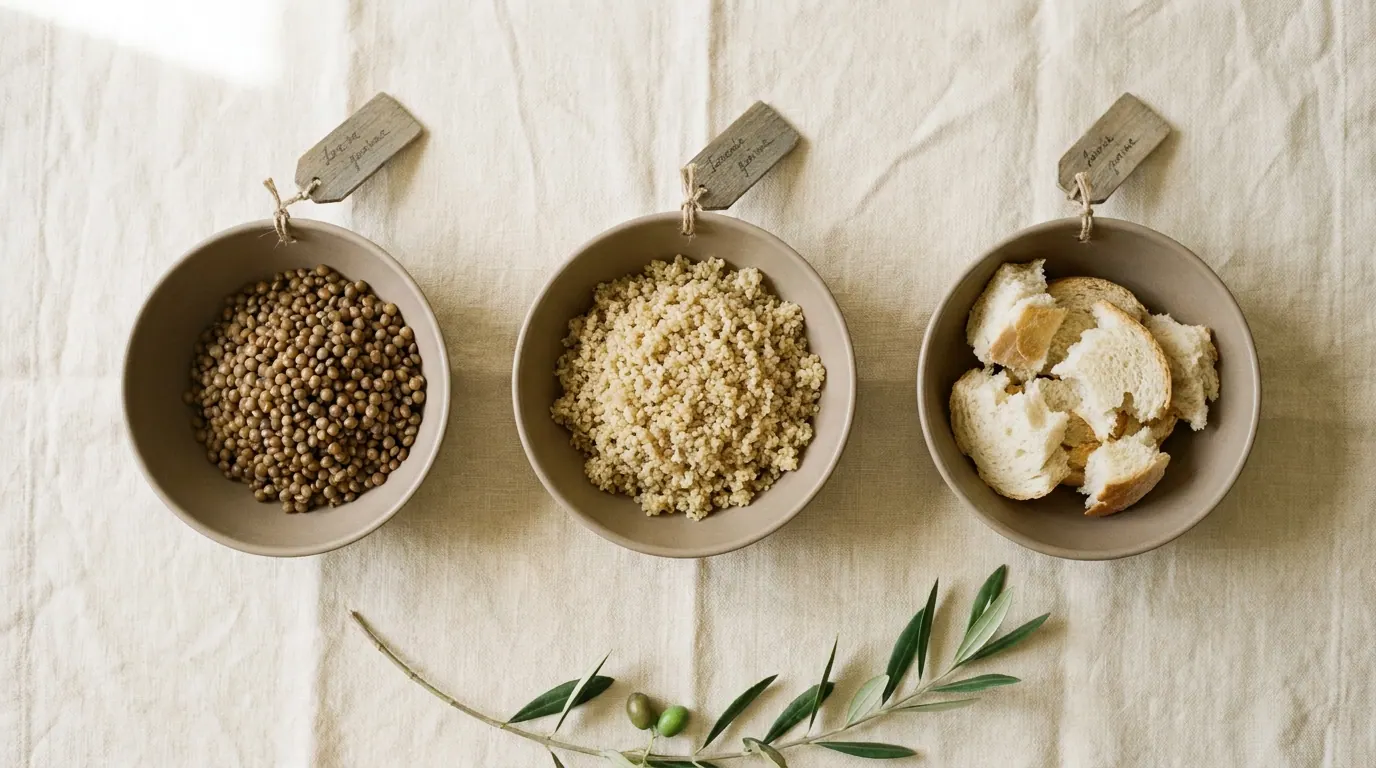
This is where the Glycemic Index (GI) comes in to complete the calculation: the quantity tells you the magnitude of the rise, and the index tells you its speed. Together, they paint the full picture. White rice and lentils might have the same grams, but lentils raise blood sugar much slower because their fiber and protein slow absorption.
What Exactly Are Carbohydrates?
Not everything that looks like 'bread' is pure carbohydrate, and not everything that doesn't look sweet is low-carb. Only the table can tell.
Three main families:
Sugars. Table sugar, honey, and fruits. Absorbed quickly, raising blood sugar immediately.
Starches. Rice, bread, pasta, potatoes, dates, and legumes. Absorbed at a moderate speed depending on preparation.
Fiber. Vegetables, fruit peels, and whole grains. Not counted towards net carbs because they are not absorbed; they are subtracted from the total.
The simple equation: Net Carbs = Total Carbohydrates − Fiber. This is the quantity that actually raises blood sugar.
Reference Table — Our Saudi Dishes
| Food | Serving Size | Net Carbohydrates |
|---|---|---|
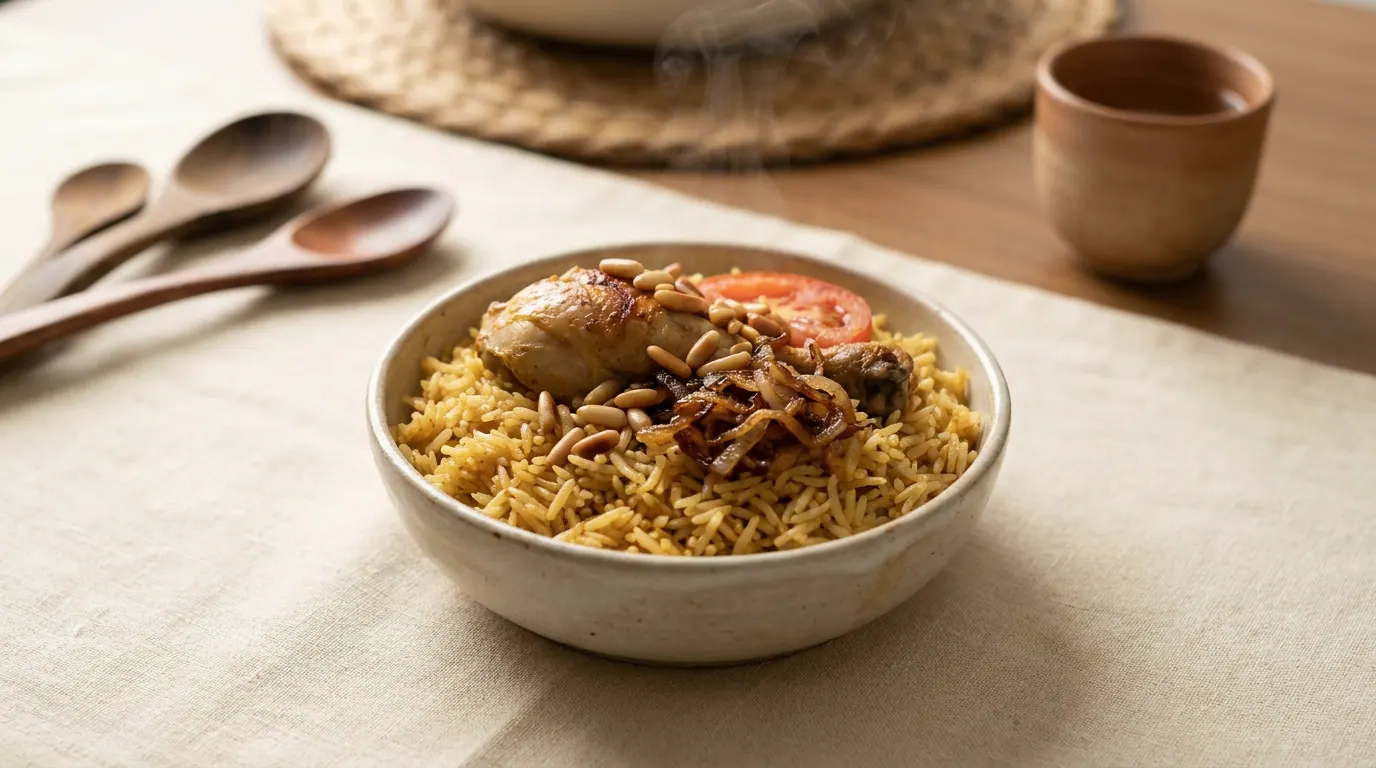
| Kabsa (Rice & Chicken) | 1 cup rice & 150g chicken | 46 grams |
| Mandi | Medium plate | 58 grams |
| Tamees Bread | Piece (70g) | 32 grams |
| Small Samoli Bread | Piece | 15 grams |
| Sukari Dates | 3 dates (24g) | 16 grams |
| Marsa (Marseer) | Small plate | 28 grams |
| Shakshuka | Medium plate | 12 grams |
| Hummus with Tahini | Half cup | 17 grams |
| Foul Medames | Half cup | 20 grams |
| Masoub | Medium piece | 42 grams |
| Tea with 1 tsp Sugar | Cup | 4 grams |
| Plain Coffee | Small cup (fanjal) | 0 grams |
| Plain Yogurt | Cup | 12 grams |
Numbers are approximate, calculated from USDA data and calibrated for Saudi healthy plate portions, and vary by serving size and preparation method.
Read the Nutrition Label Like an Expert
The nutrition label on products (according to the Saudi Food and Drug Authority) is a treasure for those who know how to read it, and a trap for those who read it quickly. Three steps:
First: Look at the serving size before any other number. All numbers are based on the stated "serving," not the entire package. A bag of chips might say "15g carbs per serving," but the bag contains 2.5 servings. Ate the whole bag? Double the number.
Second: Subtract fiber from the total. "Total Carbohydrates" includes fiber. Whole wheat bread listed with 22g total and 7g fiber = 15g net carbs that raise blood sugar.
Third: Beware of "Sugar-Free." A product might be sugar-free but packed with starch or sugar alcohols. Sugar alcohols raise blood sugar at about half the rate of regular carbohydrates, so count half their grams towards your meal.
Distribute Your Daily Budget
Instead of counting every bite individually, think of a "daily budget" to distribute across your meals. This calculator divides your goal evenly (main meals get a larger share than snacks):
The distribution is an indicative starting point (main meal is weighted twice a snack). The actual goal and its distribution should be adjusted with your doctor or diabetes educator, especially for those on insulin.
A Week-Long Plan — How to Learn Step by Step
Print the common dishes table (above, with your additions). Hang it on the fridge. Don't count anything today. Just read, familiarize yourself, and absorb the numbers.
Choose your breakfast. Before eating, write down on paper: How many grams of carbs do you expect? Refer to the table. Correct yourself. You'll notice that "hidden carbs" (milk and fruit juice) are more than you anticipated.
Two meals a day are counted. Kabsa, Mandi, vegetables. Start by recognizing "portions": a cup of rice is 46g, half a cup is 23g, and so on. Your eye will train to estimate size.
All your meals are counted. Write down the daily total. Review your dosage with your doctor if you are on insulin. Notice how your eye starts to estimate before your hand counts.
The Plate Method — For Beginners Who Hate Counting
If counting feels overwhelming initially, the Diabetes Plate Method from the American Diabetes Association[2] is a visual alternative without numbers: divide a plate about 9 inches (23 cm) in diameter like this:
Salad, cucumber, zucchini, spinach, eggplant. Fill half the plate; they barely raise blood sugar.
Chicken, fish, lean meat, legumes. It's filling and slows sugar absorption.
Rice, bread, dates. This is where your carbs are concentrated; a quarter is enough.
This method automatically controls portion size without a scale. Many start with it, then transition to precise counting when they feel comfortable.
Tips to Simplify Counting and Mistakes to Avoid
The Fist and Palm. Your fist = about 1 cup = 45 to 46g carbs for rice or pasta. Your palm for bread = 15 to 20g. Quick visual rules.
Non-starchy vegetables are almost free. They contain about 5g of carbs per cup and are 75% water. You can ignore them in your count if you eat two cups or less.
Juices are liquid sugar. A cup of fresh orange juice is about 26g, while a whole orange is about 15g. Juice loses fiber and doubles the speed of sugar absorption.
Source: USDA FoodData Central and product labels. Plain coffee has zero carbs and is a friend for appetite control.
The biggest mistake: Ignoring beverages. "I just had my coffee" can hide 30g of sugar if it had three teaspoons. Every liquid counts.
Second mistake: Counting total instead of net carbs. Always subtract fiber. The difference can be up to a third of the number in fiber-rich foods.
Third mistake: Fixing the numbers. The 150g isn't a rule for everyone, but a starting point. With your doctor, you might go lower or higher. Every body responds differently.
Safety First — Lows and Insulin Ratios
Carbohydrate counting is a powerful tool, and with power comes the responsibility of safety. Two points that must not be overlooked:
The 15-15 Rule for Low Blood Sugar
If your blood sugar drops below 70 mg/dL (dizziness, shaking, sweating, sudden hunger), the recommended action[1] is: consume 15 grams of fast-acting sugar (3 dates, half a cup of juice, or 3 teaspoons of sugar in water), then wait 15 minutes and re-measure. If it remains low, repeat. This rule can save a life.
Insulin-to-Carbohydrate Ratio (ICR)
For those taking rapid-acting insulin with meals, carb counting translates into a dosage via a personal "ratio": for example, 1 unit of insulin for every 10 grams. This ratio must be determined individually with your medical team and not guessed, and it may vary between breakfast and dinner. Carb counting here is not a luxury but a necessity for dose adjustment.
Frequently Asked Questions
- Non-starchy vegetables (salad, cucumber, zucchini, spinach) are very low, about 5g per cup, and you can ignore them within about two cups. Starchy vegetables (potatoes, corn, peas) are counted as carbohydrates.
- There's no single rule. Many find comfort in 3 meals and 1-2 snacks, ensuring each meal stays within its budget. Consistency in distribution day-to-day is key, as it stabilizes blood sugar and simplifies medication adjustment.
- They are not forbidden, but counted. Three dates are about 16g, fitting into your budget. They also have the advantage of treating hypoglycemia due to their quick sugar. Moderation, not prohibition, is the rule.
- Don't beat yourself up. Record what happened, go for a 20-minute walk after the meal as exercise helps lower blood sugar, and return to your budget at the next meal. One day won't break your control; consistency builds results.
- Paper is sufficient for learning in the first week. However, an app saves you from manual table lookups and calculations, and keeps a record for your doctor. EEINA automatically calculates net carbs for our Saudi dishes within your limits.
Seven Points to Remember
- Carbohydrates alone directly raise blood sugar. They are the focus of counting.
- Net carbs = Total minus Fiber. This is what actually raises your blood sugar.
- Quantity and speed are different. Carbs tell you the amount, the index tells you the speed.
- Read the serving size first. The biggest pitfall on a nutrition label.
- Distribute your budget across meals. Easier than counting every bite.
- The Plate Method is an alternative without numbers. Half vegetables, a quarter protein, a quarter carbs.
- Safety first. Memorize the 15-15 rule, and adjust insulin ratios with your team.
EEINA Calculates for You Automatically
Choose your meal from our calculated Saudi recipe library · automatically calculates net carbs and glycemic index · and builds your daily plan within your limits.